Brief Awakenings and Oxygen Dips: 2026 Study
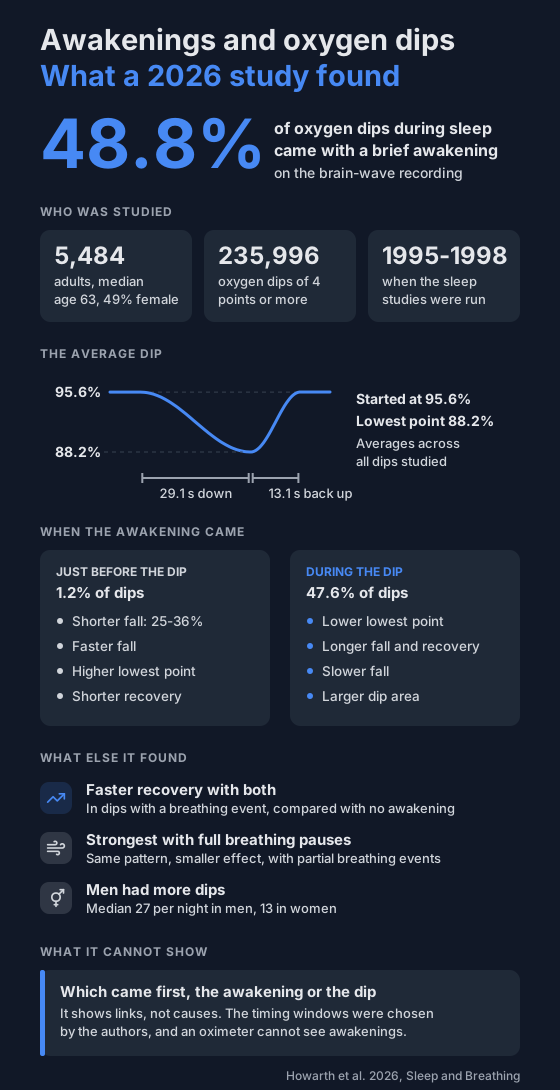
A 2026 study of 235,996 overnight oxygen dips found that 48.8% came with a brief awakening. Dips with an awakening during them went lower and lasted longer.
Your brain can wake for a few seconds at night without you knowing. Sleep researchers call these arousals, and they show up on a brain-wave recording.
A study published in September 2026 looked at how they line up with oxygen dips. Nearly half of the dips came with one.
Who was in the study?
- 5,484 adults from the Sleep Heart Health Study, recorded between 1995 and 1998.
- Median age 63, and 49% were women.
- 85.7% had at least one health condition.
- Software found 235,996 dips of 4 points or more.
- 93.6% of the dips were linked to a full or partial pause in breathing.
What did an average dip look like?
- It started at 95.6% and bottomed out at 88.2%.
- The fall took 29.1 seconds.
- The climb back took 13.1 seconds.
Men had a median of 27 dips a night, women 13.
What changed when an awakening came first?
This was rare, at 1.2% of dips. The awakening had to end in the 10 seconds before the dip.
- The fall was 25-36% shorter, and faster.
- The lowest point was higher, once age, sex and health were accounted for.
- The recovery was shorter.
And when it came during the dip?
This was common, at 47.6% of dips.
- The lowest point was lower.
- The fall and the recovery both took longer.
- The area of the dip, which is depth times time, was larger.
In dips linked to a breathing event, oxygen climbed back faster with both kinds of awakening than with none. The pattern was strongest in dips linked to full breathing pauses. In dips with no breathing event, an awakening beforehand mostly showed no link.
The authors suggest a deeper, longer dip may be what wakes the brain.
What doesn't it tell you?
- Which came first. It's a look back at old recordings. It shows what went together, not what caused what.
- Exact timing. Blood takes time to get from the lungs to the finger, so the matching is approximate. The authors chose the time windows.
- Why each awakening happened. It wasn't recorded.
- Every dip. Almost 20% were dropped because they fell in periods scored as awake.
What can you do with this?
An oximeter can't see awakenings. The authors say dip shape might one day stand in for them, but that needs more research.
You can check how deep and how long your own dips are in your report. Your desaturation index counts them per hour. If you feel worn out in the day, tell your doctor.
Not a medical device. Does not diagnose, treat or prevent any condition. Discuss results and changes with a clinician.
References
- Howarth TP, Karhu T, Saad HB, Bahammam A, Luukinen M, Pahari P, Ebrahimian S. Differential associations of arousals and respiratory events on oxygen desaturation and resaturation parameters in sleep. Sleep and Breathing. 2026;30(5):257. doi:10.1007/s11325-026-03797-7