Sleep Apnea Traits From Oximeter Data
A 2026 preprint, not yet peer reviewed, read two sleep apnea traits from the oxygen trace of 5,792 sleep studies. In 3 of 4 checks they moved the way the authors expected.
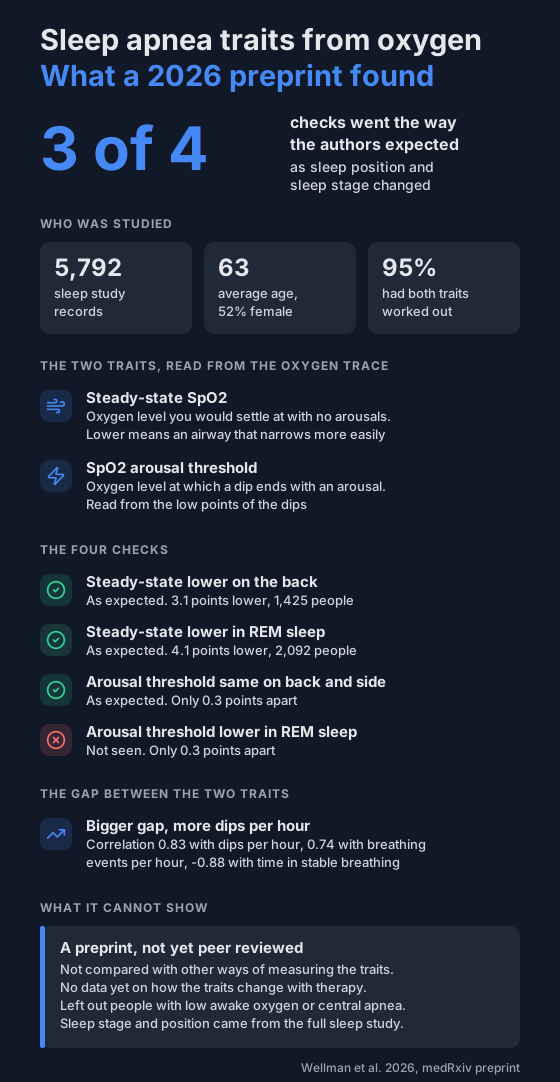
Researchers describe sleep apnea by traits, like how easily the airway narrows and how easily you wake. Measuring those traits has needed a full sleep study or a lab setup with CPAP.
A 2026 preprint from Brigham and Women's Hospital in Boston tries to read two of them from the oxygen trace instead. A preprint hasn't been peer reviewed yet, so read it as early work.
What are the two traits?
- Steady-state SpO2. The oxygen level you'd settle at during sleep if nothing woke you. The authors use it as a sign of how easily your airway narrows: lower means it narrows more.
- SpO2 arousal threshold. The oxygen level at which a dip ends with a brief arousal. It's read from the low points of the dips.
Plotted on one scale with awake oxygen, the two traits show a gap. If the steady-state level sits below the arousal threshold, breathing keeps dipping and recovering. If it sits above, breathing stays stable.
How did they read them?
- The night was cut into 5-minute blocks.
- A block with at least one dip of 3 points or more counted as unstable.
- A block with no dips counted as stable.
- Stable blocks gave the steady-state level directly.
- Unstable blocks gave the arousal threshold from the dip low points.
- A survival-analysis method combined both kinds of block into one estimate for each sleep stage and position.
For what counts as a dip, see what counts as an oxygen dip.
Who was studied?
- 5,792 overnight records from the Sleep Heart Health Study, a large community study.
- Average age 63, average BMI 28, 52% women.
- 207 people with awake oxygen below 92% and 70 with mostly central apnea were left out.
- The traits could be worked out for 95% of the group.
Did the traits behave as expected?
The authors set four checks. Three came out the way they predicted.
- On the back, steady-state SpO2 was lower. By 3.1 points, in 1,425 people with at least 10 dips per hour and more than an hour each on the back and off it.
- In REM sleep, steady-state SpO2 was lower. By 4.1 points, in 2,092 people with at least 10 dips per hour and more than an hour each of REM and non-REM sleep.
- On the back, the arousal threshold barely moved. It differed by 0.3 points, statistically significant but too small to matter, the authors say.
- In REM sleep, the arousal threshold didn't drop as predicted. The paper calls it no different, though it reports a 0.3-point difference with p < 0.001.
The authors say the REM result lowers their confidence in the arousal threshold measure. They also say it may reflect how arousals work in REM sleep, and needs checking in other groups.
To see what position does to your own trace, compare back and side sleeping.
Did the gap match the dips?
Yes. The bigger the gap between the two traits, the more dips people had.
- 0.83 correlation with dips per hour (ODI).
- 0.74 correlation with breathing events per hour from the full sleep study.
- -0.88 correlation with time spent in stable breathing.
The authors say they don't mean the gap to replace existing measures.
What did they suggest about therapy?
The paper sketches how the traits might one day guide therapy. An easily triggered arousal threshold might point to sleep medication, a low steady-state level to oral appliances or surgery, and a large gap to CPAP. They note sleep medication alone could let oxygen sit low for long stretches when the steady-state level is also low. The authors call this speculative. They haven't tested how any therapy changes the traits.
What can't it show?
- Peer review. It's a preprint.
- A comparison with other methods. The study couldn't compare these traits with ones from the standard sleep study method, because the data lacked a nasal pressure signal.
- Oximeter alone. Wake, sleep stage and position came from the full sleep study, not from the oximeter.
- Everyone. The method assumes the dips come from the airway closing. It doesn't fit people with low awake oxygen or central apnea, and the authors think it likely doesn't fit heart failure.
- Arbitrary rules. The 5-minute block and the 3-point dip were choices the authors made.
Who funded it?
The US National Institutes of Health. Five of the nine authors list ties to companies, several of them working on sleep apnea therapies:
- Wellman consults for Apnimed, Nox, Inspire, Mosanna, Takeda and iNOS, has had grants from Prosomnus, and has a financial interest in Apnimed, Mosanna and iNOS.
- Azarbarzin consults for Respicardia, Eli Lilly, Inspire, Cerebra and Apnimed.
- Sands consults for Nox Medical, Merck, Apnimed, Respicardia, Inspire, Lilly, LinguaFlex and Forepont, and has grants from Apnimed, Prosomnus and Dynaflex for other studies; the paper says his consulting is outside this work.
- White has had consulting fees from Bairitone, SleepDev, SleepMechanics, Cryosa, Nidra, Mosanna, Onera, Apnimed and SleepRes.
- Messineo has grants from Apnimed and ProSomnus for other work and consults for SleepRes.
What can you do with this?
Your oximeter app won't show these two traits. You can still see stable stretches and dipping stretches in your own trace. Your oximeter doesn't record position, so to compare back and side nights you'd note position yourself.
For more on what sits behind each dip, read brief awakenings and oxygen dips. If your recordings show lots of dips, share them with your doctor.
Not a medical device. Does not diagnose, treat or prevent any condition. Discuss results and changes with a clinician.
References
- Wellman A, Messineo L, Azarbarzin A, Esmaeili N, Aishah A, Vena D, Sumner J, White DP, Sands SA. Oxygen-based endotypes of Obstructive Sleep Apnea. medRxiv [Preprint]. 2026 Jun 4:2026.06.03.26354835. doi:10.64898/2026.06.03.26354835 (PubMed)