Sleep Apnea in Women vs Men: Overnight Oxygen
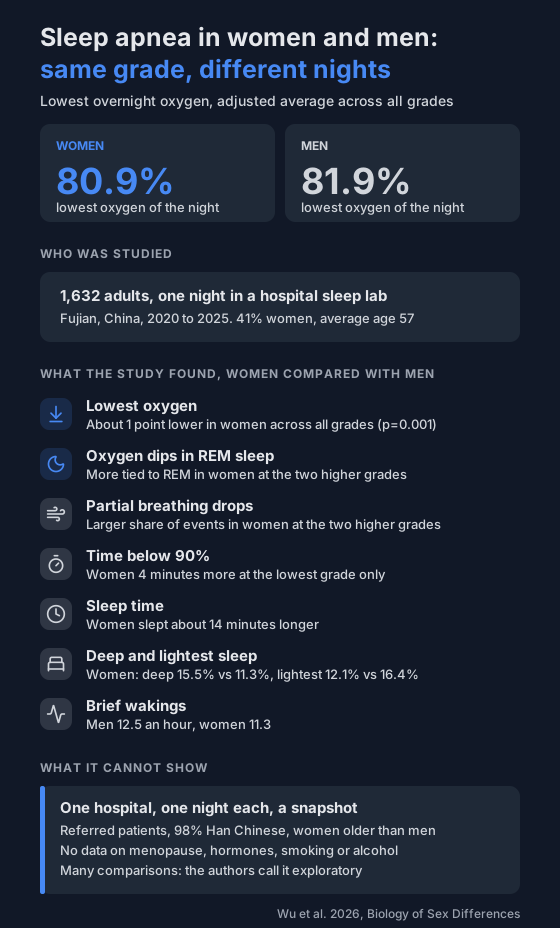
A 2026 study of 1,632 adults with sleep apnea in China found that, at the same grade, women reached slightly lower oxygen lows than men and, at the higher grades, their oxygen dips were more concentrated in REM sleep.
Sleep apnea is graded by one number: breathing events per hour. Two people with the same number can still have quite different nights.
A 2026 study from China compared women and men in the same grade. Women's oxygen went slightly lower at its lowest point. At the higher grades, their oxygen dips were also more concentrated in REM sleep, the dreaming stage.
Who was studied?
- 1,632 adults who spent one night in a hospital sleep lab in Fujian, China, between 2020 and 2025.
- All had at least 5 breathing events an hour.
- 41% were women and the average age was 57.
- 98% were Han Chinese.
- The women were older than the men (58 to 65 on average, against 54 to 55) and had a lower BMI.
- Insomnia was more common in the women.
Each person was put into one of three grades by events per hour. The group averages were about 10, 22 and 50 to 56 events an hour.
In the highest grade the men had more events than the women, so the authors weighted that group to even it out. Results were adjusted for age, BMI, insomnia and leg movements, and the oxygen results also for sleep time and time on the back.
What did it find about oxygen?
Lowest oxygen. The women's lowest reading of the night was about 1 point lower than the men's: 80.9% against 81.9%, adjusted (p=0.001). The gap did not differ significantly between grades. Before adjustment, the men in the highest grade actually had the lower average (75% against 77%).
Dips in REM sleep. The authors compared how many 3% oxygen dips an hour happened in REM sleep with how many happened in the rest of sleep.
- In women, dips stayed more frequent in REM sleep at every grade.
- In men, the REM excess shrank, and at the highest grade it was close to zero.
- The gap between the sexes was significant at the two higher grades (p below 0.001), not the lowest.
Partial breathing drops. At the two higher grades, a larger share of women's events were partial drops in airflow rather than full pauses. At the highest grade the gap was about 12 percentage points.
Time below 90%. This was mixed. At the lowest grade women spent about 4 minutes more below 90%. At the other two grades there was no statistically significant difference. Before adjustment, the lowest-grade men had the higher average (17 against 14 minutes). See what T90 is.
And their sleep?
Across all grades, the women's sleep was longer, deeper and less broken:
- About 14 minutes more sleep (6.70 against 6.47 hours).
- More deep sleep: 15.5% of the night against 11.3%.
- Less of the lightest sleep stage: 12.1% against 16.4%.
- Fewer brief wakings: 11.3 an hour against 12.5.
Men had slightly more REM sleep, but only at the lowest grade (1.5 points).
What can't it tell you?
- Cause. It's a snapshot of one night per person. It shows differences, not why they happen.
- Everyone. One hospital, people referred for a sleep study, almost all Han Chinese.
- Younger women. The women averaged 58 to 65, so many were likely past menopause. The authors say the results may not apply to younger women.
- Leftover differences. Weighting evened out the highest grade's event counts, but the authors say some imbalance may remain.
- Missing factors. There was no data on menopause, hormone therapy, smoking, alcohol or some other health conditions.
- Chance findings. The authors ran many comparisons and call the study exploratory, to be repeated in other groups.
The suggested reasons, such as smaller lung volumes in women, weren't measured. The authors call them speculative.
The study was funded by Fujian provincial science grants and Swedish foundation grants, which had no role in the study. The authors declare no competing interests.
What can you do with this?
This part is ours, not the study's.
- Your oximeter shows your lowest oxygen and your ODI, the count of oxygen dips an hour. See what the ODI means.
- It can't tell which dips happened in REM sleep, so the REM finding can't be checked on your own data.
- A 1-point gap in lowest oxygen is a group average. It says little about any one person.
For how sex changes the event count itself, read the 3% vs 4% dip rule. For older women, see women over 70 and overnight oxygen.
If you snore, wake up unrefreshed or feel tired most days, talk to a doctor, even if you don't fit the usual picture. The sleep apnea risk check can help you decide whether to bring it up, and you can share your recordings.
Not a medical device. Does not diagnose, treat or prevent any condition. Discuss results and changes with a clinician.
References
- Wu M, Xue P, Yan J, Benedict C. Sex differences in sleep architecture and nocturnal oxygenation across obstructive sleep apnea severity: an observational hospital-based study. Biology of Sex Differences. 2026;17(1):160. doi:10.1186/s13293-026-00951-4