Sleep Apnea After 70: Women's Oxygen vs Men's
A 2025 study of 1,290 sleep apnea patients aged 60 and over in China found men had more breathing events per hour, with no significant difference in time below 90% oxygen. In the 70 and over subgroup, women spent 7.4% of sleep below 90% against 3.8% for men.
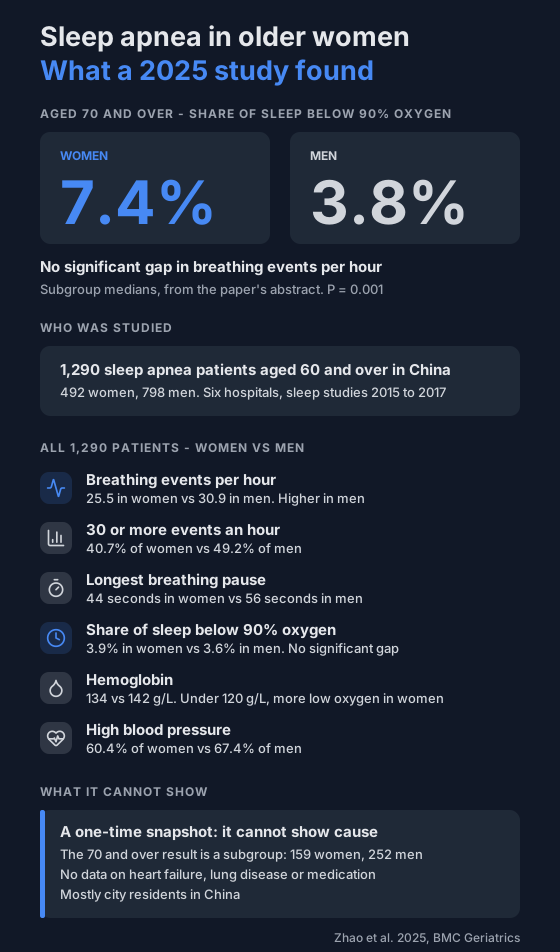
Sleep apnea is usually graded by how many breathing events you have per hour. On that count, men tend to come out higher than women.
A 2025 study of older patients in China found the oxygen numbers didn't follow the event count. Men had more events, but there was no statistically significant difference in time below 90% oxygen. In the 70 and over subgroup, women spent longer below 90% than men.
Who was studied?
- 1,290 patients aged 60 and over, all found to have obstructive sleep apnea on an overnight sleep study.
- 492 women and 798 men, from six hospitals in China, between January 2015 and October 2017.
- The numbers are from when each patient was first found to have sleep apnea, before any therapy.
- It's a cross-sectional study: one sleep study per person, compared between women and men.
Median age was 65 for women and 66 for men. About a third of each group was 70 or over.
What did the men's numbers look like?
Across all 1,290 patients, men had more events and longer pauses. Women first, with medians for the counts and times:
- Breathing events per hour: 25.5 vs 30.9.
- 30 or more events an hour: 40.7% of women vs 49.2% of men.
- Average breathing pause: 21.2 seconds vs 23.1 seconds.
- Longest breathing pause: 44 seconds vs 56 seconds.
And the oxygen numbers?
There was no statistically significant difference between women and men on any of them:
- Share of sleep below 90% oxygen (T90): 3.9% vs 3.6%.
- Lowest oxygen level: 80% vs 79%.
- Average oxygen level: 93% in both.
- Oxygen dips per hour (ODI): 21.7 vs 24.8.
So women had fewer and shorter breathing events, with no significant difference in time at low oxygen.
New to these numbers? See what T90 is and what ODI is.
What changed at 70 and over?
The study split patients into those aged 60 to 69 and those aged 70 and over. The older group had 159 women and 252 men.
- Women spent 7.4% of sleep below 90% oxygen, against 3.8% for men (P = 0.001).
- Breathing events per hour were not significantly different between them.
- Men still had longer breathing pauses.
In the 60 to 69 group it went the other way: men had more events, longer pauses and slightly more low oxygen.
The 7.4% and 3.8% figures are medians for the 70 and over subgroup only. They are from the paper's abstract, and the full subgroup table is in a supplementary file. Across all ages the figures were 3.9% and 3.6%.
Why might that be?
The authors point to hemoglobin, the protein in red blood cells that carries oxygen.
- Women had lower hemoglobin than men: a median of 134 g/L against 142 g/L.
- Among patients with hemoglobin under 120 g/L, women had more overnight low oxygen than men.
- The authors tested whether sex and hemoglobin together were linked to spending 12% or more of sleep below 90% oxygen.
- That interaction was statistically significant across all patients (P = 0.037) and in the 70 and over group (P = 0.003).
- It was not significant in the 60 to 69 group, or in the groups split by BMI or by event count.
They also suggest two other possible reasons: women carried more weight around the waist relative to their height, and all the women were past menopause. The study didn't test either one. The authors say prospective studies are needed to find out whether addressing anemia changes overnight oxygen.
What else differed?
- Body size. Men had a higher BMI (26.7 vs 25.8), but women had a higher waist-to-height ratio (0.56 vs 0.53).
- High blood pressure. 60.4% of women and 67.4% of men had it.
- Smoking and drinking. 6.5% of women and 32.7% of men were current or former smokers. For alcohol it was 2.6% and 18.1%.
- Diabetes and high blood fats. No significant difference.
Among patients with a BMI of 30 or more, the event count was 49.6 per hour for women and 46.3 for men, which was not a significant difference. Time below 90% was 12.3% for women and 8.7% for men, which was also not significant.
What can't it show?
- It's a snapshot, so it can't show that being a woman, or having lower hemoglobin, causes lower overnight oxygen.
- The 70 and over finding comes from a subgroup of 159 women and 252 men.
- There was no data on heart failure, coronary heart disease or chronic lung disease, which can each lower overnight oxygen.
- There was no data on medication or income.
- Most patients were city residents in China, so the results may not apply elsewhere.
- Everyone already had sleep apnea, so the results don't cover older adults without it.
What can you take from it?
The number of breathing events per hour and the time spent at low oxygen are two different measurements. In this study, the group with fewer events didn't have less time below 90%.
- If you track your overnight oxygen, look at time below 90% as well as the dip count.
- If you're older and sleeping badly, tell your doctor.
- Got recordings? Here's how to share them.
- Sleep apnea in older adults
- Sleep apnea beyond event counts
- How the 3% and 4% rules change the count for women
Not a medical device. Does not diagnose, treat or prevent any condition. Discuss results and changes with a clinician.
References
- Zhao L, Zhang W, Gao Y, Cai W, Zhao Z, Rui D, Zhang Z, Lin J, Fan L, Ma C, Liu L, Li K. Female predominance in nocturnal hypoxemia among elderly OSAS patients: hemoglobin mediates sex-specific hypoxic burden in Chinese cohorts. BMC Geriatrics. 2025;25(1):598. doi:10.1186/s12877-025-06281-1