3% vs 4% Oxygen Dip Rule: Does Sex Matter?
A 2025 study of 1,354 sleep lab patients found women had about half the odds of men of meeting the stricter 4% oxygen dip rule for sleep apnea, and no significant difference by race.
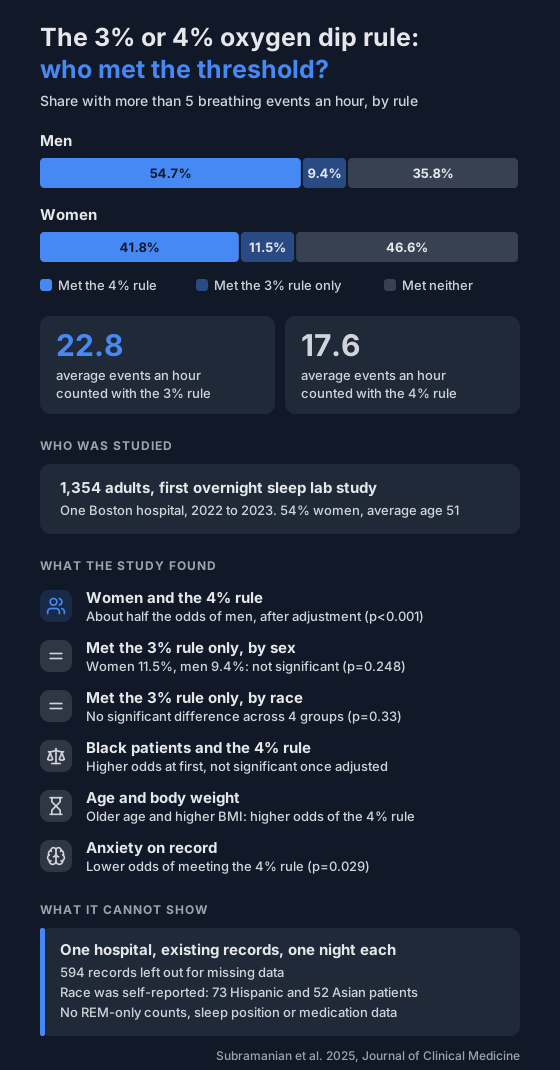
A sleep lab counts breathing events per hour, and the total depends on which rule it uses. Under one rule a partial drop in airflow only counts if your oxygen falls by 4%. Under the other, a 3% fall or a brief waking is enough.
A 2025 study from Boston asked whether the choice of rule changes who ends up over the line, by race and by sex.
What are the two rules?
Both start with airflow falling by at least 30%.
- 3% rule. The event counts if oxygen drops 3%, or if it causes a brief waking.
- 4% rule. The event counts only if oxygen drops 4%.
The 4% rule is stricter, so it gives a lower count. The paper says US Medicare and many commercial insurers use only the 4% rule.
Your oximeter's ODI-3% and ODI-4% follow the same idea, but they count oxygen dips only, not airflow. See what counts as an oxygen dip.
Who was studied?
- 1,354 adults having their first overnight sleep lab study at Boston Medical Center, January 2022 to May 2023.
- 54% were women. The average age was 51 and the average BMI was 35.
- 774 were Black, 455 White, 73 Hispanic and 52 Asian, by self-report.
- 594 other records were left out because BMI or health history was missing.
Each night was put in one of three groups:
- More than 5 events an hour under the 4% rule.
- More than 5 under the 3% rule, but not under the 4% rule.
- Fewer than 5 under the 3% rule.
How much did the rule change the count?
- With the 3% rule, the average was 22.8 events an hour.
- With the 4% rule, it was 17.6.
What did it find for women?
| Met the 4% rule | Met the 3% rule only | Met neither | |
|---|---|---|---|
| Men | 54.7% | 9.4% | 35.8% |
| Women | 41.8% | 11.5% | 46.6% |
- Women were less likely than men to meet the 4% rule, compared with meeting neither.
- After adjusting for age, BMI and other health conditions, their odds were about half those of men (p below 0.001). The odds ratio was 0.48 in the model that also included race and 0.49 in the model without it.
- The share who met the 3% rule only was not significantly different between women and men (p=0.248).
So the study did not show that more women than men fall into the gap between the two rules. It showed that fewer women got over the stricter line at all, and more women met neither rule.
The authors say this fits earlier work, and suggest why: women's airways tend to be less collapsible, and their event counts tend to be higher in REM sleep. This study could not count REM events separately.
For how sleep apnea records split by sex, see sleep apnea by age and sex.
And by race?
The authors expected a gap. Pulse oximeters can read high on darker skin, so a 4% drop could be harder to register. We covered that in pulse oximeters and skin tone.
They didn't find one.
- The share meeting the 3% rule only was 11.9% of White, 10.3% of Black, 9.6% of Hispanic and 3.9% of Asian patients. The difference was not statistically significant (p=0.33).
- Black patients had higher odds than White patients of meeting the 4% rule at first (odds ratio 1.37, p=0.013). After adjusting for sex, age, BMI and health conditions it was no longer significant (p=0.181).
- Black patients had the highest average event counts under both rules. The authors say that could hide an oximeter effect, because those patients would clear the 4% line anyway.
What else went with meeting the 4% rule?
- Older age and higher BMI: higher odds.
- Anxiety on record: lower odds (odds ratio 0.74, p=0.029).
What can't it tell you?
The authors list these limits:
- Beyond one hospital. All the records came from one urban academic hospital.
- Cause. It looked back at existing records, with no data on sleep position, medication or noise in the room.
- Lower event counts. People with fewer events may not have been referred for a sleep study at all.
Three more are our own reading, not the authors':
- Smaller groups. There were 73 Hispanic and 52 Asian patients.
- Skin tone. Race was self-reported. The paper doesn't describe a skin tone measurement.
- Health or care afterwards. It counted who met each rule on one night, not what happened next.
The authors declare no conflicts of interest.
The authors conclude that the 4% rule should be retired in favour of the 3% rule. That's their view, and they call for larger studies across several centres to check the findings.
What can you do with this?
This part is ours, not the study's.
- If your app shows ODI-3% and ODI-4%, expect the 4% number to be lower. Compare like with like.
- If you have a sleep study report, you can ask which rule it used.
- An oximeter counts oxygen dips. It doesn't measure airflow or wakings, so its count isn't the sleep lab's count.
If you snore loudly, someone has heard you stop breathing, or you're exhausted during the day, see a doctor. The sleep apnea risk check can help you decide whether to bring it up.
Not a medical device. Does not diagnose, treat or prevent any condition. Discuss results and changes with a clinician.
References
- Subramanian S, Miner AE, Auerbach S, Spector A. Sex, but Not Race, Influences OSA Diagnosis When Applying the 4% Versus 3% Hypopnea Scoring Rule. Journal of Clinical Medicine. 2025;14(24):8878. doi:10.3390/jcm14248878