Sleep Apnea by Age and Sex: 556,474 Records
A 2026 study of 556,474 US patient records with obstructive sleep apnea found the largest age group was 55 for both men and women, and 58% also had high blood pressure on record.
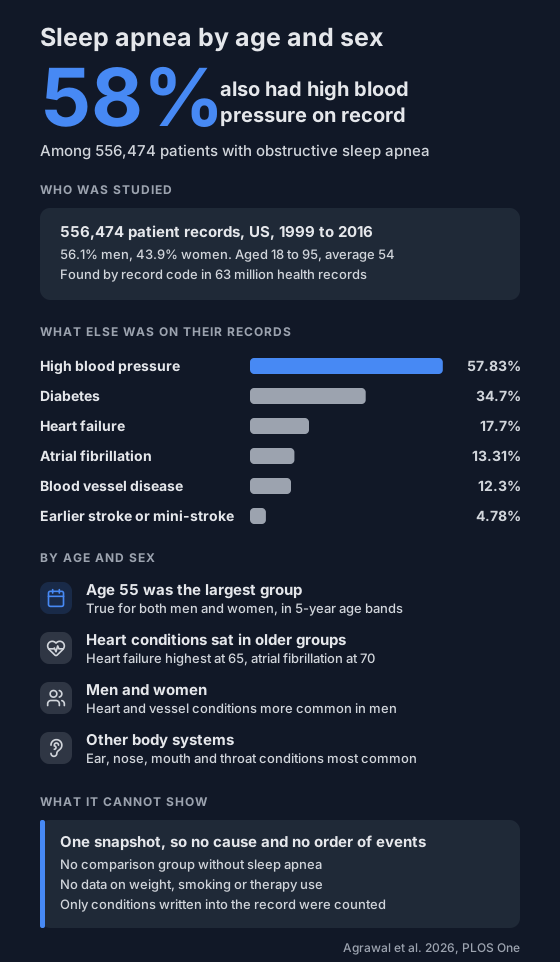
Who has obstructive sleep apnea on their medical record, and what else is on it? A September 2026 study counted, using 556,474 US patient records.
It's a cross-sectional study: one snapshot, no follow-up.
Who was in the study?
- 556,474 patients with an obstructive sleep apnea code, from 63 million records in the Cerner HealthFacts database (1999 to 2016).
- 312,450 men (56.1%) and 244,024 women (43.9%).
- Aged 18 to 95, average 54.
- 67.71% were Caucasian and 74.83% lived in urban areas.
What else was on their records?
The authors counted atrial fibrillation, an irregular heartbeat, and the conditions used to score stroke risk with it.
- High blood pressure: 57.83%
- Diabetes: 34.7%
- Heart failure: 17.7%
- Atrial fibrillation: 13.31%
- Blood vessel disease: 12.3%
- An earlier stroke or mini-stroke: 4.78%
The stroke, heart failure and atrial fibrillation figures were lower than in earlier studies.
What age was most common?
- Of the 5-year age bands, 55 was the largest for both sexes: 10.43% of the men and 9.28% of the women.
- High blood pressure was also most common at 55, and diabetes at 60.
- Heart failure was most common at 65 and atrial fibrillation at 70.
- Blood vessel disease peaked at 65 in men and 60 in women.
The authors say these are differences between age groups, not a timeline for any one person. See also sleep apnea in older adults.
Did men and women differ?
The age pattern for sleep apnea was similar, slightly higher in men. Heart and blood vessel conditions were more common in men. At age 70, atrial fibrillation was 10.53% of all the men against 6.66% of all the women.
What about the rest of the body?
Grouped by body system, ear, nose, mouth and throat conditions were the most common (about 150,000 patients).
What can't it show?
- Cause, or which condition came first.
- How people without sleep apnea compare. There was no comparison group.
- Unrecorded conditions. Only coded ones were counted.
- The effect of weight, smoking or therapy use. None was available. On weight, see this cohort study.
- Other health systems. All records came from one database.
Some by-age counts in the paper exceed its own overall totals, so lean on the overall percentages. The study had no specific funding.
What can you do with this?
If you snore or wake unrefreshed, the risk check gives you something to take to your doctor. Home oximetry is not a sleep study, but you can share your recordings too.
Not a medical device. Does not diagnose, treat or prevent any condition. Discuss results and changes with a clinician.
References
- Agrawal R, Delen D, Benjamin B, Misra R. Age- and sex-stratified prevalence of obstructive sleep apnea and stroke risk comorbidities: A large cross-sectional EHR study. PLOS One. 2026;21(9):e0357824. doi:10.1371/journal.pone.0357824