Obesity and Sleep Apnea: A 2026 Cohort Study
A study followed 18,955 adults with excess body fat for about 8 years. Of those who developed a weight-related health problem, one in three had obstructive sleep apnea.
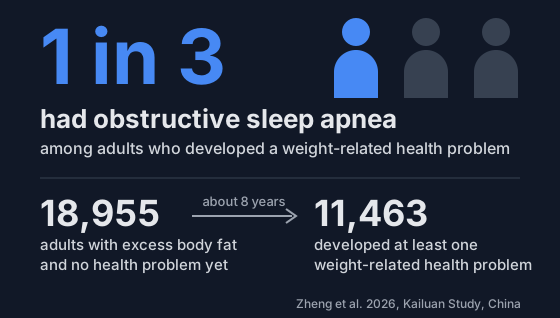
Carrying extra weight is a known risk factor for obstructive sleep apnea. A study published in September 2026 puts a number on how often the two turn up together.
It followed 18,955 adults in northern China for about 8 years. Of those who went on to develop a weight-related health problem, one in three had obstructive sleep apnea.
Who was in the study?
- 18,955 adults from the Kailuan Study, a long-running health survey in Tangshan, China.
- Their average age was 51, and 75% were men.
- All of them had excess body fat by BMI and waist measurements, but no weight-related health problem yet. A 2025 Lancet commission calls this "preclinical obesity".
- About a third (34%) had fatty liver on an ultrasound scan at the start.
What happened to them?
Over a median of 7.8 years, 11,463 of them developed at least one weight-related health problem. The commission calls this stage "clinical obesity".
The three most common were:
- High blood pressure: 84.2%
- Obstructive sleep apnea: 33.9%
- High blood sugar and blood fats: 27.9%
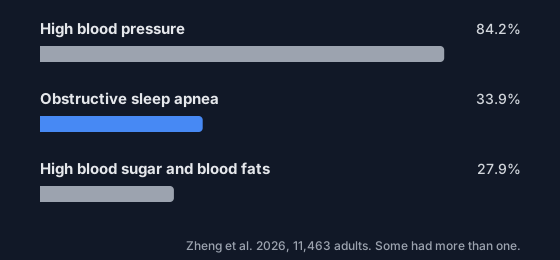
About half of them had more than one problem. High blood pressure together with sleep apnea was the most common pair, at 18.2%.
Where does fatty liver come in?
That was the study's main question.
- With fatty liver, 104 in every 1,000 people developed a weight-related health problem each year.
- Without it, 61 did.
- After adjusting for age, sex, lifestyle and medication, the hazard ratio was 1.59.
- The more fat the scan showed, the higher the figure.
That result covers all the health problems together, not sleep apnea on its own.
What doesn't it tell you?
- Cause. It's an observational study. It shows what went together, not what caused what.
- Everyone. The group was mostly men from one community in China.
- How sleep apnea was recorded. The main paper doesn't describe it, and the authors say some problems may have been missed.
What can you do with this?
If you snore loudly, someone has heard you stop breathing in your sleep, or you're exhausted during the day, see a doctor. For the other signs, read snoring vs sleep apnea.
Not sure? The sleep apnea risk check takes about a minute and helps you decide whether to talk to a doctor.
An overnight oximeter can't tell you whether you have sleep apnea. It records what your oxygen and pulse did, and you can share that with your doctor.
Not a medical device. Does not diagnose, treat or prevent any condition. Discuss results and changes with a clinician.
References
- Zheng H, Huang P, Hong G, Wang Y, Huo Z, Liang Y, Zheng H, Lan Y, Chen S, Vidili G, Casu G, Sechi LA, Wu S, Chen Y. Ultrasound-defined fatty liver and the risk of progression from preclinical to clinical obesity: a prospective cohort study. Frontiers in Nutrition. 2026;13:1877518. doi:10.3389/fnut.2026.1877518
- Rubino F, Cummings DE, Eckel RH, Cohen RV, Wilding JPH, Brown WA, et al. Definition and diagnostic criteria of clinical obesity. The Lancet Diabetes & Endocrinology. 2025;13(3):221-262. doi:10.1016/S2213-8587(24)00316-4