Snore Recording App vs a Home Sleep Test
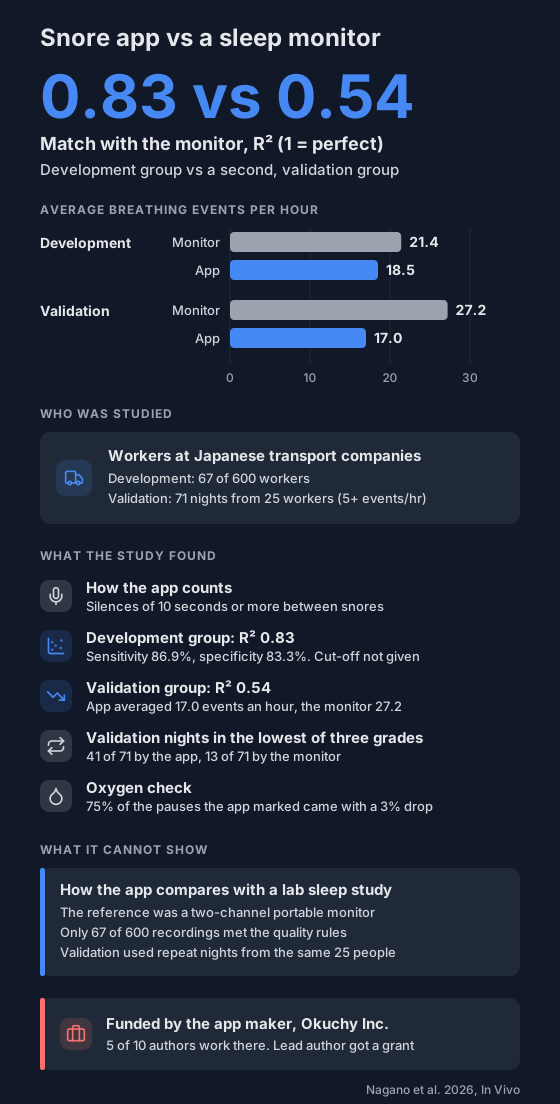
A 2026 Japanese study compared a snore recording phone app with a two-channel portable sleep monitor. The match was close in the group used to build it (R² 0.83) and weaker in a second group (R² 0.54).
A phone on the bedside table can record your snoring all night. Some apps go further and turn that sound into a count of breathing events per hour. A 2026 study from Japan checked one such app against a simple portable sleep monitor.
The app maker paid for the study, and half the authors work for it.
Who was studied?
Workers at Japanese transport companies, in two groups:
- Development group: 600 workers recorded a night with the app and the monitor at the same time. 67 recordings met the quality rules and were analysed.
- Validation group: 25 workers with at least 5 events an hour, recorded on 71 nights. They came from a separate trial of throat exercises, recorded before, during and at the end.
The abstract describes the 25 workers as the group used to build the app's method. The methods and results describe them as the validation group, and this article follows the full text.
The reference was a two-channel portable monitor, a simple type of home sleep test. It records oxygen plus airflow or pulse.
How does the app count events?
- It records breathing sounds through the phone and analyses them in the cloud.
- A silence of 10 seconds or more between snores counts as an event.
- A deep learning model was trained to match snoring patterns to dips in the monitor's oxygen trace.
What did it find?
In the development group:
- The app's events per hour lined up closely with the monitor's, with an R² of 0.83 (1 would be a perfect match).
- The app averaged 18.5 events an hour, the monitor 21.4.
- Sensitivity was 86.9% and specificity 83.3%. The paper doesn't say which events-per-hour cut-off these use.
In the validation group, the match was weaker:
- R² was 0.54.
- The app averaged 17.0 events an hour, the monitor 27.2.
- The app put 41 of the 71 nights in the lowest of three grades. The monitor put 13 there.
So the app counted fewer events than the monitor in both groups, and the gap was larger in the validation group. The authors put the gap down to the two devices estimating sleep time differently.
There was also an oxygen check. The authors report that 75% of the pauses the app marked came with an oxygen drop of 3% or more. The paper doesn't say which group this was measured in.
What can't it show?
- How it compares with a lab sleep study. The reference was a two-channel monitor, which the authors say is not fully accurate. A lab sleep study comparison is planned.
- How well it holds up beyond the data it was built on. The match fell from 0.83 to 0.54 in the validation group, which is the better test of a new tool. The paper doesn't say whether any validation workers were also in the development group.
- A typical group of users. Only 67 of 600 development recordings passed the quality rules, and the 71 validation nights came from the same 25 people.
- Agreement night by night. The paper reports R² and averages, not how far apart the two counts were on a single night.
- Industry ties. The study was funded by Okuchy Inc., which makes and sells snore recording apps. Five of the ten authors work for it, and the lead author received a research grant from it.
What does it mean for you?
A snore app records sound. An oximeter records your blood oxygen and pulse. In this study the app's count sat below the monitor's in both groups, and well below it in the validation group.
For more on what each one records, see snoring apps vs oximeters. For the difference between snoring and sleep apnea, see snoring vs sleep apnea. If you're unsure about your sleep, try the sleep apnea risk check and take your recordings to your doctor.
Not a medical device. Does not diagnose, treat or prevent any condition. Discuss results and changes with a clinician.
References
- Nagano T, Hashimoto M, Izumi S, Hata Y, Katsurada N, Katsurada M, Tsuji M, Morota K, Hata A, Kobayashi K. A Novel Snore Recording Application Demonstrating High Correlation With Two-channel Portable Monitoring for Diagnosing Sleep Apnea Syndrome. In Vivo. 2026;40(4):2033-2039. doi:10.21873/invivo.14356