Opioids and Sleep Apnea Symptoms: 2026 Study
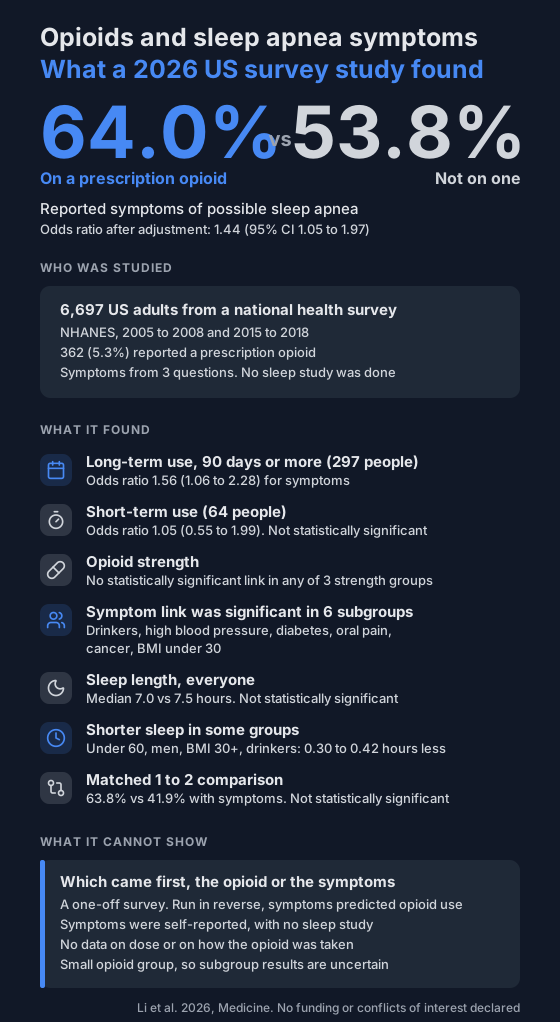
A 2026 analysis of 6,697 US adults found that 64.0% of people on a prescription opioid reported symptoms of possible sleep apnea, against 53.8% of those not on one. It was a one-off survey with no sleep study.
Opioids are known to slow breathing, and that includes breathing during sleep. Whether people who take them also have more signs of obstructive sleep apnea is less clear, and earlier studies disagree.
A study published in June 2026 looked at this in a large US health survey. People on a prescription opioid reported sleep apnea symptoms more often. The study can't say the opioid was the reason.
Who was in the study?
- 6,697 adults from NHANES, a national US health survey, in four survey rounds: 2005 to 2008 and 2015 to 2018.
- 362 of them (5.3%) reported taking at least one prescription opioid.
- Median age was 58 in the opioid group and 56 in the rest.
- The paper lists 64 short-term users (under 90 days) and 297 long-term users (90 days or more in the abstract, more than 90 in the methods).
- By our sum that is 361, one short of 362, and the paper doesn't explain the gap.
- People taking common insomnia medicines were left out.
How did it count sleep apnea symptoms?
Nobody had a sleep study. The survey asked three questions: how often you snore, how often you snort or stop breathing, and how often you feel overly sleepy in the day.
You counted as "possible sleep apnea" if you answered:
- "Occasionally" or "Frequently" to either of the first two, or
- "Almost always" to the sleepiness question.
That's a loose bar. More than half of the people not on opioids met it.
Sleep length was self-reported too, from one question about how many hours you get.
What did it find?
- Symptoms. 64.0% of the opioid group met the bar, against 53.8% of everyone else. These are survey-weighted figures.
- After adjusting for age, sex, BMI, smoking, drinking, income and health conditions, the odds ratio was 1.44 (95% CI 1.05 to 1.97).
- Long-term use. Odds ratio 1.56 (1.06 to 2.28).
- Short-term use. Odds ratio 1.05 (0.55 to 1.99), not statistically significant.
- Opioid strength. After full adjustment, no statistically significant link in any of the three strength groups. The paper had no dose data.
- Sleep length. Median 7.0 hours in the opioid group and 7.5 in the rest. The difference was not statistically significant.
For what counts as a sign, see snoring vs sleep apnea.
Was it different for some groups?
The symptom link was statistically significant in people who:
- Drink alcohol: odds ratio 1.78.
- Have high blood pressure: 1.91.
- Have diabetes: 2.10.
- Have oral pain: 2.08.
- Have cancer: 2.15.
- Have a BMI under 30: 1.57.
Sleep was shorter with opioid use in four groups:
- Under 60: 0.34 hours less.
- Men: 0.30 hours less.
- BMI of 30 or more: 0.42 hours less.
- Drinkers: 0.32 hours less.
That's about 18 to 25 minutes a night, by our conversion of the paper's figures. In both lists, the pattern showed up with long-term use and not with short-term use.
Each subgroup had few opioid users in it, so these figures are less certain than the overall one.
What doesn't it tell you?
Limits the authors state:
- Which came first. Everyone was surveyed once. When the authors ran the analysis in reverse, having symptoms also predicted opioid use (odds ratio 1.42). The authors say shared underlying causes may sit behind both.
- Whether anyone had sleep apnea. Symptoms were self-reported. The authors say people on opioids may see clinicians more often and report symptoms more readily.
- Dose. The survey has no data on dose or how the opioid was taken.
- A weaker result on a second test. The authors matched each opioid user with two similar non-users. The gap was 63.8% against 41.9%, and it was not statistically significant. They say the true link may be weaker than their main result. A regression reported alongside it still linked long-term use to symptoms (odds ratio 1.43, 95% CI 1.07 to 1.92).
- Small numbers. 362 opioid users, split further for the subgroups.
Our own observations:
- The symptom bar was loose enough that more than half of the comparison group met it. With a stricter bar (all three answers), the odds ratio was 2.98 (1.46 to 6.08).
- The subgroup tables run many comparisons, and the paper doesn't describe a correction for that.
The authors report no funding and no conflicts of interest.
What can you do with this?
The authors' own conclusion is aimed at clinicians: they say people on long-term opioids should have their sleep and breathing symptoms followed.
The rest of this section is our suggestion, not a finding of the study.
- If you snore loudly, someone has seen you stop breathing in your sleep, or you're very sleepy in the day, tell your doctor. That applies whatever you take.
- The sleep apnea risk check takes about a minute and helps you decide whether to raise it.
- An overnight oximeter can't tell you whether you have sleep apnea. It records what your oxygen and pulse did, and you can share that with your doctor.
Decisions about your medication are for you and your prescriber.
For how oxygen readings are used around opioids in hospitals and clinics, see SpO2 cut-offs for opioid breathing problems.
Not a medical device. Does not diagnose, treat or prevent any condition. Discuss results and changes with a clinician.
References
- Li C, Mei Y, Xie P, Lu T, Huang J, Zhao Z. Examining the relationship between opioid use and symptom-defined obstructive sleep apnea and sleep duration: A cross-sectional study. Medicine. 2026;105(24):e49192. doi:10.1097/MD.0000000000049192