Snoring Sound AI vs a Wearable: 2026 Study
A 2026 study in three Chinese hospitals compared a snoring-sound AI model and a wearable with a lab sleep study. The two did not differ by a statistically significant amount.
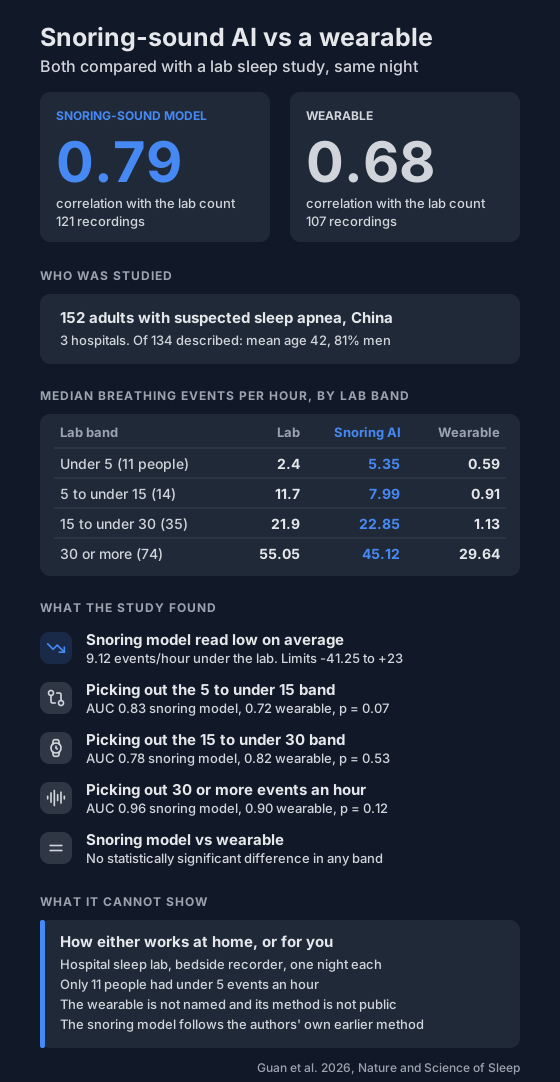
Snoring apps listen. Wearables read pulse, oxygen and movement at the wrist. A 2026 study put one of each next to a lab sleep study on the same night to see which came closer.
The snoring-sound model tracked the lab count more closely. Head to head, though, the difference between the two wasn't statistically significant.
Who was in the study?
- 152 adults sent for a sleep study because of snoring, mouth breathing or pauses in breathing someone had seen.
- Three hospitals in China, June to August 2025.
- The authors call it a multicenter pilot study.
- Each person slept one night in the sleep lab for the full sleep study, with a bedside audio recorder and a wearable recording at the same time.
- Not everyone ended up with all three. The paper's flowchart shows 152 sleep studies, 150 snoring recordings and 111 wearable recordings before quality checks.
- After poor-quality recordings were dropped, 144 sleep studies, 121 snoring recordings and 107 wearable recordings were usable.
- The paper describes 134 participants: mean age 42, 81% men.
- 74 of those 134 (55%) had 30 or more breathing events an hour on the lab study. Only 11 (8%) had fewer than 5.
The snoring model is an AI model that turns the audio into an estimate of breathing events per hour. It was trained before this study and not adjusted on these recordings. The wearable is not named. The paper calls it a smartwatch, and its estimate comes from oxygen dips and movement.
How close did each get to the lab count?
- Snoring model. Correlation with the lab count was 0.79. Agreement (ICC) was 0.753 on a 0 to 1 scale.
- Wearable. Correlation with the lab count was 0.68. The paper gives no agreement figure or average gap for it.
Correlation only says the two rise and fall together. It doesn't say the numbers match.
On average the snoring model read 9.12 events an hour lower than the lab. The 95% limits of agreement ran from 41.25 lower to 23 higher, which is the range most individual gaps are expected to fall in. That's a wide range for one person's result.
What did the numbers look like band by band?
The paper's Table 1 gives the median events per hour for each method, grouped by the lab result:
| Lab result | Lab | Snoring model | Wearable |
|---|---|---|---|
| Under 5 (11 people) | 2.4 | 5.35 | 0.59 |
| 5 to under 15 (14 people) | 11.7 | 7.99 | 0.91 |
| 15 to under 30 (35 people) | 21.9 | 22.85 | 1.13 |
| 30 or more (74 people) | 55.05 | 45.12 | 29.64 |
The head counts are from the 134 people described, and not all of them had a usable recording from every method. The wearable's median stayed close to 1 until the lab count reached 30 or more. The snoring model's median was above the lab's in the lowest band and below it in the 5 to under 15 band and the top band.
Which one sorted people into the right band?
The authors scored this with AUC. 0.5 is a coin toss and 1 is perfect. For each band, they tested how well a method separated people in that band from everyone else.
In the head-to-head comparison:
- Under 5 events an hour: 0.82 for the snoring model, 0.75 for the wearable (p = 0.35).
- 5 to under 15: 0.83 against 0.72 (p = 0.07).
- 15 to under 30: 0.78 against 0.82 (p = 0.53).
- 30 or more: 0.96 against 0.90 (p = 0.12).
None of those differences was statistically significant. The snoring model's figure was higher in three of the four bands, and the wearable's was higher in the 15 to under 30 band.
The paper also split the results by sex, age and BMI. Neither method came out ahead consistently, and the ranges were wide in the smaller groups, especially women.
What can't it tell you?
Limitations the authors state:
- The sample was modest, so small differences between the methods could be missed.
- All three centres were in China.
- Not everyone had usable data from all three methods, which may have affected the comparison.
- Most participants had 15 or more events an hour, so there was less to go on at the lower end.
- The lab counted a partial breathing event only with an oxygen drop of 4% or more, which gives lower counts than the 3% rule.
- The wearable's method is proprietary, so the authors couldn't inspect it.
Things we noticed:
- The recordings were made in a hospital sleep lab with a bedside audio recorder, not a phone on a bedside table at home.
- The snoring model follows a method the authors' own group published earlier.
- The methods say accuracy, sensitivity and specificity were calculated, but the main text doesn't report them.
- The paper doesn't say how many people had both a snoring and a wearable recording for the head-to-head test. It can't be more than 107.
- The conclusion says the snoring model agreed with the lab better than the wearable, particularly in the 5 to under 15 band. The paper's own test put that difference at p = 0.07, and it gives no agreement figure for the wearable.
- One unnamed wearable was tested, so the result doesn't carry over to other watches or rings.
The study was funded by Chinese national, provincial and city research grants. The authors declare no competing interests.
What can you do with this?
These are our suggestions, not the study's findings.
- A snoring app, a wearable or an overnight oximeter can't tell you whether you have sleep apnea. In this study, the snoring model's 95% range for one person ran from 41 events an hour below the lab count to 23 above.
- If you snore loudly, someone has seen you stop breathing, or you're exhausted during the day, see a doctor. A sleep study is the reference test.
- Sound and oxygen are different signals. See snoring apps vs oximeters for what each one records.
- For how to read a wearable's figures, see how valid are smartwatch numbers.
- Got overnight recordings already? Here's how to share them with your doctor.
Not a medical device. Does not diagnose, treat or prevent any condition. Discuss results and changes with a clinician.
References
- Guan H, Huang J, Liu D, Yang L, Zeng H, Huang J, Miao B. Multicenter Validation of an AI-Based Snoring Model vs. Wearables for Diagnosing Sleep Apnea. Nature and Science of Sleep. 2026;18:582714. doi:10.2147/NSS.S582714