How Valid Are Smartwatch Health Numbers?
A 2026 review went through the common smartwatch metrics. Resting heart rate was off by about 2 bpm, calorie counts often by more than 10-20%, and readiness scores have no reference to test against.
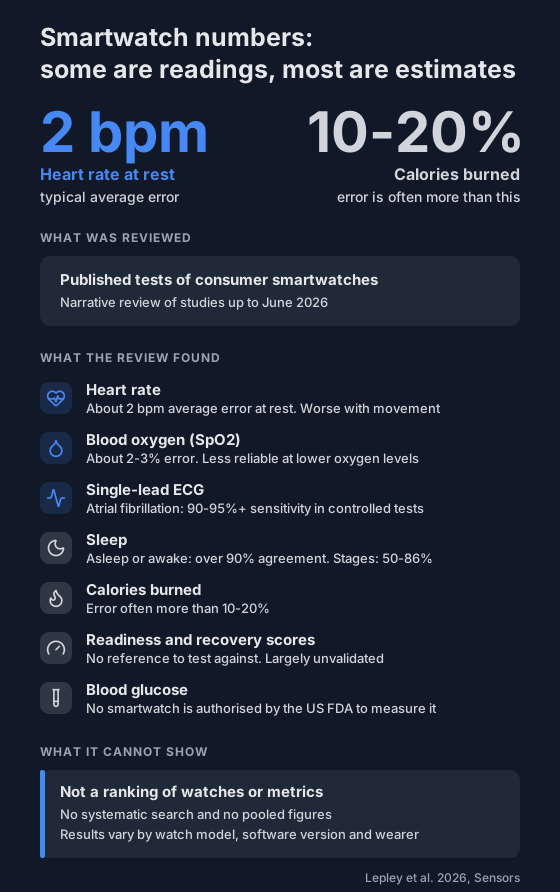
A smartwatch shows heart rate, blood oxygen, sleep stages, calories and a readiness score side by side. A 2026 review says they aren't the same kind of number.
A few are close to what the sensor picks up. Most are estimates built by the maker's own algorithm.
What did the review look at?
- Published tests of consumer smartwatches against reference methods, searched up to June 2026.
- It's a narrative review, so there were no participants and no pooled figures.
Which numbers hold up?
Mostly the ones closest to the sensor, in steady conditions.
- Heart rate. About 2 bpm average error at rest and at a steady pace. Error grows with movement.
- Blood oxygen. About 2-3% error in the usual range, and less reliable at lower oxygen levels.
- Single-lead ECG. Sensitivity and specificity for telling atrial fibrillation from a regular rhythm were commonly above 90-95% in controlled tests.
- Steps. Error was often below 10% when walking outdoors at a usual pace.
- Asleep or awake. Over 90% agreement with a sleep lab recording.
Darker skin, tattoos, hair and a loose fit all weaken the optical signal. The review says darker skin may make SpO2 read too high. More on that in pulse oximeters and skin tone and sensor fit and pressure.
Which ones are rough estimates?
- Sleep stages. 50-86% sensitivity. Lying awake and still is often counted as light sleep.
- Calories burned. Error is often more than 10-20%.
- VO2max, body composition, sweat loss. About 5-13%, 9-19% and 25-33% error.
- Readiness and recovery scores. No reference exists to test them against. A study of 14 scores from 10 makers found the weightings generally lack published validation.
- Blood pressure without a cuff. Agreement is highly variable. One wrist device got US FDA clearance in July 2025, but 2025 US guidelines recommend against using cuffless devices to manage high blood pressure.
- Blood glucose. The US FDA hasn't authorised any smartwatch to measure it.
What can't this review tell you?
- Which watch is best. The authors say it's a framework, not a ranking.
- Exact figures. The search wasn't systematic.
- What your watch does today. Software updates can change the numbers without notice.
What can you do with this?
The review's advice is to use watch numbers for your own trend over time, not as exact values or to compare yourself with someone else.
- A small change may be within the error.
- For overnight oxygen, see smartwatch SpO2 vs a pulse oximeter.
Not a medical device. Does not diagnose, treat or prevent any condition. Discuss results and changes with a clinician.
References
- Lepley AS, Davis F, Melvin AC, Zhao ZY. Consumer Smartwatch Technology in Health and Performance Research: Validity, Limitations, and Real-World Applications. Sensors. 2026;26(14):4486. doi:10.3390/s26144486