Apple Watch Blood Oxygen Accuracy: A Review
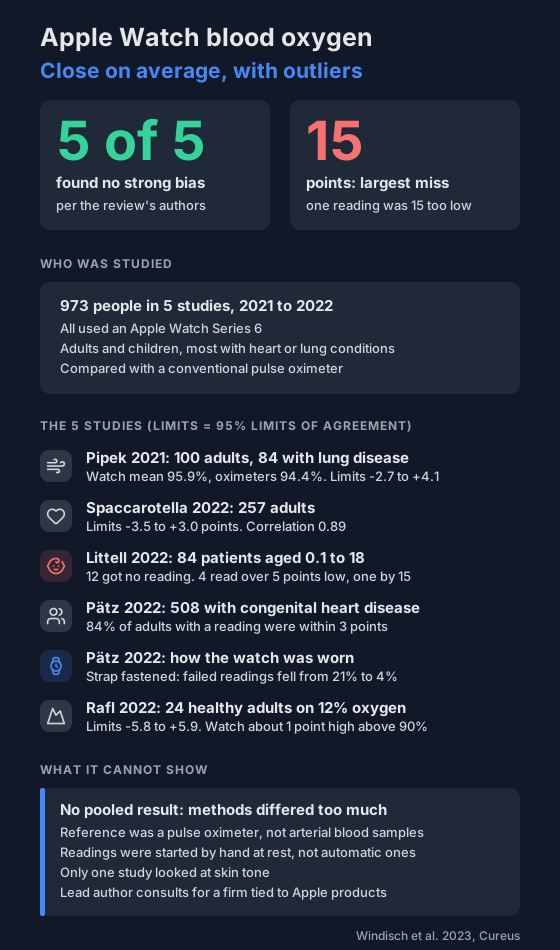
A 2023 systematic review found five studies of the Apple Watch Series 6 blood oxygen reading, covering 973 people. None showed a strong systematic bias, but one reading was 15 points too low.
The Apple Watch has shown a blood oxygen number since the Series 6. Apple frames it as a wellness feature, and it hasn't been through the FDA clearance the watch's ECG has.
So how close is it? A 2023 systematic review searched for studies that checked the watch's reading against a reference measurement. It found five, and none showed the watch reading consistently high or low by much. Single readings were another matter.
What did the review look at?
- The authors searched PubMed and Google Scholar up to October 2022.
- 17 articles came back, 3 of them duplicates, and 5 met the criteria.
- Together they covered 973 people: adults and children, most with a heart or lung condition.
- All five used the Apple Watch Series 6.
- All five compared it with a conventional pulse oximeter.
The watch works differently from a fingertip clip. A clip shines light through the finger. The watch shines light into the wrist and reads what bounces back, which the review says gives a smaller and less stable signal. For the basics, see how accurate pulse oximeters are.
What did the five studies find?
The studies mostly report "95% limits of agreement". That's the range that 95% of the gaps between watch and oximeter fell inside, in points of SpO2.
- Pipek 2021, 100 adults, 84 of them with lung disease. The watch averaged 95.9% and the fingertip oximeters 94.4%. Limits of agreement were -2.7 to +4.1.
- Spaccarotella 2022, 257 adults, most with heart or lung disease. Limits of agreement were -3.5 to +3.0.
- Rafl 2022, 24 healthy adults breathing 12% oxygen. Limits of agreement were -5.8 to +5.9. When the oximeter read above 90%, the watch averaged 1 point higher.
- Pätz 2022, 508 adults and children with congenital heart disease. In 84% of the adults who got a reading, the watch was within 3 points of the oximeter.
- Littell 2022, 84 children and young people at a heart clinic. The average gap, ignoring direction, was 2.0 points. The review reads the limits of agreement off the paper's chart at about -7 to +5.
Four of the five author groups concluded the watch was usable for the people they tested. The Pätz group concluded it isn't yet up to the standard of a conventional pulse oximeter.
How big were the outliers?
- In the Littell study, 4 readings were more than 5 points below the oximeter, and one was 15 points below.
- 12 of the 84 patients in that study never got a reading from the watch at all.
- The Pätz study didn't count readings where the three watch attempts disagreed by more than 4 points, so its 84% leaves those out.
The review's conclusion says outliers "appear to occur fairly often", but the authors couldn't put a figure on how often.
Apple only offers the reading to users aged 18 and over. Two of the five studies included children, and the Littell study sometimes put the watch on a palm, foot or leg.
Does it matter how you wear it?
In the Pätz study, yes.
- At first the watch was just laid on the wrist.
- After 259 patients, the researchers started fastening the strap properly.
- Failed readings after three attempts went from 21% to 4%.
The review says this raises the question of how much fit affects accuracy too, which the studies didn't answer. A separate review looked at sensor fit and pressure directly.
What about skin tone?
Only the Pipek study checked. It found no statistically significant difference by skin type, but it doesn't say how many people of each skin type took part. Two of the other studies described their participants as white, and two didn't report it.
The review's authors say this still needs investigating. For what's known about fingertip devices, see pulse oximeters and skin tone.
What can't the review tell you?
- One overall number. The studies measured and reported things too differently to pool, so there's no combined result.
- How it compares with blood. Every study used a pulse oximeter as the reference. Arterial blood samples are the FDA's standard for testing a new oximeter. A later lab study compared the watch with blood samples.
- Background readings. Every reading was started by hand with the person sitting or lying still. The automatic readings the watch takes during your day weren't tested.
- Newer watches. All five studies used the Series 6.
- Everything published. The search only covered two databases and needed "Apple Watch" or "Apple Smartwatch" in the title or abstract. The review wasn't registered in advance and had no published protocol.
The review's lead author declared consulting fees from a technology company with business related to Apple products. The five studies themselves declared no conflicts of interest.
What can you do with this?
The review makes four points for people who wear the watch.
- One odd reading isn't a pattern. The authors put the usual range for SpO2 at 95% to 100%, and say that with gaps of this size you'll eventually see a reading outside it. On its own, in someone otherwise healthy, they say that's no cause for concern.
- It doesn't record all the time. The watch takes readings several times a day, so the authors say it can't be relied on to catch a sudden drop.
- Averages over time are where it could help. For people with a condition that affects their oxygen, the authors say the watch could be a convenient way to see how SpO2 changes on average over longer periods.
- It may not tell most wearers much. For most people using it as a wellness tracker, the authors say it likely won't give meaningful health guidance, and outliers could cause worry.
If you want every dip through the night, that takes a device that records continuously. See is an overnight pulse oximeter worth it.
If low readings keep turning up, or you're short of breath, talk to a doctor.
Not a medical device. Does not diagnose, treat or prevent any condition. Discuss results and changes with a clinician.
References
- Windisch P, Schröder C, Förster R, Cihoric N, Zwahlen DR. Accuracy of the Apple Watch Oxygen Saturation Measurement in Adults: A Systematic Review. Cureus. 2023;15(2):e35355. doi:10.7759/cureus.35355