Apple Watch vs Finger Oximeter in Low Oxygen
A 2026 lab study lowered blood oxygen in 9 adults and compared an Apple Watch Series 7 and a fingertip oximeter with blood samples. Both read high, the watch by more.
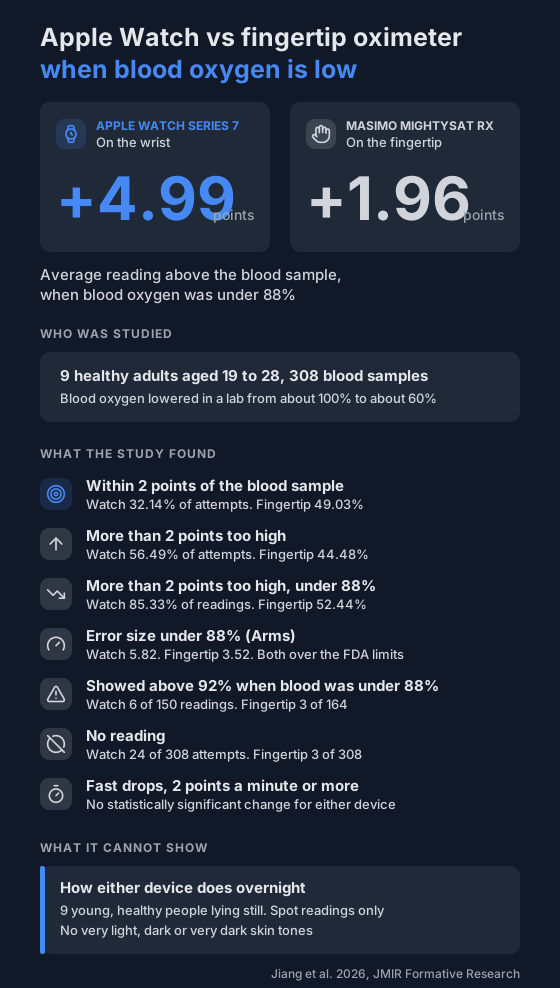
A smartwatch and a fingertip oximeter both give you a blood oxygen number. Earlier comparisons mostly didn't check how they do when oxygen is actually low. A 2026 study from Duke University lowered people's blood oxygen on purpose and compared both devices with blood samples.
Who was studied?
- 9 healthy adults aged 19 to 28: 5 men and 4 women.
- They lay on a stretcher and breathed a controlled gas mix that took their blood oxygen from about 100% down to about 60% in steps.
- They wore an Apple Watch Series 7 on the right wrist and a Masimo MightySat Rx, an FDA-cleared fingertip oximeter, on the right middle finger.
- Each reading was compared with blood taken from an artery at the same time: 308 samples in all.
What did it find?
Both devices tended to read higher than the blood sample.
- Average gap. The watch read 3.26 points above the blood sample and the fingertip oximeter 1.80. Under 88%, that was 4.99 and 1.96.
- Within 2 points. 32.14% of watch attempts and 49.03% of fingertip attempts.
- More than 2 points too high. 56.49% and 44.48% of attempts. Under 88%, 85.33% and 52.44% of readings.
- No reading. The watch gave none on 24 of 308 attempts, the fingertip oximeter on 3.
The error grew as oxygen fell. Under 88%, the root mean square error (Arms) was 5.82 for the watch and 3.52 for the fingertip oximeter. The FDA recommends under 3.5 for wrist-style sensors and under 3 for fingertip ones, and the authors say both were over.
Did either one miss low oxygen?
When blood oxygen was under 88%, the watch showed above 92% in 6 of 150 readings and the fingertip oximeter in 3 of 164.
Fast drops, of 2 points a minute or more, made no statistically significant difference to the average gap for either device.
What can't it tell you?
- Overnight use. These were spot readings on people lying still, with the watch started by hand.
- Other people. The authors say nine young, healthy adults may not represent older people or people with lung conditions.
- All skin tones. Nobody in the very light, dark or very dark groups took part. See pulse oximeters and skin tone.
- Funding. AstraZeneca part-funded it, alongside US public grants. One author sits on a Google consumer health advisory board and consults for Samsung Research America.
What can you do with this?
A wearable's oxygen number is an estimate, and in this study it was less exact when oxygen was low. If you feel unwell, or your readings worry you, talk to a doctor.
Read smartwatch SpO2 vs a pulse oximeter and how accurate pulse oximeters are.
Not a medical device. Does not diagnose, treat or prevent any condition. Discuss results and changes with a clinician.
References
- Jiang Y, Spies C, Roghanizad AR, Wang WK, Bhosai SJ, Snyder L, Burke A, MacLeod D, Dunn J. Performance of Wearable Pulse Oximetry During Controlled Hypoxia Induction: Instrument Validation Study. JMIR Formative Research. 2026;10:e85253. doi:10.2196/85253
- US Food and Drug Administration. Pulse Oximeters - Premarket Notification Submissions [510(k)s]: Guidance for Industry and Food and Drug Administration Staff. March 2013. fda.gov