Garmin Fenix SpO2 at 4,559 m vs Blood Samples
A 2021 field study compared a Garmin Fenix 5X Plus with arterial blood samples at 4,559 m. The watch read about 7 points too high on average. A hospital fingertip monitor averaged 0.1 points off.
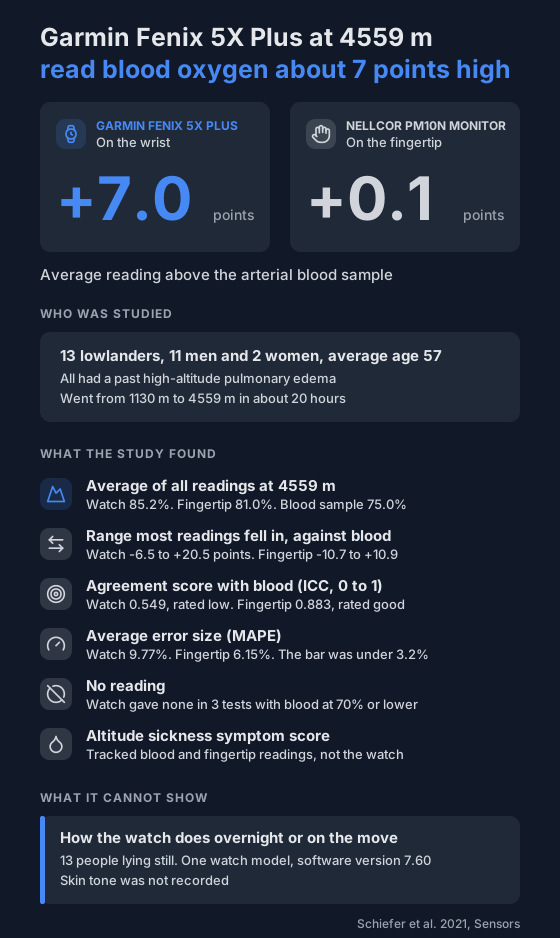
Lots of climbers and trekkers check the blood oxygen number on their watch as they go up. A 2021 study took a Garmin Fenix 5X Plus to a hut at 4,559 m and checked it against arterial blood samples.
The watch read about 7 points too high on average. A hospital fingertip monitor used at the same moments averaged 0.1 points off.
A 2025 lab study of the Garmin fenix 6 is covered separately.
Who was in the study?
- 13 people who live at low altitude: 11 men and 2 women, average age 57.
- All of them had a history of high-altitude pulmonary edema, which is fluid in the lungs brought on by altitude.
- They were taking part in a trial of acetazolamide for that condition. This paper reports only the oxygen readings.
- They went from 1,130 m to the Capanna Regina Margherita hut at 4,559 m in about 20 hours and stayed three nights.
How were the readings taken?
At six points over the stay, from 6 to 68 hours after arrival, each person lay still on their back.
- Watch. The Fenix 5X Plus sat above the wrist bone, and the reading was noted after 5 minutes.
- Fingertip monitor. A Covidien Nellcor PM10N, a certified hospital monitor, was clipped to the other hand at the same time.
- Blood. At four of the six points, blood was drawn from an artery and run through a blood gas analyser three times. This is the reference method.
What did the watch read?
Across all the readings at 4,559 m, the averages were:
- Watch: 85.2%
- Fingertip monitor: 81.0%
- Arterial blood: 75.0%
Those averages are not matched reading for reading. Blood was drawn at four of the six points and stopped once someone was found to have lung fluid, and the watch sometimes gave no reading. The paper also reports the average difference from blood for each device. The pair counts are the ones printed in its results table:
- Watch against blood, 37 pairs. 7.0 points too high on average. Most single readings fell between 6.5 points below and 20.5 points above the blood value.
- Fingertip monitor against blood, 26 pairs. 0.1 points too high on average. Most single readings fell between 10.7 points below and 10.9 points above.
So the fingertip monitor was right on average, but a single reading could still be well off.
The study also used an agreement score from 0 to 1, called the intraclass correlation. The watch scored 0.549, which the authors' scale rates as low. The fingertip monitor scored 0.883, rated good.
On average percentage error, the watch came out at 9.77% and the fingertip monitor at 6.15%. The authors had set 3.2% as acceptable before they started. Neither device met it.
What happened at the lowest oxygen levels?
- In three measurements where blood oxygen was 70% or lower, the watch gave no reading at all.
- The authors say the watch tended to read too high most when blood oxygen was low. Their statistical test for that pattern was not significant (p = 0.625).
Did the readings line up with altitude sickness?
10 of the 13 had acute mountain sickness during the stay, and 7 of the 13 had high-altitude pulmonary edema on a chest X-ray.
The study compared each oxygen figure with a symptom score, the Lake Louise score. Lower oxygen went with a higher score, and how strongly depended on the source:
- Arterial blood: strong link (r = -0.809).
- Fingertip monitor: weaker link (r = -0.541).
- Watch: no statistically significant link (r = -0.167).
Whether someone had acute mountain sickness or not showed no statistically significant link with any of the three oxygen figures. Having lung fluid was linked to lower oxygen in the blood samples only (r = -0.345).
The authors conclude they can't recommend the watch for managing acclimatisation at high altitude. They say a reading that is too high could make the risk look smaller than it is.
For other approaches, see predicting altitude sickness from oximetry.
What doesn't it tell you?
- Overnight or moving readings. Every reading was a spot check after 5 minutes lying still.
- Other watches or newer software. It tested one model on software version 7.60 in 2019. The authors say later firmware could change the result.
- Everyone. This was a small study inside a drug trial: 13 people, mostly men, all with a history of altitude-related lung fluid. The authors expect the results to carry over to others, but didn't test that. They say a larger sample would have had more statistical power.
- Skin tone. It wasn't recorded.
Other watches have done differently. A Huawei watch tested up to 4,014 m stayed close to a fingertip oximeter, though that study had no blood samples.
What can you do with this?
- Don't rely on one watch reading to tell you how you're coping up high. Go by how you feel, and follow your guide's or doctor's advice.
- If you're tracking a trip, a fingertip or ring oximeter that records all night gives you more to look at than spot checks. See blood oxygen at altitude for what to expect.
- No home device matches a blood sample. Read more on pulse oximeter accuracy.
Not a medical device. Does not diagnose, treat or prevent any condition. Discuss results and changes with a clinician.
References
- Schiefer LM, Treff G, Treff F, Schmidt P, Schäfer L, Niebauer J, Swenson KE, Swenson ER, Berger MM, Sareban M. Validity of Peripheral Oxygen Saturation Measurements with the Garmin Fēnix® 5X Plus Wearable Device at 4559 m. Sensors. 2021;21(19):6363. doi:10.3390/s21196363