Garmin fenix 6 Blood Oxygen Accuracy: A Study
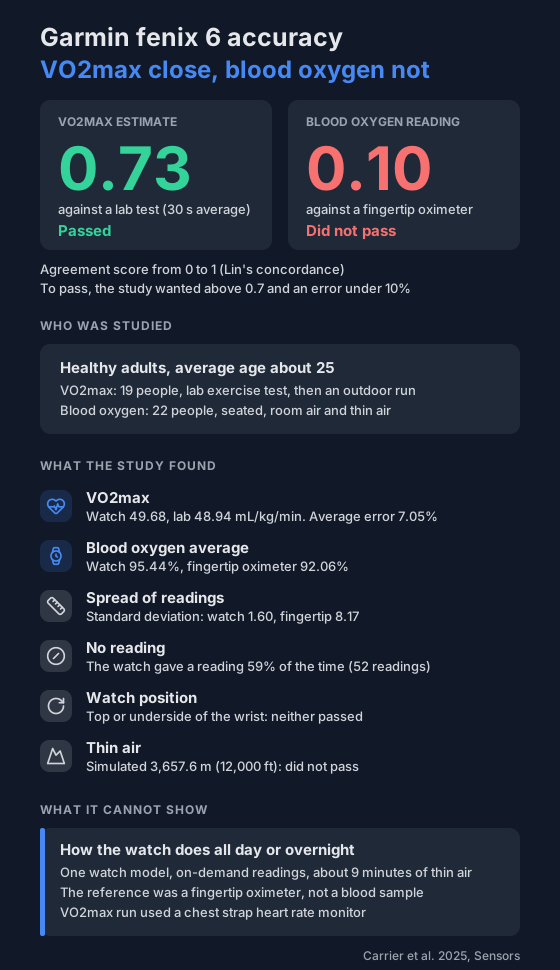
A 2025 lab study tested the Garmin fenix 6. Its VO2max estimate was close to a lab test. Its blood oxygen readings did not agree with a fingertip oximeter, and it gave a reading 59% of the time.
A Garmin watch gives you a VO2max estimate and a blood oxygen reading. It's easy to assume both are about as good as each other.
A 2025 study from the University of Nevada, Las Vegas tested both on the Garmin fenix 6. The VO2max estimate was close to a lab test. The blood oxygen reading was not close to a fingertip oximeter.
Who was in the study?
- Healthy adults, some active and some not, with an average age of about 25.
- 19 people did the VO2max test: 11 men and 8 women.
- 22 people did the blood oxygen test: 13 men and 9 women.
- Some people did both.
How was it tested?
VO2max. Each person did a graded exercise test in the lab, with a metabolic cart measuring the oxygen they used. Two to seven days later they did a 10 to 15 minute outdoor run with the watch and a Garmin chest strap heart rate monitor. The watch then gave its VO2max estimate.
Blood oxygen. Each person sat with the watch on the left wrist and a Roscoe fingertip pulse oximeter on the right index finger. The researchers triggered a reading on the watch and wrote down the fingertip number at the same moment.
They did this four ways:
- In room air, with the watch on the top of the wrist.
- In room air, with the watch on the underside of the wrist.
- In thin air, with the watch on the top of the wrist.
- In thin air, with the watch on the underside of the wrist.
The thin air came from an altitude simulator set to 3,657.6 m (12,000 ft). It was set lower for anyone who felt lightheaded. People spent about 9 minutes on it on average.
What counted as accurate?
The researchers set two bars before they started, and a result had to clear both:
- An average error under 10%.
- An agreement score above 0.7. The score is called Lin's concordance and runs from 0 to 1.
How did VO2max do?
It passed.
- The watch's average estimate was 49.68 mL/kg/min. The lab's was 48.94, using the best 30 seconds of the test.
- The average error was 7.05%.
- The agreement score was 0.73.
It also passed against the lab's best 15 seconds: error 7.23%, score 0.71. It did not pass against the best 4 breaths (error 10.70%, score 0.49) or the best minute (error 8.53%, score 0.68).
A further test, called equivalence testing, did not find the watch and the lab equivalent for any of the four. The authors reported that test but left it out of their pass mark.
How did blood oxygen do?
It did not pass, in any of the four conditions or with all of them combined.
With all conditions combined:
- The average error was 4.29%, which is under the 10% bar.
- The agreement score was 0.10, far below 0.7.
- The watch averaged 95.44%. The fingertip oximeter averaged 92.06%.
- The watch's readings had a standard deviation of 1.60. The fingertip oximeter's had 8.17.
So the fingertip readings ranged widely across room air and thin air, and the watch's stayed in a narrow band.
The authors say the watch did poorly, "especially during the hypoxic conditions". The figures for each condition are in a supplementary table, not the main paper.
How often did the watch give a reading at all?
59% of the time.
The researchers tried up to three times whenever the watch gave nothing. They ended up with 52 watch readings.
What do the authors conclude?
- The fenix 6 "may reasonably be expected" to give an accurate VO2max estimate when a lab test isn't available.
- People who want to track how they're adjusting to altitude "should look elsewhere" for blood oxygen readings.
- The watch is a consumer product, not a medical device, and no regulator checks its accuracy.
What doesn't it tell you?
- Overnight or all-day readings. Only on-demand readings were tested. The authors suggest future research tests readings taken through the day.
- Longer stays at altitude. People breathed thin air for about 9 minutes. The authors call this acute hypoxia.
- Other watches. One model was tested.
- Other people. The group was small, young and healthy.
- The true blood oxygen level. The reference was a fingertip pulse oximeter, not a blood sample. Fingertip oximeters have their own error.
- Wrist-only VO2max. The run used a chest strap for heart rate.
- VO2max in any weather. The runs were outdoors, and the authors say temperature can change heart rate and so the estimate.
- Strict uses. The authors call their pass marks "fairly liberal" and say sport at a high level, research and healthcare may need tighter ones.
Some figures in the paper don't line up. The text says 19 people did the VO2max test and the results table says 20. The methods describe eight blood oxygen trials per person, but 52 readings at 59% works out to about four attempts each. The two blood oxygen averages are 3.38 points apart, but the paper's bias figure is 1.12. The text says equivalence testing was met for the combined blood oxygen data, but one of the two p values in the table is 0.13.
What can you do with this?
In this study, a single fenix 6 reading was not a reliable guide to blood oxygen level, least of all in thin air.
- For how wrist readings compare in other studies, see smartwatch SpO2 vs a pulse oximeter and the Apple Watch against a fingertip oximeter in low oxygen.
- Heading to the mountains? Read blood oxygen at altitude.
- Choosing a device for overnight tracking? See ring vs fingertip vs wrist.
If a reading worries you, or you feel unwell at altitude, talk to a doctor.
Not a medical device. Does not diagnose, treat or prevent any condition. Discuss results and changes with a clinician.
References
- Carrier B, Marten Chaves S, Navalta JW. Validation of Aerobic Capacity (VO2max) and Pulse Oximetry in Wearable Technology. Sensors. 2025;25(1):275. doi:10.3390/s25010275