Smartwatch SpO2 Accuracy at High Altitude
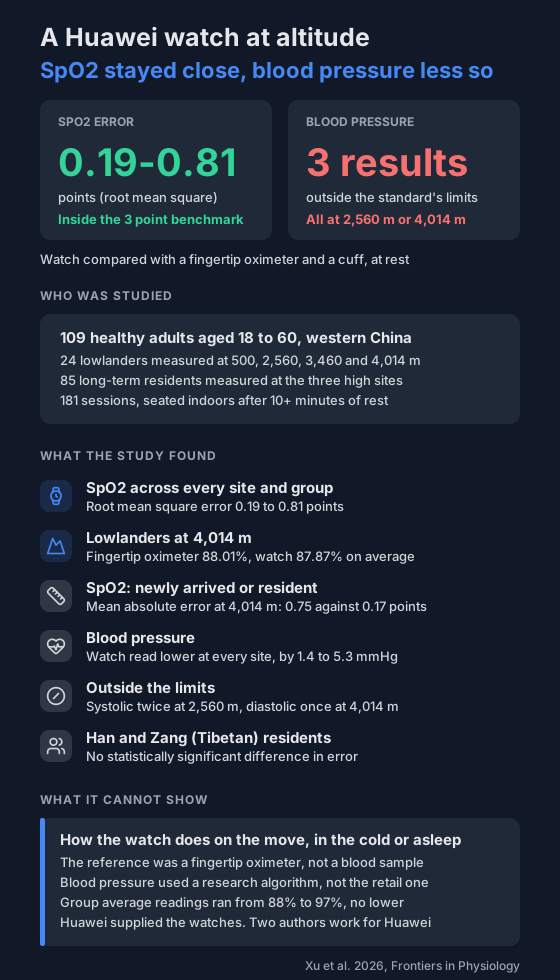
A 2026 field study checked a Huawei watch against a fingertip oximeter and a blood pressure cuff from 500 m to 4,014 m. The SpO2 error stayed under 1 point (root mean square). Blood pressure was less consistent.
Most watch blood oxygen sensors were developed and tested near sea level. So it's fair to ask whether the reading holds up in thin air.
A study published in 2026 took a Huawei Watch GT3 Pro up to 4,014 m and checked it against a fingertip oximeter and a blood pressure cuff. Two of the nine authors work for Huawei, and Huawei supplied the watches.
Who was in the study?
109 healthy adults in western China, aged 18 to 60, in two groups:
- 24 lowlanders who live at 500 m. They were measured at home in Chengdu, then at 2,560 m, 3,460 m and 4,014 m.
- 85 long-term residents of the three high sites, measured where they live.
That made 181 sessions. Each one was done seated, indoors at 20 to 25 °C, after at least 10 minutes of rest.
The watch reading was compared with:
- A fingertip pulse oximeter for SpO2.
- A mercury cuff and stethoscope, used by a trained operator, for blood pressure.
How close was the SpO2 reading?
Close, at every site.
- The root mean square error ran from 0.19 to 0.81 points across all sites and groups.
- The standard for pulse oximeters (ISO 80601-2-61) allows up to 3 points.
- At 500 m the lowlanders averaged 97.46% on the fingertip oximeter and 97.68% on the watch.
- At 4,014 m they averaged 88.01% and 87.87%.
In the lowlanders, the error didn't change by a statistically significant amount from one altitude to the next (P = 0.199).
The authors call this benchmarking, not certification. The standard compares a device with oxygen measured in an arterial blood sample. This study compared the watch with another oximeter.
For how watches and finger sensors differ, see smartwatch SpO2 vs a pulse oximeter.
Did it matter if you'd just arrived?
On average, the watch read no higher or lower in one group than the other by a statistically significant amount. Individual readings scattered more in the lowlanders.
At 4,014 m:
- Lowlanders: readings were 0.75 points off on average (mean absolute error), and the 95% limits of agreement ran from 1.74 below to 1.45 above the fingertip oximeter.
- Residents: readings were 0.17 points off on average, and the limits ran from 0.33 below to 0.43 above.
- The variance of the error was 17.5 times larger in the lowlanders.
The lowlanders also had lower oxygen at every high site, 88.01% against 90.22% at 4,014 m. For what to expect at each height, see blood oxygen at altitude.
Among the residents, the error was no different between Han and Zang (Tibetan) participants by a statistically significant amount. Only 7 Han residents were measured at 4,014 m, so the authors say to read that with caution.
What about blood pressure?
It was less consistent.
- The watch read lower than the cuff on average at every site, by 1.4 to 5.3 mmHg.
- The standard for blood pressure monitors (ISO 81060-2) allows an average difference of 5 mmHg and a spread of 8 mmHg.
- Three results went outside those limits.
- Systolic pressure in the lowlanders at 2,560 m: 5.29 mmHg low, with a spread of 9.88 mmHg.
- Systolic pressure in both groups combined at 2,560 m: a spread of 8.06 mmHg.
- Diastolic pressure in the lowlanders at 4,014 m: 5.28 mmHg low.
The blood pressure numbers came from a research algorithm that Huawei supplied for the study. The paper says it isn't the same as the feature on the watch sold in shops.
The authors say the watch's blood pressure readings shouldn't be used for medical decisions above 3,500 m or soon after arriving at altitude, and that a cuff should be used to confirm them.
What can't it tell you?
- Movement, cold and sleep. Every reading was taken at rest in a warm room. The authors say hiking and cold weren't tested. Overnight readings weren't either.
- Lower readings. The lowest group average was 88%. The study doesn't show how the watch does below that.
- True blood oxygen. The reference was a fingertip oximeter, which has its own error. See how accurate pulse oximeters are.
- Other watches. One model was tested.
- Skin tone and wrist size. Neither was assessed.
- Independence. Huawei provided the devices and the algorithm, and two authors are Huawei employees. The operators taking cuff readings could see earlier measurements.
- Small groups. 24 lowlanders, and 25 to 30 residents per site.
One more thing. The paper's discussion says accuracy got worse with altitude. Its own tables are less clear: the SpO2 error at 3,460 m was smaller than at 500 m, and the test for a change across altitudes wasn't statistically significant.
What can you do with this?
If you wear a watch on a trip to altitude, this study suggests a resting SpO2 reading can follow the trend as you climb. It tested one Huawei model, so other watches may differ. Sit still for the reading and keep the strap snug, as the study did.
A single reading doesn't tell you how you're coping. If you feel unwell at altitude, go by how you feel and get medical help, whatever the number says.
A wrist reading taken at rest isn't an overnight recording. For what a night at altitude can show, see overnight oxygen and altitude sickness.
Not a medical device. Does not diagnose, treat or prevent any condition. Discuss results and changes with a clinician.
References
- Xu R, Guo J, Li W, Xie Z, Zhai Y, Jiang S, Li Y, Xia K, Chen Y. Accuracy of wearable smartwatch for measuring blood pressure and oxygen saturation across a wide altitudinal gradient: a comparative study in Migrant and Resident populations. Frontiers in Physiology. 2026;17:1746894. doi:10.3389/fphys.2026.1746894