Predicting Altitude Sickness From Oximetry
A 2026 pilot study followed 20 trekkers to 4,554 m. A model built on one night of oximetry at 2,600 m sorted all 16 recordings correctly, and the authors say that score is itself a warning sign.
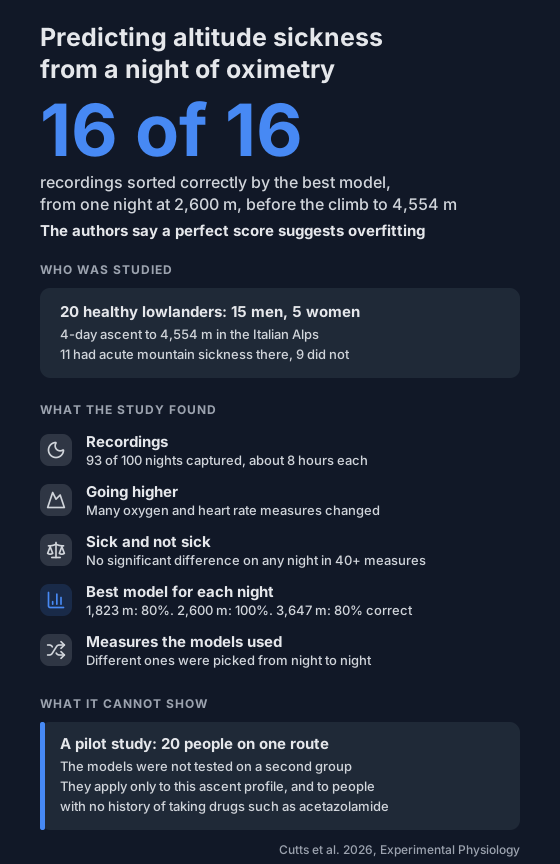
On the same climb, some people get altitude sickness and others don't. A pilot study published in 2026 asked whether a night of oximetry lower down the mountain could tell them apart in advance.
The answer was "maybe", and the authors don't trust their own best result yet.
Who was studied?
- 20 healthy lowlanders, 15 men and 5 women, average age 36.8.
- They went up to 4,554 m in the Italian Alps over 4 days and spent two nights there.
- Each wore a wrist oximeter with a finger sensor every night.
- 93 of 100 recordings worked, about 8 hours each.
- At the top, a doctor's examination found acute mountain sickness in 11.
Did their nights look different?
- The researchers pulled more than 40 measures from each recording, including average SpO2, dips per hour and time spent below set SpO2 levels.
- Many changed as the group went higher.
- None showed a statistically significant difference between the two groups on any single night.
- One, the ratio of heart rate to SpO2, differed between the groups across the ascent as a whole in the paper's results table (P = 0.020), though its abstract reports no effect.
Could a model pick out who got sick?
The researchers then trained machine learning models, one night at a time, on two or three measures each.
- Night at 2,600 m. The best model sorted all 16 usable recordings correctly: 9 people who got sick and 7 who didn't.
- Nights at 1,823 m and 3,647 m. The best models were 80% accurate.
- Which measures? Different nights and different selection methods picked different ones.
What can't it show?
- It's a pilot. 20 people on one route, with no second group to test the models on.
- The perfect score is a warning sign. The authors say it points to overfitting or data leakage. The model may have fitted these 16 recordings and not a real pattern.
- One ascent profile. The authors say the models apply only to this ascent, and to people with no history of taking drugs such as acetazolamide ahead of a climb.
They call for a larger study.
What can you do with this?
Your own recording can't tell you whether you'll get sick. Go by how you feel, not by the number. The paper notes that acute mountain sickness can progress to life-threatening illness.
If you want to log a trip:
- Read what to expect from your blood oxygen at altitude, including when to stop or go down.
- Record a few nights at home first, then put them side by side with the compare nights tool.
Not a medical device. Does not diagnose, treat or prevent any condition. Discuss results and changes with a clinician.
References
- Cutts L, Ashdown K, Simpkins C, Trender W, Clarke S, Delamere J, Lucas SJE, Joyce KE. Prediction of acute mountain sickness occurring at 4554 m using overnight pulse oximetry from lower altitude: A pilot study. Experimental Physiology. 2026. Online ahead of print, no volume yet. doi:10.1113/EP093777