Flying With Lung Disease: Oxygen Formulas
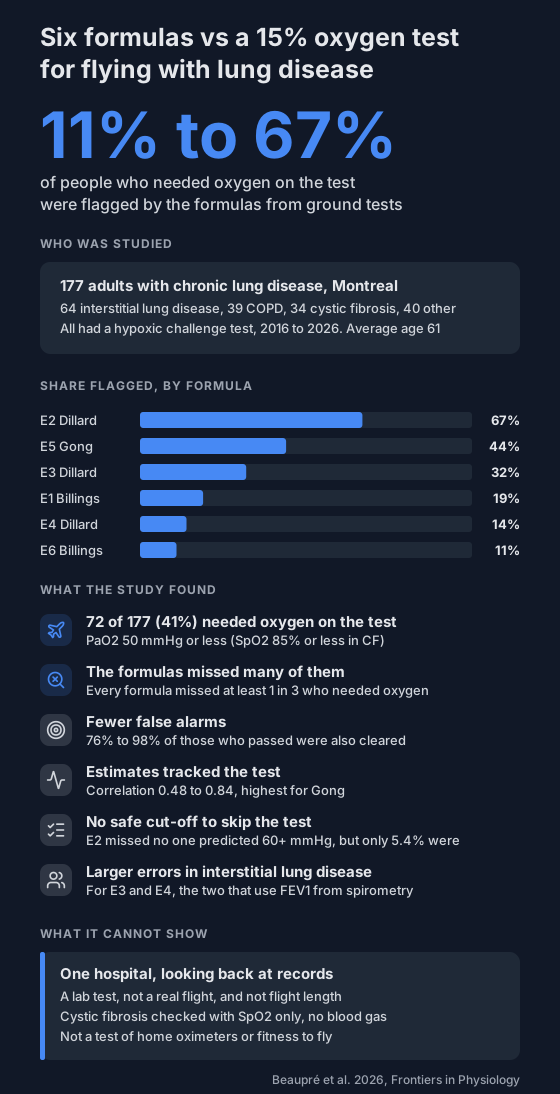
A 2026 study of 177 adults with chronic lung disease tested six formulas that estimate in-flight blood oxygen from ground tests. They flagged only 11% to 67% of the people who needed oxygen on a hypoxic challenge test.
An airliner cabin is pressurised to the equivalent of up to 8,000 feet. Most healthy people read a few points lower there and feel fine, as we covered in blood oxygen on flights. With a lung condition, the drop can be much bigger.
The usual way to check is a hypoxic challenge test: you breathe 15% oxygen, about what a cabin at 8,000 feet gives you, while your oxygen is measured. It takes time and kit, and not every hospital offers it. So doctors have published formulas that estimate in-flight oxygen from ground tests instead.
A 2026 study from Montreal checked six of them against the real test. They missed many of the people who needed oxygen.
Who was studied?
- 177 adults who had a hypoxic challenge test at one Montreal hospital between 2016 and 2026.
- 64 had interstitial lung disease, 39 COPD, 34 cystic fibrosis and 40 other lung conditions.
- Average age was 61. The cystic fibrosis group was younger, at 38.
- Their average resting SpO2 on the ground was 96%.
It was a retrospective study: the researchers went back through the hospital's records.
How did the test work?
- People breathed 15% oxygen through a sealed mask for 20 minutes.
- Then a blood sample from an artery gave their oxygen level (PaO2).
- 50 mmHg or less counted as needing oxygen for the flight.
- The cystic fibrosis group had SpO2 checked instead, with 85% or less as the cut-off.
72 of the 177 (41%) needed oxygen on the test. The interstitial lung disease group had the lowest readings, and the cystic fibrosis group the highest.
What did the formulas use?
Each one takes measurements from the ground, mostly a resting arterial blood gas, sometimes with a breathing test (FEV1).
- Three are from Dillard and colleagues, 1989.
- One is from Gong and colleagues, 1984.
- Two are from Billings and colleagues, 2013. One of them estimates oxygen saturation instead of PaO2, so it was the only one that could be used for cystic fibrosis.
Not everyone had every measurement, so each formula was tested on between 110 and 123 people, except the saturation one.
What did the study find?
The formulas' estimates moved with the real results. The correlation ran from 0.48 to 0.84, and Gong's formula tracked the test most closely.
But being close on average didn't sort people well. Of the people who needed oxygen on the test, the formulas flagged:
- 67% with Dillard's simplest formula (E2), the best of the six.
- 44% with Gong's.
- 32% and 14% with Dillard's other two.
- 19% and 11% with the two Billings formulas.
So every formula missed at least one in three people who needed oxygen, and some missed most of them.
False alarms were less common. Of the people who passed the test, 76% to 98% were also cleared by the formulas.
The authors say a small error matters because the decision rests on one cut-off. Being a few mmHg out can put someone on the wrong side of it.
Could a higher cut-off rule people out?
The researchers tried stricter cut-offs, to see if a formula could at least clear some people safely without the test.
- With Dillard's E2, nobody predicted at 60 mmHg or more failed the test.
- But only 5.4% of people reached that level.
So no higher cut-off reliably cleared a useful share of people.
Did the type of lung disease matter?
- Overall, the formulas did about as well in COPD as in interstitial lung disease.
- The two Dillard formulas that use FEV1 had bigger errors in interstitial lung disease.
- The authors point out those formulas came from small groups of people with COPD.
What can't it show?
- It's one hospital, looking back at records, so it may not reflect everyone.
- Cystic fibrosis was checked with SpO2 only, so most formulas couldn't be tested there.
- The 15% oxygen test matches the highest cabin altitude allowed. Many flights sit lower, so the test may be tougher than a real flight.
- Neither the test nor the formulas account for flight length. The authors say the test measures your response to low oxygen, not overall fitness to fly.
- It didn't look at home pulse oximeters at all.
What does this mean for you?
The authors conclude that the hypoxic challenge test should stay the reference when it's unclear whether someone needs oxygen to fly.
- A home oximeter reading on the ground isn't a fitness-to-fly test. In this study, people averaged 96% SpO2 at rest on the ground, and 41% still needed oxygen on the test.
- If you have a lung or heart condition, or use oxygen at home, talk to your doctor before you book a flight.
- If you record a flight, keep it apart from your usual nights. Sleeping on a flight can push readings lower still.
- If you feel breathless or unwell on board, tell the cabin crew. Don't wait for a number.
For how pressure affects oxygen, see blood oxygen at altitude. To bring your readings to an appointment, here's how to share them.
Not a medical device. Does not diagnose, treat or prevent any condition. Discuss results and changes with a clinician.
References
- Beaupré ME, Huang GS, Dubé BP. External validation of predictive equations for determining the need for in-flight oxygen supplementation in patients with respiratory disease. Frontiers in Physiology. 2026;17:1946975. doi:10.3389/fphys.2026.1946975