Wearable Sensor Fit and Pressure: A Review
A 2026 scoping review of 21 studies found that how hard a wearable optical sensor presses on the skin changes the signal, and in some studies the heart rate and oxygen figures worked out from it.
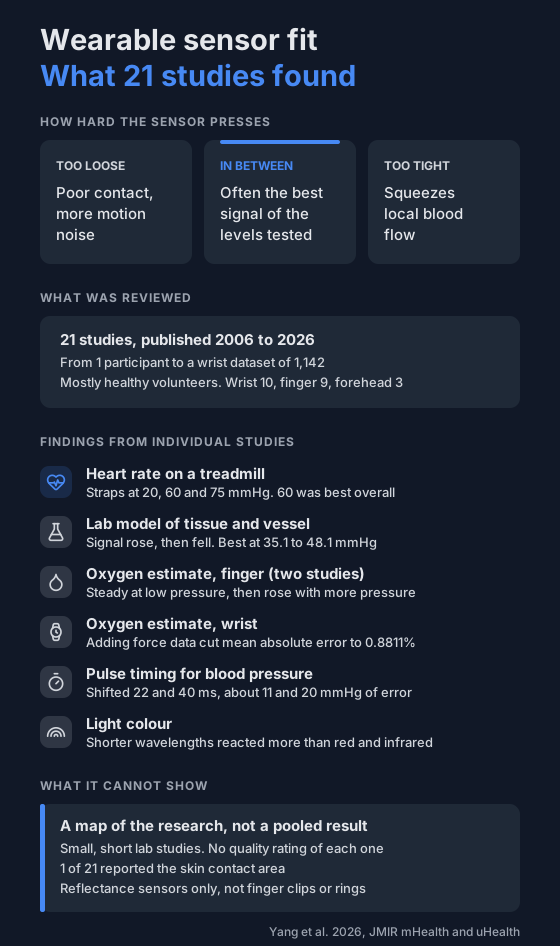
A smartwatch reads your pulse by shining light into your skin and measuring what bounces back. Strap tightness sounds like a comfort setting. A scoping review published in August 2026 collected the studies that tested it.
What did the review cover?
- 21 studies published between 2006 and 2026.
- All used reflectance sensors, the kind in watches and bands.
- 10 used the wrist, 9 the finger and 3 the forehead. Some used more than one site.
- Sample sizes ran from 1 participant to a wrist dataset of 1,142. Most human studies recruited healthy volunteers.
What did it find?
Contact pressure changed the signal and, in fewer studies, the figures worked out from it. A middle level of pressure often gave a better signal than the lowest or highest level tested.
- Heart rate. A treadmill study of 25 volunteers tested wrist straps at 20, 60 and 75 mmHg. 60 mmHg was best overall, though the best pressure varied between people.
- Too loose, too tight. In a step-exercise study of 17 people, very low pressure led to poor contact and motion noise. Very high pressure could cut precision by squeezing local blood flow.
- Oxygen. In two finger studies from one research group, SpO2 estimates stayed fairly stable at low pressure, then began to rise as pressure approached diastolic and mean arterial pressure.
- Blood pressure estimates. In one finger study, pressure shifted two pulse timing measures by 22 and 40 milliseconds, about 11 and 20 mmHg of error.
The review says the best level varies with body site, light wavelength and what's being measured.
What can't it tell you?
- A pressure to aim for. The authors didn't pool the results or rate the quality of each study.
- Everyday wear. Most studies were small, short and run in a lab. The evidence doesn't show whether contact stays the same over several hours.
- Comparable units. Studies reported newtons, mmHg or strap settings. 1 of the 21 reported the skin contact area.
- Skin tone. The studies didn't adequately cover whether skin tone changes the effect of pressure.
- Rings and finger clips. The review covers reflectance sensors only. The authors say its pressure figures shouldn't be carried over directly to devices that shine light through the tissue.
What can you do with this?
- Wear your device the same way each night.
- If a recording has gaps, check the fit first. See O2Ring sizing and why O2Ring data has gaps.
- Wrist or finger? Read smartwatch SpO2 vs a pulse oximeter.
Not a medical device. Does not diagnose, treat or prevent any condition. Discuss results and changes with a clinician.
References
- Yang C, Xie J, He Z, Li J, Liu C. Mechanical Contact Conditions in Wearable Reflectance Photoplethysmography: Scoping Review. JMIR mHealth and uHealth. 2026;14:e99333. doi:10.2196/99333