Shoulder Pulse Oximeter vs Finger: A Pilot
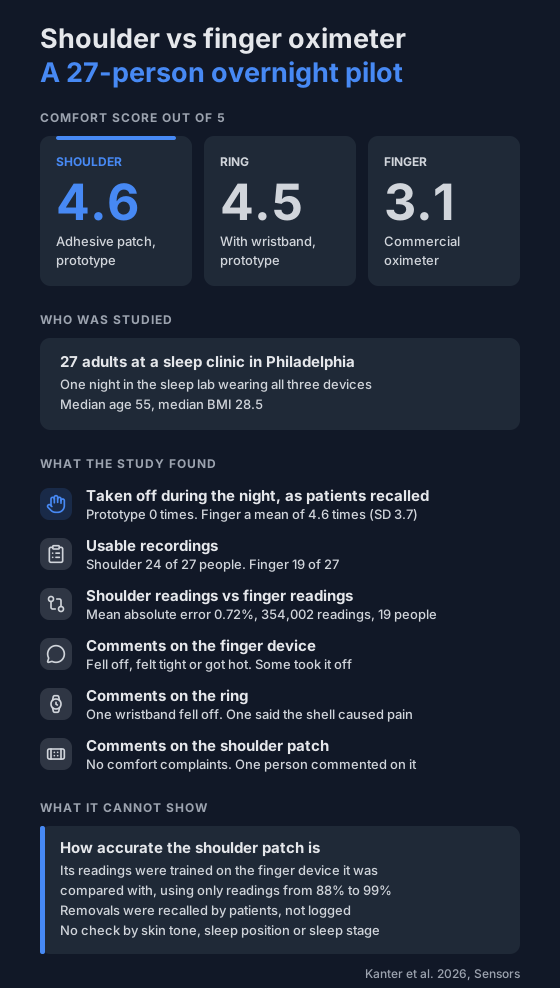
A 2026 pilot had 27 sleep clinic patients wear a prototype shoulder oximeter, a prototype ring and a finger oximeter for one night. The shoulder patch scored 4.6 out of 5 for comfort, the finger device 3.1.
Most overnight oximeters sit on a finger. That's also where they get knocked, squeezed and pulled off in your sleep.
A pilot study published in 2026 tried a different spot: a patch stuck to the shoulder. It was a small test of prototypes, not a product you can buy.
Who was in the study?
- 27 adults at a sleep clinic in Philadelphia, all there for an overnight sleep study because of suspected breathing problems in sleep.
- Their median age was 55 and their median BMI was 28.5.
- Each wore three devices for the night:
- a prototype adhesive patch on the upper arm, over the shoulder muscle
- a prototype ring on the index finger, with a wristband holding the battery and storage
- a commercial finger oximeter, the EMAY EMO-80, as the comparison
The shoulder patch was the main device under test. The ring was included for comparison and for comfort ratings.
Which was more comfortable?
People rated each device from 1 (very uncomfortable) to 5 (very comfortable).
- Shoulder patch: 4.6
- Ring and wristband: 4.5
- Finger oximeter: 3.1
Both prototypes scored higher than the finger oximeter (p < 0.01).
In their written comments:
- Finger oximeter. Many said it fell off, before sleep or during the night. Some took it off on purpose because of irritation, fit or a trip to the toilet. Some said it felt hot.
- Ring. One person's wristband fell off in the night. One said the plastic shell holding the electronics caused pain.
- Shoulder patch. Nobody said it made them less comfortable. Only one person commented on it at all: a side sleeper who said it didn't move much.
Several people said the ring or the finger oximeter disrupted their sleep. Tightness was the most common problem with those two. If that's your problem with a ring oximeter, see O2Ring sizing.
Did the devices stay on?
- The paper says participants removed "the prototype" 0 times. It doesn't name which prototype; the sentence sits with the shoulder patch results, and the patch was the main device under test.
- They removed the finger oximeter a mean of 4.6 times (SD 3.7).
- The shoulder patch gave usable data for 24 of the 27 people. Two files were corrupted and one memory card was unavailable.
- The finger oximeter gave usable data for 19 of 27.
Gaps like these are familiar from home recordings too. See why an O2Ring recording has gaps.
How did the readings compare?
The paper reports a mean absolute error of 0.72% between the shoulder patch and the finger oximeter. That's from 354,002 readings in the 19 people who had data from both.
Read that number with care:
- The shoulder patch turns its light signal into an oxygen figure with a machine-learning model.
- That model was trained on the finger oximeter's readings from this same study.
- So the patch was compared with the device it learned from.
- The model was built using only readings from 88% to 99%.
It doesn't tell you how the patch does during deeper oxygen dips, or against a blood sample. For how accuracy is usually tested, see how accurate pulse oximeters are.
What doesn't it tell you?
The authors list several limits, and the design adds more.
- Size. 27 people, one night each, in a sleep lab.
- Prototypes. Neither the patch nor the ring is a finished product.
- Who ran it. The authors say their group developed a shoulder-mounted device, so this isn't an independent test.
- Funding and conflicts. One author reports consulting fees from Fujifilm/Sonosite, and the others declare no conflicts. The publisher's record lists a US National Institute on Drug Abuse grant, and the paper says the funders had no role in the study.
- The comparison device. The authors call the finger oximeter an imperfect reference whose own accuracy may be limited.
- Removals. They were recalled by the participants. Nobody logged them in real time.
- Why people liked it. Most participants didn't write comments on every device, so the reasons behind the scores are thin.
- Skin tone, sleep position and sleep stage. None were adjusted for. See pulse oximeters and skin tone.
- Signal quality. No formal signal quality measure was applied.
- Scope. The authors say it wasn't designed to measure health outcomes or to apply to sicker patients.
What can you do with this?
Nothing to buy yet. The useful part is the reminder that comfort and staying on decide how much of the night you record.
- If a fingertip clip keeps coming off, compare the other styles you can buy now. See ring vs fingertip vs wrist.
- Fit changes the signal as well as the comfort. See sensor fit and pressure.
- Check a recording for gaps before reading anything into it. The session viewer shows them.
Not a medical device. Does not diagnose, treat or prevent any condition. Discuss results and changes with a clinician.
References
- Kanter KN, Wang A, Gordon D, Singer A, Brenner JS, Gurubhagavatula I, Lingamoorthy A, Oni O, Baston CM. Feasibility and Form Factor Validation of Reflective Shoulder-Mounted Pulse Oximeter in Patients with Suspected Sleep Apnea. Sensors. 2026;26(4):1276. doi:10.3390/s26041276