Breathing Rate From Heart Rhythm: A Pilot
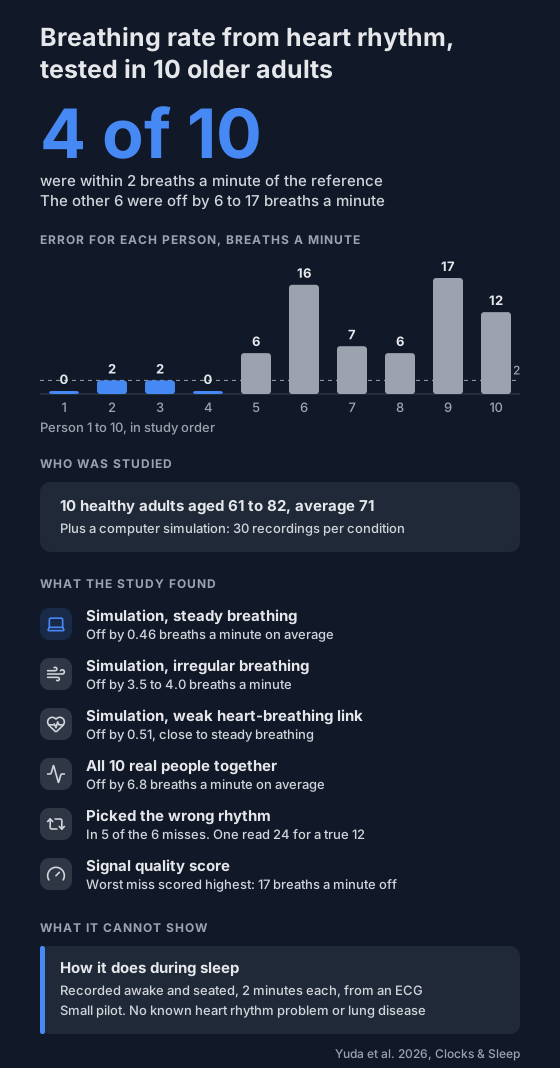
A 2026 pilot study estimated breathing rate from beat-to-beat heart rhythm, the method behind many wearables. It was within 2 breaths a minute in 4 of 10 older adults and off by 6 to 17 in the other 6.
Your heart speeds up a little when you breathe in and slows when you breathe out. Many wearables use that pattern to estimate your breathing rate without measuring breathing at all. The authors name Apple Watch, Polar, Garmin and WHOOP as using this principle.
A pilot study from Japan, published in August 2026, tested how well it works in older adults. It worked well for some people and badly for others.
How does the method work?
- A device times each heartbeat.
- The gaps between beats rise and fall with each breath.
- Software finds the strongest rhythm in the usual breathing range and turns it into breaths per minute.
It only works if the strongest rhythm really is your breathing.
What did the study test?
Two things.
- A computer simulation. Made-up heartbeat series with a known breathing rate, 30 recordings per condition, 3 minutes each.
- 10 real people. Healthy adults aged 61 to 82, average 71, five men and five women. They sat awake while an ECG recorded their heartbeat and a sensor at the nose and mouth measured their breathing. 2 minutes of each recording were analysed.
People with a known heart rhythm problem, active lung disease or medication that dampens heart rate variability were left out.
How close was it in the simulation?
- Steady breathing at rest: off by 0.46 breaths a minute on average.
- Irregular breathing: off by 3.5 to 4.0 breaths a minute.
- A noisy signal with 8% bad beats: off by 1.72.
- A weaker link between heartbeat and breathing, on its own: off by 0.51, close to steady breathing.
So in the simulation, irregular breathing caused most of the error.
And in the 10 real people?
- 4 of 10 were within 2 breaths a minute. Their average error was 1.0.
- The other 6 were off by 6 to 17 breaths a minute.
- Across all 10, the average error was 6.8 breaths a minute.
The authors traced each miss to a cause found by inspecting the heart rhythm afterwards.
- In two people, a slower heart rhythm that wasn't breathing took over.
- In three, it picked a competing rhythm. One person breathed 12 times a minute and it read 24, double the true rate.
- In one, the link between heartbeat and breathing was weak.
The study also tested a signal quality score meant to catch bad estimates. It didn't catch the worst one: the person who was 17 breaths a minute off had the highest quality score of the group. The authors note the score shows how sharp a rhythm is, not whether it comes from breathing.
What can't it tell you?
- How it does during sleep. Everyone was awake and sitting. The authors expect it to work best in non-REM sleep, when breathing is steadier, but say that's untested.
- How a specific watch or ring does. The heartbeats came from a 2-minute ECG, not a light sensor on the wrist or finger.
- How it does in people with health conditions. Everyone was healthy. The authors say conditions like atrial fibrillation and sleep apnea need their own testing.
- Anything firm. 10 people is a small pilot. The authors call for larger studies.
The study was funded by NEDO, a Japanese government agency, and the authors declared no conflicts of interest.
What can you do with this?
- Read a breathing rate from a watch or ring as an estimate from your heartbeat, not a measurement of your breathing.
- Be wary of a single odd value: in this study the method was far off in 6 of 10 people, and a high quality score didn't rule that out.
- Compare like with like: same device, same time of night.
For how other wearable numbers hold up, see how valid smartwatch numbers are and how close wearable HRV is to an ECG.
Not a medical device. Does not diagnose, treat or prevent any condition. Discuss results and changes with a clinician.
References
- Yuda E, Morikawa N, Hayano J. HRV-Based Respiratory-Rate Estimation in Older Adults: Error Modeling and Pilot Validation for Wearable Sleep Monitoring. Clocks & Sleep. 2026;8(3):54. doi:10.3390/clockssleep8030054