Is Fitbit Versa 4 Overnight HRV Accurate?
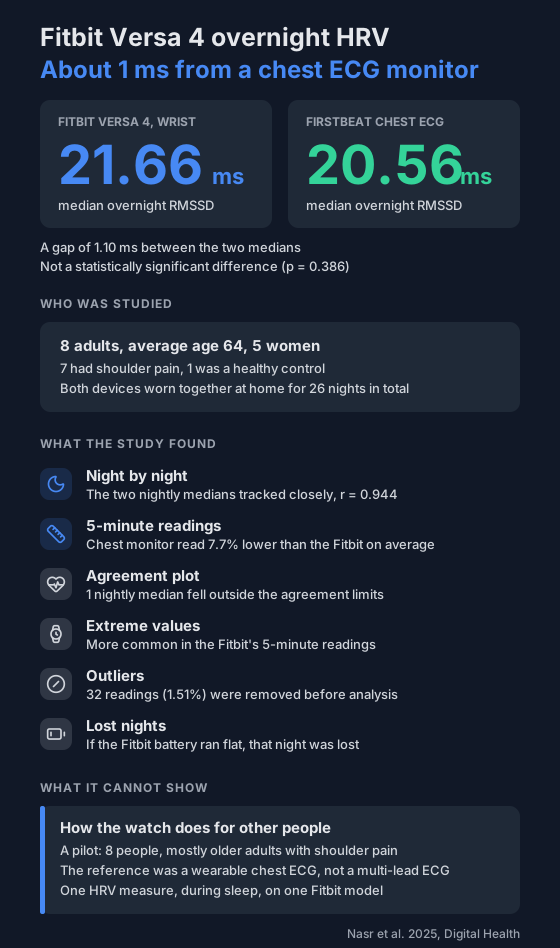
A 2025 pilot study had 8 adults wear a Fitbit Versa 4 and a chest ECG monitor for 26 nights in total. The median overnight HRV was 21.66 ms on the Fitbit and 20.56 ms on the ECG monitor.
A Fitbit gives you one heart rate variability (HRV) number each morning. It comes from a light sensor on your wrist, not from the heart's electrical signal.
A pilot study published in 2025 checked that number against a chest ECG monitor worn on the same nights. The two were about 1 ms apart, in 8 people.
Who was in the study?
- 8 adults, average age 64, 5 of them women.
- 7 had shoulder pain and 1 was a healthy control.
- They were recruited through a larger study of people scheduled for shoulder replacement surgery.
- Each wore a Fitbit Versa 4 and a Firstbeat Bodyguard 3 together, from at least an hour before bed to at least an hour after waking, for at least three nights.
- That gave 26 nights with both devices recording.
The Firstbeat is an ECG recorder that attaches to the chest with electrodes.
What was compared?
RMSSD, the overnight HRV measure the Fitbit shows.
- The Fitbit works out RMSSD for 5-minute blocks during sleep, then reports the median for the night.
- It skips blocks where its own algorithm rejects the heart rate data. How it filters them isn't public.
- The researchers worked out RMSSD from the chest ECG for the same 5-minute blocks.
How close were they?
The median RMSSD on each device:
- Fitbit: 21.66 ms.
- Chest ECG monitor: 20.56 ms.
- That's a gap of 1.10 ms, and the difference wasn't statistically significant (p = 0.386).
- The paper's table puts n = 2178, the number of 5-minute blocks, beside that gap, so it isn't clear whether these medians are of nights or of blocks.
- Night by night, the two medians rose and fell together (r = 0.944 across 26 nights).
- On the agreement plot, 1 nightly median fell outside the limits of agreement.
The authors call that acceptable agreement.
Did the Fitbit read high or low?
Slightly high.
- Across the 5-minute blocks, the chest monitor read 92.3% of the Fitbit's value on average.
- That 7.7% gap was statistically significant (p < 0.0001).
- The authors say a gap that size is unlikely to be clinically meaningful.
- In the discussion they put the Fitbit's average overestimate of the nightly median at 0.76 ms in the participants with shoulder pain.
An earlier study of a different model, the Fitbit Charge 4, found it read lower than a chest strap. That's the opposite direction.
What about single readings?
They were noisier than the nightly figure.
- The Fitbit's 5-minute readings showed more extreme values than the chest monitor's.
- The authors suggest wrist movement and strap tightness as possible explanations.
- They removed 32 readings (1.51%) that sat more than three standard deviations from the average before running the analysis.
See how sensor fit and pressure change a reading.
What can't it tell you?
- Much about other people. It's a pilot with 8 participants, mostly older adults with shoulder pain. Their RMSSD was in the low 20s.
- How it compares with a full ECG. The reference was a wearable chest ECG. The authors say devices like it can also have measurement error outside a lab.
- Anything beyond overnight RMSSD. Daytime HRV, other HRV measures and other Fitbit models weren't tested.
- How many nights went missing. The watches weren't synced until they were posted back. A flat battery lost a whole night of data, and the paper doesn't say how often that happened.
The work was part-funded by a university research grant, and the authors declared no conflicts of interest.
What can you do with this?
The paper gives no advice for wearers. These are our suggestions, not the authors':
- Read the nightly number as a trend over weeks, not one morning's figure.
- Wear the watch the same way each night, snug enough that it doesn't slide.
- Charge it before bed.
- Don't compare your number with someone else's. HRV varies a lot from person to person, and with age, sex and fitness.
For the wider picture, a review of 43 studies looked at how close wearable HRV is to an ECG. If you record with an oximeter too, see what your overnight heart rate pattern shows.
Not a medical device. Does not diagnose, treat or prevent any condition. Discuss results and changes with a clinician.
References
- Nasr A, Behbehani K, Wang J, Pierson C, Jarrett RB, Greer T, Zafereo J. Agreement between Fitbit Versa 4 and a reference standard on time-domain nocturnal heart rate variability: A pilot study. Digital Health. 2025;11:20552076251394960. doi:10.1177/20552076251394960