Long COVID Fatigue, Sleep and HRV
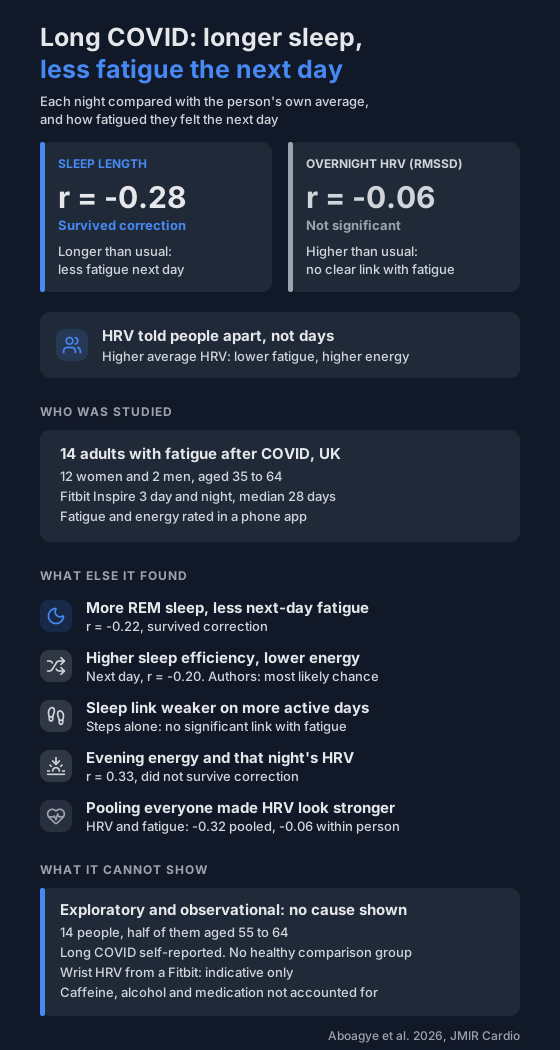
A 2026 study tracked 14 adults with long COVID fatigue on a Fitbit for a median of 28 days. Nights with more sleep than usual were linked to less fatigue the next day, but night-to-night HRV wasn't.
Low heart rate variability (HRV) has been linked to worse long COVID symptoms. So it's tempting to check your overnight HRV each morning to see what kind of day you'll have.
A small study published in 2026 tested that, alongside sleep. In 14 people with long COVID, a longer night than usual went with less fatigue the next day. A higher HRV than usual didn't.
Who was in the study?
- 14 adults in the UK who reported fatigue after COVID, recruited through an earlier Newcastle University study, patient groups and social media.
- 12 women and 2 men, aged 35 to 64. Half were 55 to 64.
- Long COVID was self-reported. A doctor's confirmation wasn't required, and there was no healthy comparison group.
- Each wore a Fitbit Inspire 3 day and night, for a median of 28 days (12 to 73).
- They rated their fatigue (4 levels) and energy (0 to 100 in steps of 25) in a phone app, whenever it suited them.
The Fitbit recorded sleep length, sleep efficiency, deep and REM sleep, steps, and HRV during sleep. RMSSD, the HRV figure many apps show, averaged 34 ms. Average sleep was 470 minutes, just under 8 hours.
Why compare each person with themselves?
Because people differ a lot from each other.
The researchers asked two separate questions:
- Day to day: on a night that's better than your own average, do you feel better the next day?
- Between people: do people with better averages feel better on average?
Mixing the two can make a link look stronger than it is. That's what happened with HRV here.
What did it find?
Comparing each night with the person's own average:
- Sleep length: more sleep than usual went with less fatigue the next day (r = -0.28).
- REM sleep: more REM than usual went with less fatigue too (r = -0.22).
- Sleep efficiency: higher efficiency went with lower next-day energy (r = -0.20). That's the opposite of what you'd expect, and the authors say it's most likely chance.
- HRV: no HRV measure was significantly linked to next-day fatigue or energy. For RMSSD and fatigue, r = -0.06.
Those three sleep results were the only ones of 16 that survived a correction for running many tests. Longer sleep also went with more energy the next day (r = 0.18). That didn't survive the correction, but the authors' main model, which separates days from people, did find it.
So does HRV mean anything here?
Yes, but between people, not between days.
- People whose HRV was higher on average reported lower fatigue and higher energy on average.
- Within the same person, a higher-HRV night wasn't significantly linked to a better next day.
- When all the readings were pooled without separating people, HRV looked linked to fatigue (-0.32). Within each person, that shrank to -0.06.
The authors suggest HRV may be more useful as a baseline for a person than as a daily forecast.
What about activity?
- Steps on their own weren't significantly linked to fatigue.
- But the link between longer sleep and less fatigue was weaker on more active days.
- The authors say that fits post-exertional malaise, where symptoms get worse after effort.
- Steps were counted up to the time of each symptom report, so the authors say this might partly reflect how long people had been awake.
Does how you feel in the evening affect that night?
Maybe, but it's not settled.
- Higher energy in the evening went with higher HRV that night (r = 0.33).
- Each 25-point rise in evening energy went with about 19% higher overnight RMSSD.
- That link didn't survive the correction for multiple tests, so the authors call it preliminary.
- Evening fatigue wasn't significantly linked to that night's sleep or HRV.
What can't it tell you?
- Cause. It's an exploratory, observational study. It shows what went together, not what caused what.
- Much about other people. 14 people, mostly women, and half aged 55 to 64. The authors note menopause can affect sleep, HRV and fatigue on its own.
- Whether it's specific to long COVID. There was no healthy comparison group.
- How accurate the HRV was. No published study has checked the Fitbit Inspire 3's HRV frequency measures against an ECG, so the authors call the HRV figures indicative only.
- Other influences. Caffeine, alcohol, medication and unrecognised sleep apnea weren't accounted for.
- Fine detail in fatigue. 65% of fatigue ratings sat at the same middle level, which makes day-to-day changes harder to pick up.
- Disturbed nights. Nights with less than half the HRV data were left out, which may have dropped restless ones.
The work was funded by the UK's National Institute for Health and Care Research. One author holds shares in a health company the paper says is unrelated to this work.
What can you do with this?
The authors say experimental studies are needed before anything is concluded. These are our suggestions, not theirs:
- Compare a night with your own average, not with someone else's.
- Don't read one morning's HRV as a forecast of your day. Look at the trend over weeks.
- If you log how you feel, log sleep length next to it and see whether they move together for you.
- Take what you notice to your doctor.
If you also record overnight oxygen, a separate study looked at overnight oxygen with long COVID. For how close wrist HRV gets to an ECG, see wearable HRV vs ECG accuracy and the Fitbit Versa 4 overnight HRV test.
Not a medical device. Does not diagnose, treat or prevent any condition. Discuss results and changes with a clinician.
References
- Aboagye NY, Baker MR, Baker K, Del Din S. Bidirectional Associations Between Autonomic Function, Sleep Quality, and Daily Fatigue and Energy Symptoms in Long COVID: Longitudinal Digital Health Study. JMIR Cardio. 2026;10:e99630. doi:10.2196/99630