Is Overnight Oxygen Lower With Long COVID?
A small 2025 study found overnight SpO2 about 1 point lower in 25 adults with long COVID than in 25 matched healthy adults, but the gap was no longer statistically significant once the authors accounted for skin tone.
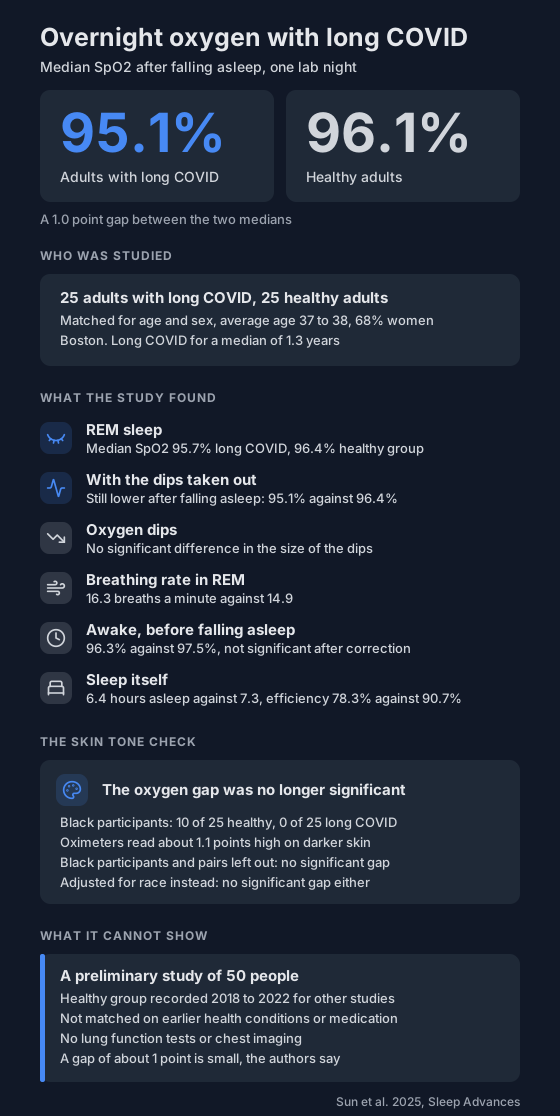
Low oxygen during exercise tests has been reported in people with long COVID. A 2025 study from Boston asked whether their oxygen is also lower during sleep.
It found a gap of about 1 point. It's a small preliminary study, and the gap was no longer statistically significant in the authors' own skin tone check.
Who was studied?
- 25 adults with long COVID on their medical record, a median of 1.3 years after it began.
- 25 healthy adults, each matched to one of them by sex and by age within 5 years.
- Average age 37 to 38, and 68% were women.
- Everyone spent one night in a sleep lab with a fingertip oximeter recording SpO2 once a second.
New to the number? See what SpO2 is.
What did it find?
Each person's average SpO2 was worked out, then the middle value (median) of each group was compared. Long COVID against the healthy group:
- After falling asleep: 95.1% against 96.1%.
- In REM sleep: 95.7% against 96.4%.
- Awake in bed, before falling asleep: 96.3% against 97.5%. This one didn't pass the study's stricter cut-off for testing nine things at once.
The authors also took the oxygen dips out of each recording and compared what was left. The gap was still there: 95.1% against 96.4% after falling asleep.
There was no statistically significant difference in the dips themselves. Both groups averaged 1.9 breathing events per hour, and nobody had more than 10.
So the study describes a slightly lower level during sleep, not more or deeper dips. The gap showed up 5 to 10 minutes after falling asleep.
Two other differences in the long COVID group:
- Breathing in REM sleep was faster, 16.3 breaths a minute against 14.9.
- Sleep was shorter and less efficient: 6.4 hours against 7.3, and sleep efficiency of 78.3% against 90.7%.
A daytime spot check was lower too, 98.0% against 99.2% on average.
Why did skin tone matter?
Pulse oximeters tend to read higher on darker skin. The authors used a figure of about 1.1 points, which is about the size of the gap they found.
The two groups weren't balanced on this:
- 10 of the 25 healthy adults were Black.
- None of the 25 adults with long COVID were.
The study didn't measure skin tone, so the authors used race as a stand-in and ran the numbers two more ways.
- Leaving out the Black participants and their matched pairs. That left 15 people per group, and none of the SpO2 differences were statistically significant.
- Keeping everyone and adjusting for race. Again, none of the SpO2 differences were statistically significant.
The faster breathing rate in the long COVID group did hold up in both checks.
The authors still conclude that the results suggest lower overnight oxygen with long COVID, and say it needs a larger study in a more diverse group.
For more on this bias, see pulse oximeters and skin tone.
What can't it show?
A lot, and the authors call it a pilot study.
- It's small. 50 people, one night each. The check with 15 per group had even less power to find a real gap.
- The healthy group came from older studies. They were recorded between 2018 and 2022 for other research, with strict rules: no health conditions, no medication, no smoking. The long COVID group had far fewer rules, so the groups differed in more than long COVID.
- Earlier health wasn't matched. Depression or anxiety, and pain or inflammation, were more common in the long COVID group before their infection.
- Volunteers may not be typical. People with more symptoms may have been more likely to sign up.
- No lung tests. The study has no lung function tests or chest imaging, so it can't say why oxygen would be lower.
- The gap is small. The authors say a difference of about 1% needs comparing against typical values for a given age, and they call for a larger study to set those.
It also compared two groups on one night, so it can't show that long COVID caused anything.
What can you do with it?
Not much yet.
- A 1 point gap between two groups is inside the error of a single oximeter. See how accurate pulse oximeters are.
- Don't compare your own nightly average against the medians in this study. Compare your nights with each other on the same device.
- The authors point out that overnight oxygen is easy to track at home and say larger studies could use home devices.
- If you have long COVID and your recordings worry you, here's how to share them with your doctor.
A much larger study looked at a different question: is sleep apnea more common after COVID?
Not a medical device. Does not diagnose, treat or prevent any condition. Discuss results and changes with a clinician.
References
- Sun H, Dang R, Haack M, Hauser K, Scott-Sutherland J, Westover MB, Parthasarathy S, Redline S, Thomas RJ, Mullington JM. Facility-measured nocturnal hypoxemia and sleep among adults with long COVID versus age- and sex-matched healthy adults: a preliminary observational study. Sleep Advances. 2025;6(2):zpaf017. doi:10.1093/sleepadvances/zpaf017