Is Sleep Apnea More Common After COVID?
A 2026 study of 910,393 patients in the Bronx found a new sleep apnea record was 1.33 to 1.41 times as likely after COVID-19 as in people with no positive test.
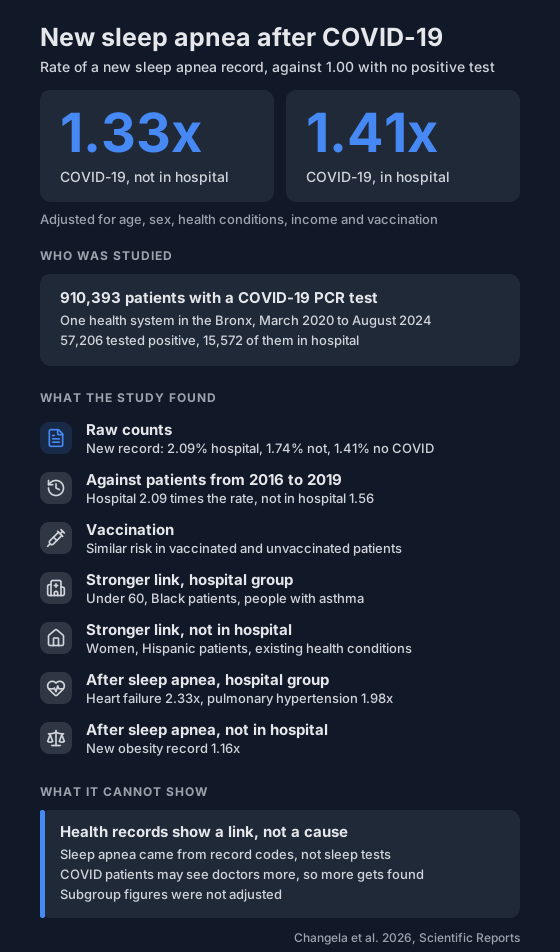
Earlier research mostly asked whether having sleep apnea makes COVID-19 worse. A study published in June 2026 asked the reverse: are people more likely to get a new sleep apnea record after COVID-19?
In this study, yes. A new record was 1.33 to 1.41 times as likely after a positive test as in patients who never tested positive.
Who was in the study?
- 910,393 patients of the Montefiore Health System in the Bronx, New York.
- All had a COVID-19 PCR test between March 2020 and August 2024.
- None had sleep apnea on their record before, and all came back to the health system at least 30 days later.
- 15,572 tested positive and were in hospital for COVID-19.
- 41,634 tested positive and were not in hospital.
- 853,187 never tested positive.
The researchers followed each patient's record for up to 4.5 years. They looked for a new obstructive sleep apnea code.
What did it find?
The raw counts of new sleep apnea records:
- COVID-19, in hospital: 327 of 15,572 (2.09%)
- COVID-19, not in hospital: 726 of 41,634 (1.74%)
- No positive test: 12,046 of 853,187 (1.41%)
The three groups were very different to begin with. The hospital group had an average age of 64, against 40 and 42 in the other two, and had more of every long-term condition the study recorded.
So the researchers weighted the groups to balance age, sex, race, ethnicity, income, insurance, vaccination and existing conditions. After that, compared with no positive test:
- In hospital with COVID-19: 1.41 times the rate of a new sleep apnea record (95% confidence interval 1.14 to 1.73).
- COVID-19 without a hospital stay: 1.33 times (1.22 to 1.46).
Could the comparison group have had COVID too?
Yes. Home tests and tests done elsewhere weren't in the records, so some "no positive test" patients will have had COVID-19.
To check, the researchers ran the comparison again against patients from 2016 to 2019, before the pandemic. The abstract gives that group as 621,046 patients.
- In hospital with COVID-19: 2.09 times the rate (1.73 to 2.55).
- Not in hospital: 1.56 times (1.42 to 1.71).
That comparison only ran to 44 months, because that's as far as the older records were followed.
Did it differ between groups of people?
The link was stronger in some groups.
- Hospital group: people under 60, Black patients compared with White patients, and people with asthma.
- Not in hospital: women compared with men, Hispanic patients compared with non-Hispanic patients, and people with existing health conditions.
These subgroup figures weren't adjusted for other factors, so read them as rough.
The authors point out that sleep apnea is often missed in women and in Black patients. They suggest a COVID-19 illness may have been what led to a check. For how sleep apnea differs between men and women, see sleep apnea by age and sex.
Did the vaccine make a difference?
Not in this study. Vaccinated and unvaccinated patients had a similar risk of a new sleep apnea record after COVID-19. "Vaccinated" here meant at least one dose, before or during follow-up.
What happened after sleep apnea was recorded?
The study also looked at new health problems in the patients who got a sleep apnea record. Compared with those who never tested positive, and adjusted for age, sex, race and ethnicity:
- Hospital group: 2.33 times the risk of heart failure (1.46 to 3.73) and 1.98 times the risk of pulmonary hypertension (1.16 to 3.39).
- Not in hospital: 1.16 times the risk of a new obesity record (1.03 to 1.32).
High blood pressure, heart attack, stroke, heart rhythm problems and type 2 diabetes showed no statistically significant difference. The numbers were small: the heart failure result rests on 16 patients in the hospital group.
What can't it show?
- Cause. This is a look back at health records. It shows a link, not that COVID-19 causes sleep apnea.
- No sleep tests. Sleep apnea was taken from record codes. Sleep study results weren't used, so there's no measure of how many breathing events per hour anyone had.
- More doctor visits. People who've had COVID-19 may see doctors more often, which gives more chances for sleep apnea to be found. The authors raise this themselves, and the study didn't adjust for it.
- Uneven groups. After weighting, the hospital group still had more obesity than the comparison group (17.5% against 11.5%), a gap the paper counted as within its limit. Obesity is a known risk factor for sleep apnea. More on that in obesity and sleep apnea.
- One place. All patients came from one health system in the Bronx, and only those who came back were counted.
- No detail on the illness. COVID-19 therapies and virus variants weren't studied.
The authors suggest possible reasons for a real effect, including lasting inflammation, effects on the nerves that control breathing, and weight gain during recovery. The study didn't test any of them.
What does this mean for you?
The authors suggest doctors consider checking for sleep apnea in people who have ongoing tiredness, poor sleep, trouble thinking or heart and lung symptoms after COVID-19. They add that it shouldn't be ruled out just because someone isn't obese.
If that sounds like you:
- Tell your doctor about the symptoms and when they started.
- Know the common signs. See snoring vs sleep apnea and sleep apnea without sleepiness.
- Try the sleep apnea risk check and take the result with you.
- If you already record your overnight oxygen, here's how to share it with your doctor.
Home oximetry isn't a sleep study. Only a sleep study ordered by a clinician can tell you whether you have sleep apnea.
Not a medical device. Does not diagnose, treat or prevent any condition. Discuss results and changes with a clinician.
References
- Changela S, Katz R, Shah J, Henry SS, Duong TQ. Risk of new-onset obstructive sleep apnea up to 4.5 years after COVID-19 in the urban population. Scientific Reports. 2026;16(1):28670. doi:10.1038/s41598-026-56469-7