TyG Index and Lowest Overnight SpO2
In 101 hospital patients in China, a blood test index linked to insulin resistance was higher in people whose lowest overnight SpO2 fell below 80%. Once breathing events per hour were taken into account, the link was no longer statistically significant.
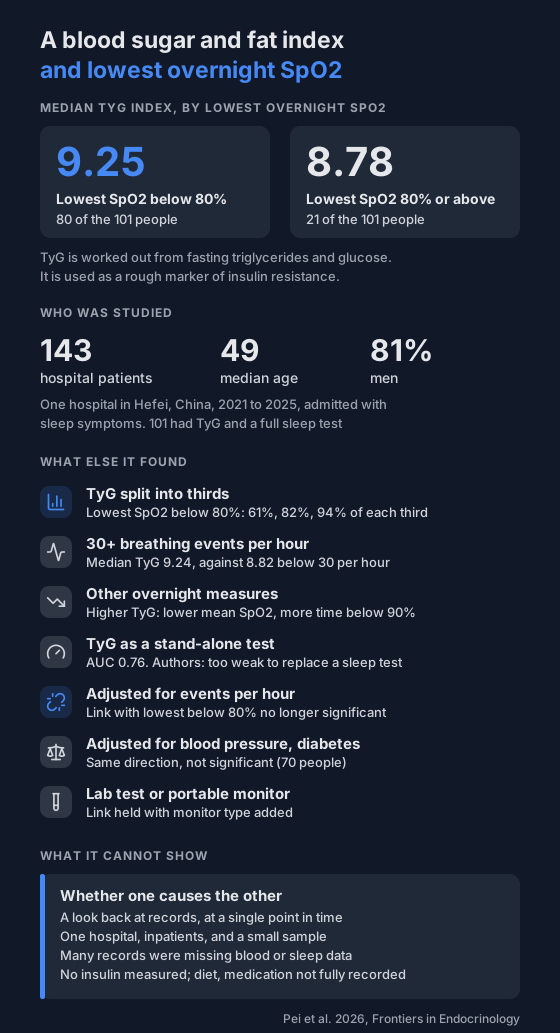
The triglyceride-glucose index, or TyG, is a number worked out from two routine fasting blood tests: triglycerides and glucose. It's used as a cheap, rough marker of insulin resistance.
Earlier studies linked a higher TyG with sleep apnea and with more breathing events per hour. A study published in July 2026 asked a narrower question: does TyG go with how low overnight oxygen falls?
It did. But once the authors accounted for how many breathing events people had, the link with the lowest SpO2 was no longer statistically significant.
Who was in the study?
- 143 adults admitted to one hospital in Hefei, China, between 2021 and 2025.
- They were in hospital for sleep symptoms like habitual snoring, pauses in breathing, gasping or daytime sleepiness.
- Median age 49, 81% men, median BMI 29.4.
- 121 had a valid sleep test in hospital, either a full lab sleep study (89) or a portable monitor (32).
- 101 had a TyG result plus a complete sleep test, so most results come from those 101.
Most of the 121 tested had a lot of breathing events. The median was 54 breathing events per hour, and the median lowest SpO2 was 69%. In the 101, 80 people had a lowest SpO2 below 80%.
What did it find?
Lowest SpO2. Median TyG was 9.25 in people whose lowest SpO2 fell below 80%, against 8.78 in those who stayed at 80% or above.
Breathing events. Median TyG was 9.24 in people with 30 or more events per hour, against 8.82 below 30.
TyG in thirds. The authors split the 101 into thirds by TyG. From the lowest third to the highest:
- Lowest SpO2 below 80%: 60.6%, 82.4%, 94.1%.
- 30 or more events per hour: 57.6%, 79.4%, 82.4%.
Other measures. Higher TyG went with lower mean SpO2, lower lowest SpO2, more events per hour and more of the night below 90% (T90). All of these were modest correlations, between 0.33 and 0.40 in either direction. TyG had no significant link with the longest breathing pause.
Did the link hold up?
Partly.
- Age, sex and BMI. The link with lowest SpO2 below 80% held after adjusting for these.
- Type of monitor. It also held with lab study or portable monitor added.
- Blood pressure and diabetes. With these added, it pointed the same way but was no longer statistically significant. Many records lacked this information, so that model had 70 people.
- Breathing events per hour. With event count added, the link with lowest SpO2 below 80% was no longer statistically significant. The link with time below 90% was borderline (p = 0.054).
The authors say this means the TyG link with low oxygen may partly reflect how many breathing events a person has overall. They can't tell whether TyG has no link of its own, or whether event count sits on the path between the two.
Could TyG stand in for a sleep test?
No, and the authors say so.
- As a stand-alone test for lowest SpO2 below 80%, TyG scored an AUC of 0.76. An AUC of 0.5 is a coin toss and 1 is perfect.
- At the best cut-off (9.095), it picked out 65% of people below 80% and correctly cleared 86% of those above.
- The authors say that is not good enough to replace a sleep study.
What doesn't it tell you?
The authors list these limits:
- Cause. A look back at records can't show whether blood sugar and fats affect overnight oxygen, or the other way round. They think it likely runs both ways, with shared factors like weight.
- Who it applies to. One hospital, inpatients, and possibly more unwell than people tested as outpatients.
- Small and patchy. Only 101 of 143 had all the data. Those included had a lower lowest SpO2 than those left out.
- Lowest SpO2 is one reading. It's an extreme value, so a single bad patch of signal can move it, though the recordings were checked by hand.
- Missing factors. No insulin measurement, and medication, diet and activity were not fully recorded.
One more point from the paper's own table, which the authors don't discuss: people whose lowest SpO2 fell below 80% were younger, with a median age of 48 against 58.
What can you do with this?
TyG comes from a blood test, so an oximeter can't tell you anything about it. Your oximeter does record your lowest SpO2, your time below 90% and how often your oxygen dips. What is SpO2 and the oxygen desaturation index explain those numbers.
The lowest SpO2 on one night can be thrown by a single poor reading. Looking at it over several nights gives a steadier picture.
For another study on overnight oxygen and blood fats, read time below 90% and triglyceride particles.
If your lowest SpO2 often falls well below 90%, share your recordings with your doctor.
Not a medical device. Does not diagnose, treat or prevent any condition. Discuss results and changes with a clinician.
References
- Pei C, Hao L, Zhang J, Xu K, Yu Y, Hu L. Triglyceride-glucose index and nocturnal oxygenation impairment in patients with obstructive sleep apnea. Frontiers in Endocrinology. 2026;17:1899452. doi:10.3389/fendo.2026.1899452