Time Below 90% and Triglyceride Particles
In 2,397 Brazilian adults, people who spent 0.6% or more of the night below 90% SpO2 had more large triglyceride-rich particles in their blood, after adjusting for waist size and other factors. The link levelled off at about 3% of the night. It was a cross-sectional study.
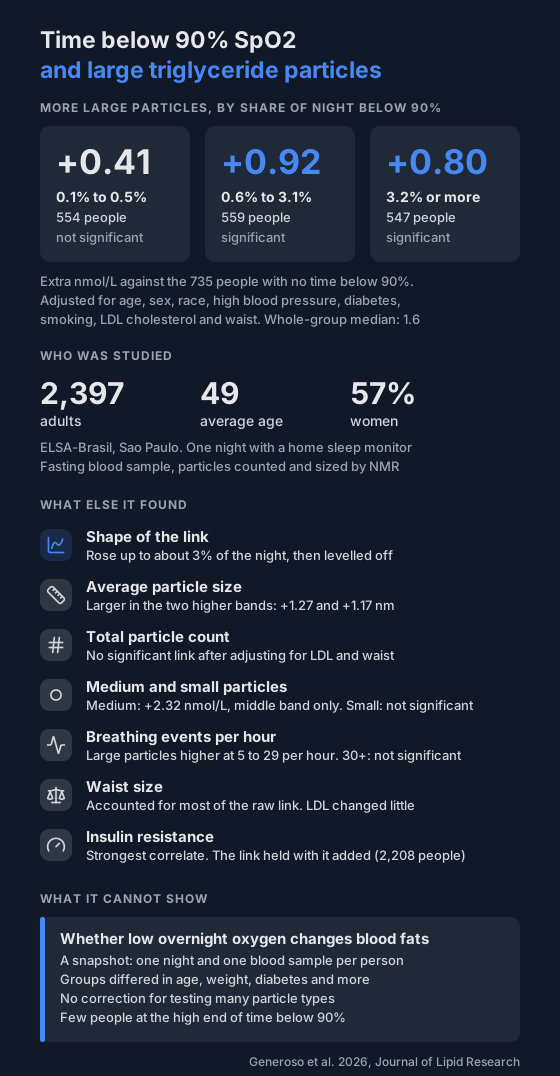
A standard blood test gives you one triglyceride number. Triglycerides travel in particles of different sizes, and a lab method called NMR can count each size.
A study published in 2026 did that for 2,397 adults who also wore a home sleep monitor for a night. People with more of the night below 90% SpO2 had more of the largest particles. The link showed up at small amounts of time below 90% and levelled off at about 3% of the night.
Who was in the study?
- 2,397 adults from the São Paulo centre of ELSA-Brasil, a long-running health study of 15,105 Brazilian civil servants.
- Their average age was 49, and 57% were women.
- 27% had high blood pressure and 16% had diabetes.
- It was a cross-sectional study: one night of recording and one blood sample per person.
What was measured?
- One night at home on a portable monitor that records airflow, chest movement and SpO2.
- Breathing events per hour, scored by hand. The median was 9.9, and 33.5% of the group had 15 or more.
- The share of the night below 90% SpO2, also called T90.
- A fasting blood sample, analysed by NMR. It counts triglyceride-rich particles in three sizes (large and very large, medium, small and very small) and gives their average size.
The authors split people into four bands by share of the night below 90%:
- None: 735 people
- 0.1% to 0.5%: 554 people
- 0.6% to 3.1%: 559 people
- 3.2% or more: 547 people. The median in this band was 8.8%.
Those counts are as printed in the paper's Table 2. They add up to 2,395, two short of the 2,397 analysed.
What went with more time below 90%?
Before any adjustment, every triglyceride measure was higher in every band than in people with no time below 90%.
The authors then adjusted for age, sex, race, high blood pressure, diabetes, smoking, LDL cholesterol and waist size. After that, the total particle count and the small particles were no longer significantly linked with time below 90%. The large particles and the average particle size were.
Large and very large particles, against people with no time below 90%:
- 0.1% to 0.5% of the night: 0.41 nmol/L more, not statistically significant (95% CI -0.25 to 1.06).
- 0.6% to 3.1%: 0.92 nmol/L more (95% CI 0.23 to 1.60).
- 3.2% or more: 0.80 nmol/L more (95% CI 0.07 to 1.54).
For scale, the median in the whole group was 1.6 nmol/L, and half the group fell between 0.2 and 6.3.
Average particle size was 1.27 nm larger in the 0.6% to 3.1% band and 1.17 nm larger in the 3.2% or more band. Medium particles were higher in the 0.6% to 3.1% band only, by 2.32 nmol/L.
Did more time below 90% mean more particles?
Not in a straight line. The authors fitted a curve to the data. Large particles and average particle size rose steeply between 0% and about 3% of the night below 90%. Past that the curve flattened. For large particles it was level beyond 10%.
The authors say the flat part may partly reflect how few people were at the high end.
What about breathing events per hour?
The same large particles were compared across bands of breathing events per hour, against people with fewer than 5:
- 5 to 14.9 per hour: 0.74 nmol/L more (95% CI 0.14 to 1.35).
- 15 to 29.9 per hour: 0.82 nmol/L more (95% CI 0.07 to 1.58).
- 30 or more per hour: 0.68 nmol/L more, not statistically significant (95% CI -0.18 to 1.54).
When the group was split in two at 15 events per hour, there was no significant link in any model. No other particle size was linked with breathing events per hour after full adjustment.
How much of it was waist size?
Most of it. Before adjustment, people in the 3.2% or more band had 3.13 nmol/L more large particles than people with no time below 90%. After full adjustment that was 0.80.
- Adding waist size on its own accounted for nearly all of that drop. Adding LDL cholesterol on its own changed little.
- In the 2,208 people not on diabetes medication, the authors added a measure of insulin resistance. It was the strongest correlate of the large particles, and the link with time below 90% remained.
- The pattern was similar in people not taking cholesterol-lowering medicine, in people not taking beta-blockers or thiazide diuretics, and in men and women separately.
What doesn't it tell you?
The authors list these limits:
- Cause. A cross-sectional study can't show that low overnight oxygen changes blood fats.
- Different groups. People with 15 or more breathing events per hour were older, more often men, heavier and more often had diabetes and high blood pressure. Adjusting may not remove all of that.
- Many comparisons. There was no correction for testing several particle sizes and several ways of banding time below 90%. The authors call the findings hypothesis-strengthening, not definitive.
- The high end. Few people had a large share of the night below 90%.
- One centre. Sleep recordings came from São Paulo only.
These points are ours, not the authors':
- Heart outcomes. The study measured particles in a blood sample, not heart attacks or strokes.
- CPAP. Nobody's particles were measured before and after CPAP, so it says nothing about what CPAP does to them.
- Interests. The paper lists public funding from Brazilian government agencies. Its conflict of interest statement says one author is a consultant and speaker for ResMed, and another consults for several drug companies. ResMed makes CPAP machines.
What can you do with this?
Time below 90% is one of the figures an overnight oximeter records. What is T90 explains how it's counted.
An oximeter can't tell you anything about your blood fats. That takes a blood test, and particle sizes aren't part of a standard one.
If your time below 90% is often above zero, share your recordings with your doctor.
For a different study on this measure and blood fats, read time below 90%, cholesterol and CPAP.
Not a medical device. Does not diagnose, treat or prevent any condition. Discuss results and changes with a clinician.
References
- Generoso G, Cesena FY, Bensenor IM, Giatti S, Parise BK, Santos RB, Santos RD, Bittencourt MS, Lotufo PA, Drager LF. Impact of sleep apnea severity and nocturnal hypoxemia on the triglyceride-rich lipoproteins particles: the ELSA-Brasil study. Journal of Lipid Research. 2026;67(8):101104. doi:10.1016/j.jlr.2026.101104