The Menstrual Cycle in Wearable Data: A Study
A 2026 study of 42,759 menstrual cycles in 2,596 WHOOP users mapped how resting heart rate, HRV, breathing rate, skin temperature and blood oxygen moved across the cycle. Three of its eight authors worked for WHOOP.
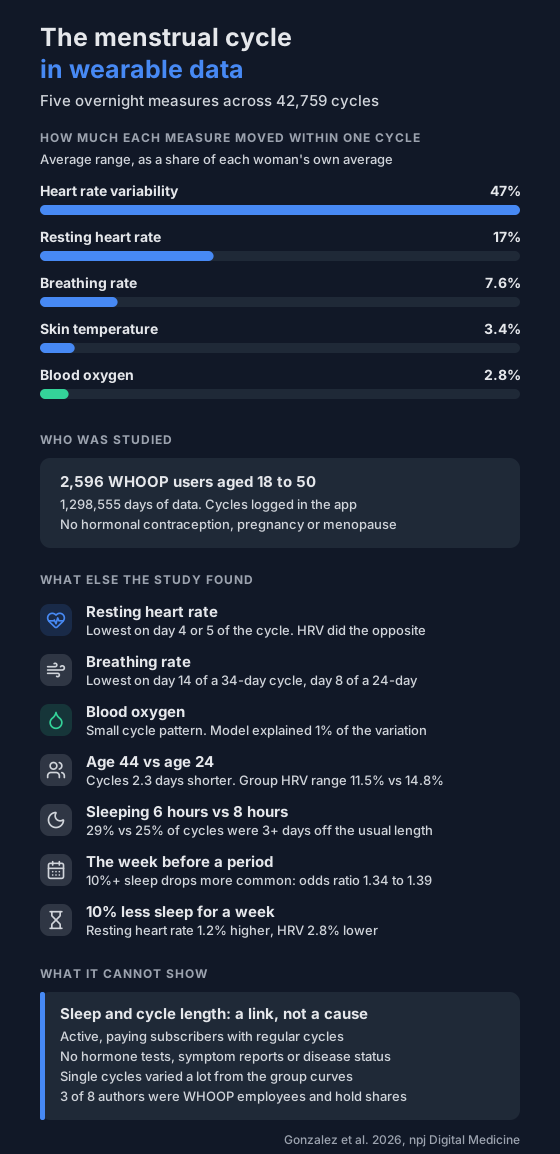
It's well known that body temperature rises in the second half of the menstrual cycle. Less is known about what the other numbers on a wearable do, day by day.
A study published in May 2026 mapped five overnight measures across 42,759 cycles. The data came from WHOOP, and three of the eight authors were WHOOP employees who hold shares in the company.
Who was studied?
- 2,596 WHOOP users aged 18 to 50, average age 33.7.
- 42,759 menstrual cycles and 1,298,555 days of data. The paper's abstract and discussion give this as 1.2 million.
- They logged their periods in the WHOOP app and wore the strap on more than 75% of nights.
- None reported hormonal contraception, pregnancy or menopause symptoms.
- Only women with a median cycle of 21 to 35 days and at least five logged cycles were included. After all the filters, 2,596 of 12,010 were left.
The strap recorded sleep time and five overnight measures:
- Resting heart rate.
- Heart rate variability (HRV).
- Breathing rate.
- Skin temperature.
- Blood oxygen, as the median of the night's readings.
15% of the data came from an older strap that didn't record skin temperature or blood oxygen.
How did the measures move across the cycle?
Day 0 is the first day of a period.
- Resting heart rate was lowest on day 4 or 5 and highest just before the next period.
- HRV did the opposite: highest on day 4 or 5.
- Breathing rate and skin temperature hit their low point later, and the timing depended on cycle length. Breathing rate was lowest on day 8 of a 24-day cycle and day 14 of a 34-day cycle.
How far did each measure move within one cycle? This is the gap between the highest and lowest value in a single cycle, averaged over all cycles and given as a share of each woman's own average:
- HRV: 47%.
- Resting heart rate: 17%.
- Breathing rate: 7.6%.
- Skin temperature: 3.4%.
- Blood oxygen: 2.8%.
The group curves were much flatter than that. For HRV the group range was 11% to 15% of the average, depending on age and cycle length. The authors say single cycles varied a lot from the group pattern.
What about blood oxygen?
It moved the least of the five.
- The authors saw "some cyclicality", but their model explained 1% of the variation in blood oxygen. For resting heart rate it explained 33%.
- The size of the blood oxygen swing barely changed with age or cycle length.
So this study doesn't give you a cycle pattern to expect in your overnight oxygen. For what does shift typical readings, see oxygen saturation by age and sex.
Did age or cycle length matter?
- Age. Cycles averaged 29.1 days at age 24 and 26.9 days at age 44. The group HRV range across a cycle shrank from 14.8% to 11.5% over the same ages.
- Cycle length. Longer cycles had bigger swings in every measure except blood oxygen. The group HRV range was 11.1% in a 24-day cycle and 14.3% in a 34-day cycle.
- Regularity. 27% of all cycles were three or more days off the woman's own median length. That share was lowest around age 33, at about 1 in 4.
What did shorter sleep go with?
More uneven cycle lengths.
- In cycles averaging 6 hours of sleep a night, the authors' model put 29% at three or more days off the woman's own median length. At 8 hours it was 25%. That's an odds ratio of 1.3.
- Average cycle length barely changed: 0.4 days shorter at 6 hours than at 8.
- Uneven sleep showed the same pattern. Sleep length with a standard deviation of 120 minutes within a cycle, against 30 minutes, went with 1.2 times the odds of an off-length cycle.
The authors checked this within the same women. In 308 women who had both short-sleep and long-sleep cycles, the odds ratio was 1.2 and not statistically significant. In 813 women who had both even-sleep and uneven-sleep cycles, it was 1.3 and significant.
A higher resting heart rate.
The authors looked at weeks where sleep changed after three steady weeks of 7 to 8 hours.
- 10% less sleep for a week, about 42 minutes a night, went with a resting heart rate 1.2% higher. At 60 beats a minute that's about 0.7 beats.
- HRV was 2.8% lower.
- Breathing rate and skin temperature went up.
- It made no statistically significant difference which week of the cycle the sleep loss fell in.
On blood oxygen the paper disagrees with itself. The results section says it went down with less sleep. The discussion lists it among the measures that went up. The main paper gives no number for it.
A smartwatch study compared short and longer sleepers on the same measures: see short sleep, heart rate and oxygen.
Is sleep shorter before a period?
Slightly, and not for everyone.
- Sleep was 1.1% shorter on average in the week before a period, against 0.4% in the period week and 0.3% in the week after.
- A drop of 10% or more happened in 503 of 16,441 premenstrual weeks.
- The odds of a drop that size were 1.39 times those in the period week and 1.34 times those in the week after.
- 176 women slept more in at least one premenstrual week.
What can't it tell you?
- Cause. The authors say the link between sleep and cycle length is an association. Short sleep could change hormones, or hormone changes could shorten sleep.
- Why heart rate rose in short-sleep weeks. The abstract says less sleep "resulted in" the changes. Nobody was assigned to sleep less, though. The authors compared weeks as they happened and say they can't tell why sleep changed, and stress or illness weren't measured.
- Everyone. These were paying subscribers who the authors describe as likely more active and health-conscious than average. Women with irregular cycles, on hormonal contraception or near menopause were left out.
- Hormones or ovulation. No hormones were measured. Cycles were lined up by the first day of a period, which users logged themselves.
- Symptoms and health. There were no symptom reports and no information on health conditions.
- Your own cycle. The curves describe a group. They aren't a reference range for one person.
- Long-term sleep changes. The sleep analysis covered single weeks.
Who paid for it and who wrote it:
- Funding came from the Wu Tsai Human Performance Alliance at Stanford and the Joe and Clara Tsai Foundation. The paper says the funder had no role in the study.
- Three of the eight authors held WHOOP shares and were WHOOP employees during the analysis and writing. The other five declared no competing interests.
- The data belong to WHOOP and aren't public. The analysis code is.
What can you do with this?
If you track overnight numbers and have a cycle:
- Log the first day of each period next to your recordings.
- Resting heart rate and HRV drifted across the cycle in this group. So compare a night with the same point in your earlier cycles, not only with last week.
- Look at several cycles before reading anything into a pattern. See how many nights to record.
For how close wearable HRV is to an ECG, see wearable HRV vs ECG. For a similar WHOOP dataset on drinking, see alcohol, heart rate and sleep.
Not a medical device. Does not diagnose, treat or prevent any condition. Discuss results and changes with a clinician.
References
- Gonzalez A, O'Day JJ, Johnson SC, Kim J, Jasinski SR, Holmes KE, Delp SL, Hicks JL. The menstrual cycle through the lens of a wearable device: insights into physiology, sleep, and cycle variability. npj Digital Medicine. 2026;9(1):633. doi:10.1038/s41746-026-02799-9