Short Sleep, Heart Rate and Overnight Oxygen
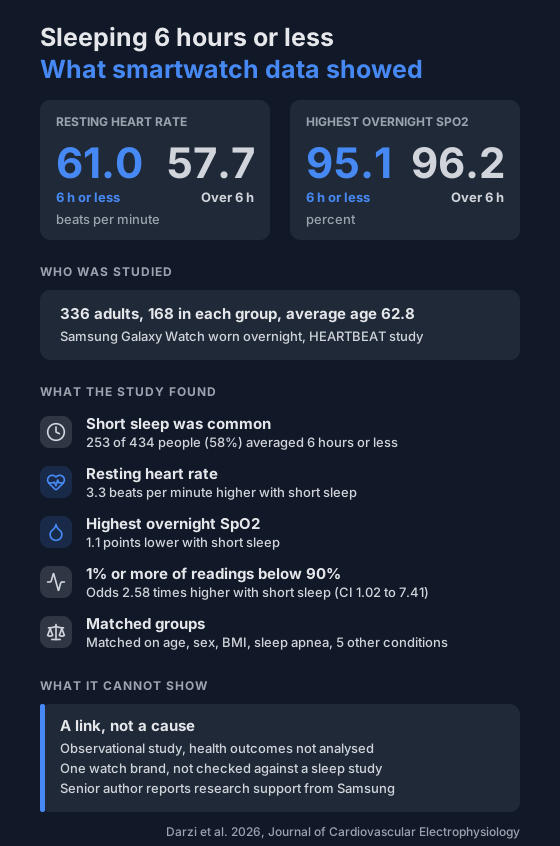
A 2026 smartwatch study matched 336 adults. Those averaging 6 hours of sleep or less had a resting heart rate 3.3 bpm higher and a highest overnight SpO2 1.1 points lower.
Short sleep has long been linked to heart problems. A study published in 2026 looked at what a smartwatch records in people who sleep 6 hours or less.
They had a slightly higher resting heart rate and slightly lower overnight oxygen than similar people who slept longer.
Who was studied?
- 434 adults in HEARTBEAT, a study run by researchers at Tulane University in the US.
- They were recruited through heart and primary care clinics, remotely and in the community.
- Each got a Samsung Galaxy Watch and was asked to wear it at least 18 hours a day, including overnight.
- 253 of them (58%) averaged 6 hours of sleep or less.
The short sleepers had more high blood pressure, diabetes and sleep apnea. So the researchers matched the two groups on age, sex, BMI, sleep apnea and five other conditions. That left 336 people, 168 in each group, with an average age of 62.8.
What did the watch data show?
In the matched groups:
- Resting heart rate: 61.0 beats per minute with 6 hours or less, against 57.7 with more. That's 3.3 higher.
- Highest overnight SpO2: 95.1% against 96.2%. That's 1.1 points lower.
Both gaps were statistically significant. The authors call them modest.
The researchers also counted how often SpO2 read below 90%. Short sleepers had 2.58 times the odds of having 1% or more of their readings there. The confidence interval was wide, from 1.02 to 7.41, and the paper doesn't say whether this used the matched groups.
New to SpO2? Start with what it is.
What can't it tell you?
- Cause. It's an observational study. It shows what went together, not that short sleep changed either number.
- What happens next. Health outcomes weren't analysed, and the study didn't test whether sleeping longer changes either number.
- Dips. The main oxygen measure was the highest reading of the night. The authors say measures of total time at low oxygen may capture more.
- Other devices. Everything came from one watch brand, with no sleep study alongside. Here's how smartwatch SpO2 compares with a pulse oximeter.
- Independence. The senior author reports research support from Samsung, among other companies.
What can you do with this?
These are group averages, and the gaps are small. If you track your own nights, compare several short ones with several long ones.
- Record enough nights first. See how many nights to record.
- Then put them side by side with the compare nights tool.
- Look at overnight heart rate as well as oxygen.
If you regularly sleep badly or wake up tired, tell your doctor.
Not a medical device. Does not diagnose, treat or prevent any condition. Discuss results and changes with a clinician.
References
- Darzi AE, Khoury CE, Massad CM, Atasi MM, Khalil MA, Menassa Y, Chaarani N, Lim C, Feng H, Marrouche NF. Short Sleep Duration Measured by Smartwatch Is Associated With Elevated Resting Heart Rate and Reduced Nocturnal Oxygen Saturation: Insights From Heartbeat. Journal of Cardiovascular Electrophysiology. 2026;37(7):1514-1521. doi:10.1111/jce.70358