Apple Watch Accuracy in Heart Patients
A 2025 study compared an Apple Watch Series 8 with a chest strap and a fingertip oximeter in 260 men with heart conditions. The averages were within about 0.2 of each other, but oxygen stayed around 97%.
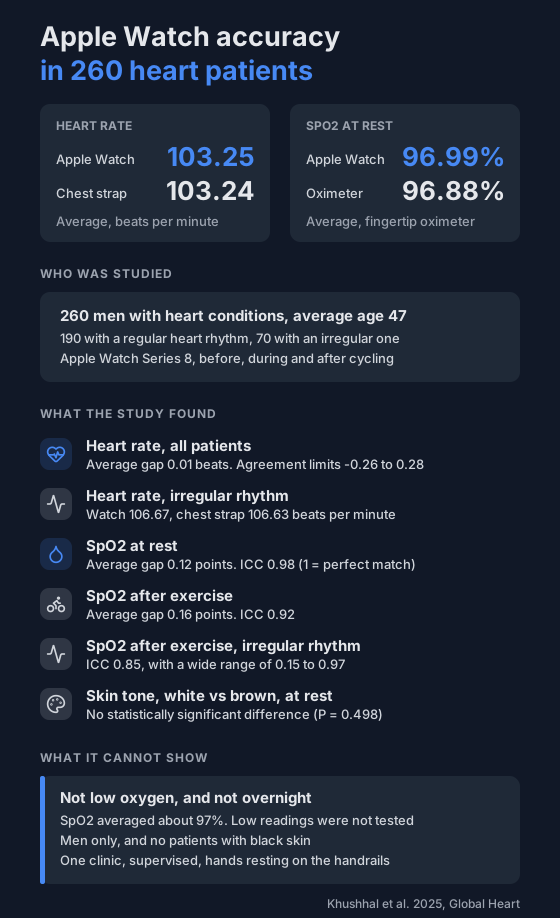
Many smartwatch accuracy studies use healthy volunteers. If you have a heart condition, and especially an irregular rhythm, you might wonder whether the numbers still hold.
A 2025 cross-sectional study in Saudi Arabia tested an Apple Watch Series 8 on 260 men with heart conditions. The watch's heart rate and SpO2 averages landed very close to the comparison devices. But nobody's oxygen was low, so it doesn't tell you how the watch does when it matters most.
Who was in the study?
- 260 men with heart conditions, average age 47, at one university medical centre.
- 190 had ischaemic heart disease with a regular rhythm. 70 had an irregular rhythm.
- The group included people after a heart attack or bypass surgery, and people with valve disease, stable atrial fibrillation or heart failure.
- Everyone had a resting ejection fraction above 50%. People with pacemakers or unstable conditions were left out.
- 160 had white skin and 100 had brown skin. None had black skin.
What did they measure?
Each man did one session on an exercise bike: 5 minutes of rest, 16 minutes of light to medium effort cycling, then 3 minutes of recovery. His hands rested on the handrails throughout.
- Heart rate: Apple Watch against a Polar H10 chest strap, every 30 seconds for the whole session.
- SpO2: Apple Watch against a Contec CMS50DL fingertip oximeter, recorded five times at rest and after exercise.
The paper reports agreement as an ICC, a score where 1 is a perfect match. It counts above 0.90 as excellent and 0.75 to 0.90 as good.
How close was the heart rate?
Very close, with or without a regular rhythm.
- All patients: watch 103.25 beats per minute on average, chest strap 103.24.
- Regular rhythm: 102.00 against 101.97.
- Irregular rhythm: 106.67 against 106.63.
- For all patients, the paper gives an average gap of 0.01 beats and limits of agreement from -0.26 to 0.28.
The paper prints the heart rate ICC as 0.100. Going by its own scale and the figures above, that looks like a misprint for 1.00.
For another heart measure, see how close wearable HRV is to an ECG.
How close was the SpO2?
Close at rest, a little less so after exercise.
- At rest: watch 96.99%, fingertip oximeter 96.88%. Average gap 0.12 points, ICC 0.98.
- After exercise, all patients: average gap 0.16 points, ICC 0.92.
- After exercise with an irregular rhythm: ICC 0.85, which the paper calls good, not excellent. The range around that figure was wide, from 0.15 to 0.97.
The authors suggest the unsteady heart rate after exercise affected the SpO2 reading. They note that Apple says you should be at complete rest for an SpO2 measurement.
Did skin tone make a difference?
The study found no statistically significant difference in resting SpO2 between the men with white skin and the men with brown skin (P = 0.498). It didn't compare them after exercise, and no one in the study had black skin.
For the wider research, read pulse oximeters and skin tone.
What doesn't it tell you?
- Low oxygen. Average SpO2 was about 97% on both devices, at rest and after exercise. The study didn't test readings in the low 90s or below. A lab study that lowered blood oxygen found the Apple Watch read high when blood oxygen was under 88%.
- Overnight. These were supervised spot readings with the arm supported, not hours of sleep.
- Women. Only men took part. The authors list this as a limitation.
- Weaker hearts. Everyone had an ejection fraction above 50%.
- Blood oxygen itself. The comparison was another pulse oximeter, not a blood sample.
- Hard exercise. Maximum heart rate was estimated from age, not measured, and the effort stayed light to medium.
- Other watches. One model and one software version were tested.
What can you do with this?
- If you have a heart condition and use an Apple Watch for heart rate during gentle exercise, this study found it tracked a chest strap closely.
- For SpO2, sit still with your arm supported. The watch agreed less well straight after exercise in people with an irregular rhythm.
- Don't read this as proof the watch will catch a low reading. That wasn't tested here.
- For overnight oxygen, see smartwatch SpO2 vs a pulse oximeter.
- If a reading worries you, or you feel unwell whatever the watch says, talk to your doctor.
Not a medical device. Does not diagnose, treat or prevent any condition. Discuss results and changes with a clinician.
References
- Khushhal AA, Mohamed AA, Elsayed ME. Accuracy of Apple Watch to Measure Cardiovascular Indices in Patients with Cardiac Diseases: Observational Study. Global Heart. 2025;20(1):74. doi:10.5334/gh.1456