Alcohol, Heart Rate and Sleep: A WHOOP Study
A 2026 study of 20,968 WHOOP users linked one drink more than usual, against one fewer, to an overnight resting heart rate 2.4 to 2.8 beats a minute higher. The study was funded by WHOOP.
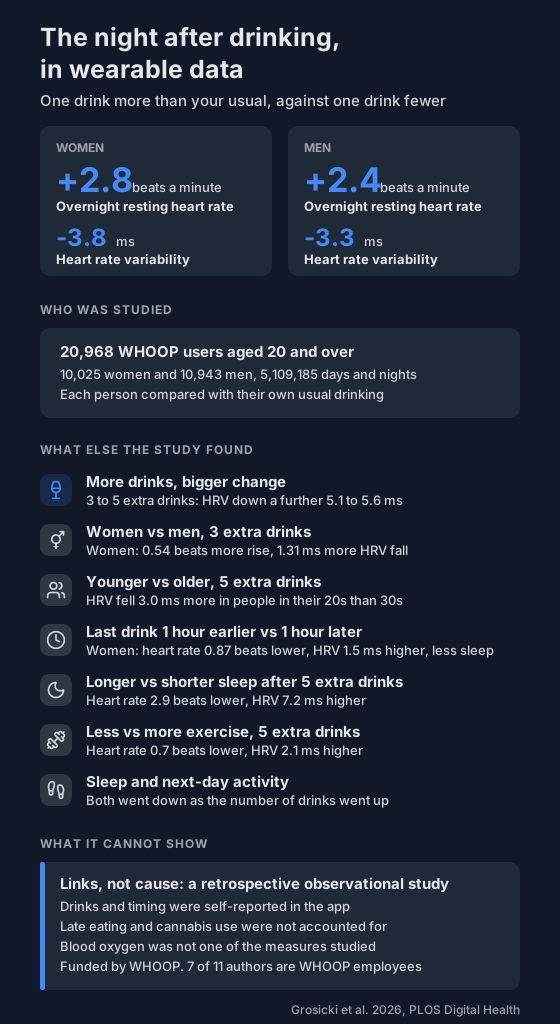
Most of what's known about alcohol and sleep comes from small lab studies. A study published in March 2026 looked at ordinary nights instead, using more than 5 million days of WHOOP wearable data.
It was funded by WHOOP, and 7 of its 11 authors work there.
Who was studied?
- 20,968 adults aged 20 and over who started wearing a WHOOP Strap 4.0 in 2023: 10,025 women and 10,943 men.
- The authors aimed for equal numbers of each sex in five age groups, from the 20s to 60 and over.
- Each person had 84 to 365 days of data, 244 on average.
- That's 5,109,185 days and nights in total. Alcohol was logged on 1,529,080 of them.
Each morning, users logged in the app whether they drank the day before, how many drinks, and the time of the last one. The strap measured overnight resting heart rate, heart rate variability (HRV), sleep time and next-day activity.
The study compared each person with themselves: nights after more drinks than their own average against nights after fewer.
What did it find?
Having one drink more than your usual, compared with one fewer, was linked to:
- Resting heart rate: 2.8 beats a minute higher in women, 2.4 higher in men.
- HRV: 3.8 ms lower in women, 3.3 ms lower in men.
The changes grew with the number of drinks. Going from three extra drinks to five was linked to a further HRV drop of 5.6 ms in women and 5.1 ms in men.
Sleep time and next-day activity also went down as drinks went up. The main paper doesn't give those numbers; they're in its supplementary tables.
The authors describe many of these changes as small.
Did it differ by sex and age?
Yes, on both counts.
- Women. At three drinks more than usual, heart rate rose 0.54 beats a minute more in women than in men, and HRV fell 1.31 ms more. That was after adjusting for body mass index.
- Younger adults. At five drinks more than usual, HRV fell 3.0 ms more in people in their 20s than in their 30s. The gap was 3.5 ms between the 30s and 40s, and 2.7 ms between the 40s and 50s.
- 50s vs 60 and over. No statistically significant difference.
Younger adults also had more drinks per drinking night, while older adults drank on more nights.
Did timing, sleep or exercise matter?
The study looked at four things that went along with smaller or larger changes.
- Timing. In women, a last drink an hour earlier than usual, against an hour later, was linked to a heart rate 0.87 beats lower and HRV 1.5 ms higher. In people in their 20s it was 1.2 beats and 3.7 ms. Results in men were similar. Earlier drinking was also linked to slightly shorter sleep.
- Sleep. After five drinks more than usual, nights with more sleep than usual had a heart rate 2.9 beats lower and HRV 7.2 ms higher than nights with less sleep.
- Exercise. After five drinks more than usual, days with less exercise than usual had a heart rate 0.7 beats lower and HRV 2.1 ms higher than days with more. They also had 4.3 minutes more sleep.
- Hydration. Users answered yes or no to whether they'd drunk enough fluid. A "yes" went with a heart rate 0.3 beats lower and HRV 0.9 ms higher after five extra drinks.
These are patterns in the data, not tested advice. The authors say randomised trials are needed to show cause.
What can't it tell you?
- Cause. It's a retrospective observational study. The authors say things that go with drinking, like late-night eating or cannabis use, could explain part of the result.
- Exact amounts. Drinks and timing were self-reported the next morning. For the 5.1% of drinking days with no drink count, the authors filled in the person's own median.
- Everyone. These were WHOOP users, on one device. The findings may not carry over to other people or other wearables.
- Long-term health. It covers the night after and the next day only.
- Oxygen. Blood oxygen and breathing weren't among the measures the study reported. For that, see alcohol and overnight oxygen.
The authors also say that showing a wearable picks up alcohol could be commercially useful to WHOOP. The data and code aren't public.
What can you do with this?
If you track your nights, you can run the same comparison on yourself.
- Note the number of drinks and the time of the last one.
- Compare those nights with your own dry nights, not with anyone else's numbers.
- Look at several nights of each kind. One night doesn't show much.
Another WHOOP-funded study did a similar analysis for tobacco: see tobacco days in wearable data. For how close wearable HRV is to an ECG, see wearable HRV vs ECG.
Not a medical device. Does not diagnose, treat or prevent any condition. Discuss results and changes with a clinician.
References
- Grosicki GJ, Robinson AT, Joyner MJ, Carter JR, von Hippel W, Presby DM, Fielding F, Bigalke JA, Kim J, Chapman C, Holmes KE. Real-world effects of alcohol on heart rate, sleep, and physical activity by age and sex. PLOS Digital Health. 2026;5(3):e0001284. doi:10.1371/journal.pdig.0001284