What Tobacco Days Look Like in Wearable Data
A 2026 study of 12,678 WHOOP members compared nights after tobacco days with tobacco-free days: resting heart rate was 1.71 beats a minute higher and sleep 9.78 minutes shorter.
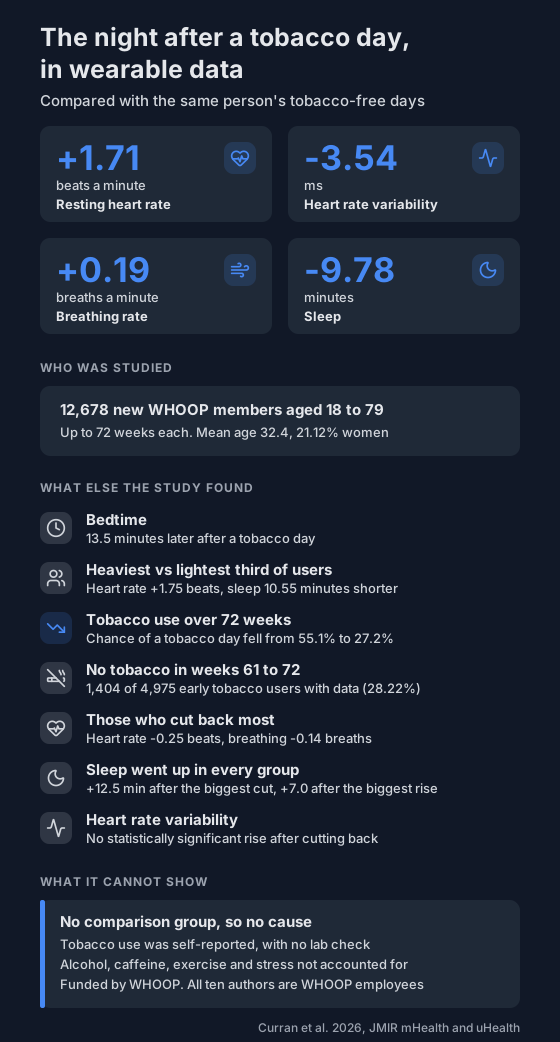
Nicotine is a stimulant, so you'd expect your overnight numbers to differ after a tobacco day. A study published in July 2026 measured by how much.
It used 3,765,573 logged days from 12,678 WHOOP members. On nights after a tobacco day, resting heart rate was 1.71 beats a minute higher and sleep was 9.78 minutes shorter than on the same person's tobacco-free days.
Who was in the study?
- 12,678 adults aged 18 to 79 who joined WHOOP between January 2022 and June 2024.
- Mean age 32.4, and 21.12% were women.
- Each morning the app asked whether they'd used tobacco the day before: yes or no.
- The wrist strap recorded resting heart rate, heart rate variability (HRV), breathing rate and sleep time each night.
- People were followed for up to 72 weeks. To be included they needed at least 8 weeks with tobacco entries.
Blood oxygen wasn't one of the measures.
What did the night after a tobacco day look like?
Compared with the same person's tobacco-free days:
- Resting heart rate: 1.71 beats a minute higher.
- HRV: 3.54 ms lower.
- Breathing rate: 0.19 breaths a minute higher.
- Sleep: 9.78 minutes shorter.
- Bedtime: 13.5 minutes later.
- Time awake in bed: up by 0.20 percentage points.
The authors call this part exploratory, and say the shorter sleep mostly went with a later bedtime, not with more time awake in bed.
Did heavier users differ from lighter users?
Yes. The study split people into thirds by how many of their logged days were tobacco days. The heaviest third, compared with the lightest third, had:
- Resting heart rate 1.75 beats a minute higher.
- HRV 1.58 ms lower.
- Breathing rate 0.25 breaths a minute higher.
- Sleep 10.55 minutes shorter.
Did tobacco use change over the 72 weeks?
It fell. The study split the 72 weeks into six 12-week quarters.
- The estimated chance of a tobacco day went from 55.1% in the first quarter to 27.2% in the last, a drop of 27.9 percentage points.
- Weekly tobacco uses went from 5.12 to 2.23, in the weeks where people logged a count.
- Among 4,975 people who logged tobacco use in the first quarter and had at least 3 weeks of data in both the first and last quarter, 1,404 (28.22%) logged no tobacco days in the last quarter.
- The drop was 30.0 points in women and 26.6 in men.
- It was 31.0 points in ages 40 to 59, 27.1 in ages 18 to 39 and 26.8 in ages 60 to 79.
- The heaviest third at the start dropped 39.3 points and the middle third 13.7. The lightest third went up 3.1.
- People who logged more often dropped more: 0.92 points for each 10-point rise in logging.
- The 1,587 people who set a tobacco goal in the app dropped less (25.0 points) than those who didn't (28.2). The authors call this exploratory and note that goal setters used more tobacco to begin with.
Fewer than half were still contributing data at the end: 12,626 people in the first quarter, 5,804 in the last. The authors say the heaviest third's large drop may partly be regression to the mean.
What happened to the numbers of people who cut back?
This part compared the first and last quarter in 5,776 people with data in both. The 1,523 people whose tobacco days fell by 25 points or more saw:
- Resting heart rate down 0.25 beats a minute. It went up 0.58 in those whose use rose by 25 points or more.
- Breathing rate down 0.14 breaths a minute, a bigger change than in every other group.
- Sleep up 12.5 minutes. Sleep went up in every group, including 7.0 minutes in those whose use rose most.
- HRV: no statistically significant rise. It fell 1.57 ms in those whose use rose most.
The authors describe these changes as modest.
What doesn't it tell you?
- Cause. There was no comparison group. The authors say the changes can't be put down to the wearable or to logging, and may reflect wider lifestyle or health changes.
- Whether the logs were accurate. Tobacco use was self-reported and not checked with a lab test.
- Which product. Cigarettes, cigars and chewing tobacco were all logged as "tobacco".
- What else was going on. Alcohol, caffeine, exercise, illness, medication and stress weren't accounted for, and neither were nicotine replacement or other quitting support.
- Everyone. These were paying subscribers who logged for at least 8 weeks, 79% of them men, with a mean age of 32.
- Independence. WHOOP funded the study, all ten authors are WHOOP employees, seven of them hold stock options, and the data isn't public. The authors ask for a repeat outside one company's platform.
For more on who these datasets miss, read who wearable studies leave out.
What can you do with this?
These are averages across thousands of people, and the differences are small. One night won't tell you much.
- Note your tobacco days and tobacco-free days, then compare averages over a few weeks. How many nights to record explains why.
- Compare nights puts two recordings side by side.
- Note alcohol too, since it shows up in overnight data as well.
- Wrist HRV has its own error. See wearable HRV vs ECG.
If you want help cutting down or quitting, talk to your doctor.
Not a medical device. Does not diagnose, treat or prevent any condition. Discuss results and changes with a clinician.
References
- Curran DJ, Leota J, von Hippel W, Fielding F, Chapman CJ, Cohen JG, Presby DM, Jhunjhunwala R, Holmes KE, Grosicki GJ. Tobacco Use Trajectories and Associated Changes in Biometrics and Sleep During the First 72 Weeks of Wearable Membership: Observational Cohort Study. JMIR mHealth and uHealth. 2026;14:e98116. doi:10.2196/98116