Smart Ring Data, Anxiety and Depression
In 1,290 Finnish adults wearing an Oura ring, those with the most anxiety symptoms had about 10 minutes less deep sleep and 9 minutes less REM sleep on weeknights. The gaps were small.
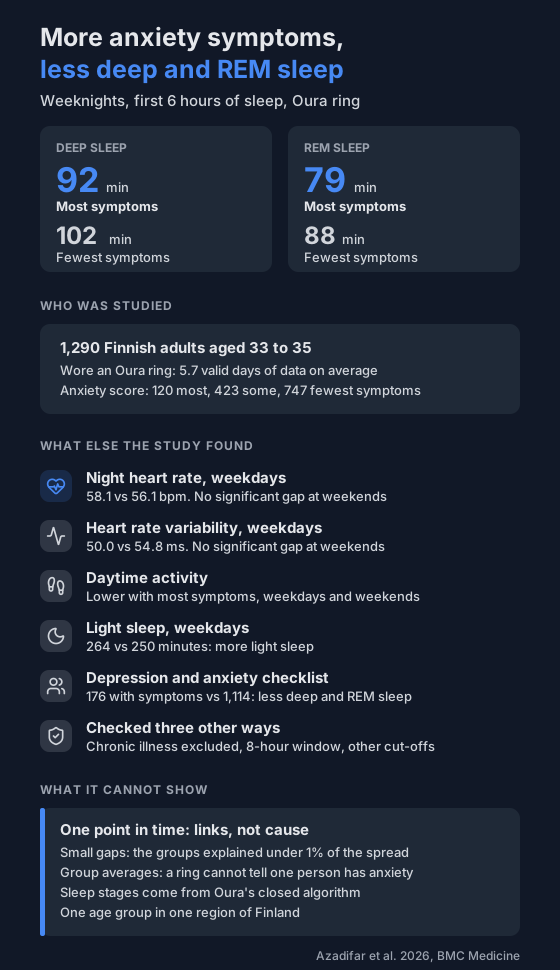
Anxiety and low mood often go with poor sleep and a higher resting heart rate. A study published in September 2026 checked whether that shows up in everyday smart ring data, in a large group of ordinary adults rather than clinic patients.
It did, on average. But the differences between groups were small, and the study can't tell you anything about one person.
Who was studied?
- 1,290 adults aged 33 to 35 from the Northern Finland Birth Cohort 1986, a group followed since birth.
- 63% were women.
- They were asked to wear an Oura ring (second generation) for 14 days, with no charger.
- A battery usually lasts about 6 days, so the average was 5.7 valid days of data per person.
- The ring showed them nothing about their sleep or activity while they wore it.
Everyone filled in two symptom questionnaires.
- Anxiety (GAD-7). Scores split people into three groups: fewest symptoms (0 to 4, 747 people), some (5 to 9, 423) and most (10 or more, 120).
- Depression and anxiety (HSCL-25). 176 people scored above the study's cut-off and 1,114 below it.
The study used the first 6 hours of each night's sleep.
What did it find?
People with the most anxiety symptoms, compared with the other two groups, after adjusting for things like sex, income, smoking, BMI and blood sugar:
- Deep sleep: 92 minutes against about 102 on weeknights, and 90 against 101 at weekends.
- REM sleep: 79 minutes against about 88 on weeknights, and 93 against 102 at weekends.
- Light sleep: 264 minutes against 248 and 250 on weeknights.
- Night heart rate: 58.1 beats a minute against 56.1 in the fewest-symptom group, on weeknights.
- Heart rate variability (HRV): 50.0 ms against 54.8 ms in the fewest-symptom group, on weeknights.
- Daytime activity: a little lower, on weekdays and weekends.
The "some symptoms" group mostly looked like the fewest-symptom group. The exceptions were weeknight heart rate and HRV, where it sat closer to the most-symptoms group.
Did depression symptoms show the same thing?
Mostly. The 176 people above the depression and anxiety cut-off had:
- About 7 to 8 minutes less deep sleep and 6 minutes less REM sleep, on weeknights and weekends.
- A weeknight heart rate of 58.2 against 56.8 beats a minute.
- Slightly less daytime activity on weekdays, but not at weekends.
Their HRV was lower on average, but not by a statistically significant amount.
Were the differences at weekends too?
For the anxiety groups, sleep stages and activity, yes. Heart rate and HRV, no. At weekends, there was no statistically significant difference in heart rate or HRV between any of the groups.
How big are these differences?
Small. Which group someone was in explained under 1% of the spread in each measure.
The authors say it's still unclear whether these gaps mean anything for one person. They call the study exploratory, and say it isn't evidence that ring data can tell people apart by mental health.
What can't it tell you?
- Cause or direction. Symptoms and ring data were measured at the same time. Poor sleep could feed anxiety, anxiety could disturb sleep, or both.
- Anything about you. These are group averages with lots of overlap. A ring can't tell you whether you have anxiety or depression.
- Exact sleep stages. Oura's algorithms aren't public, and rings are weaker on sleep stages than a sleep lab. See how accurate smart rings are for sleep.
- Everyone. All participants were 33 to 35 and from northern Finland.
- Oxygen. The study didn't look at blood oxygen or breathing during sleep.
The patterns looked broadly the same when the authors removed people with chronic illness, used an 8-hour sleep window and tried other anxiety cut-offs.
The study was paid for by public and university research grants, not by Oura. The authors declared no competing interests.
What can you do with this?
This study doesn't show that your own ring numbers say anything about your mood. If you track sleep, heart rate or HRV, you can log how you feel alongside them as a self-experiment. Compare yourself with yourself, over several nights, not with anyone else's numbers.
If low mood or worry is affecting your sleep or your days, talk to your doctor.
For how wearable HRV compares with an ECG, see wearable HRV vs ECG. For a study linking sleep apnea risk and mental health, see sleep apnea risk and mental health.
Not a medical device. Does not diagnose, treat or prevent any condition. Discuss results and changes with a clinician.
References
- Azadifar S, Sameh A, Nauha L, Kärmeniemi M, Niemelä M, Farrahi V. Severity of depression and anxiety symptoms is reflected in physiological and behavioral metrics collected from a consumer-grade wearable ring. BMC Medicine. 2026;24(1):532. doi:10.1186/s12916-026-05276-y