Sleep Apnea Risk and Mental Health in Canada
A study of 30,097 Canadians aged 45 to 85 found that those at high sleep apnea risk had about 40% higher odds of poor mental health, at two visits about 3 years apart.
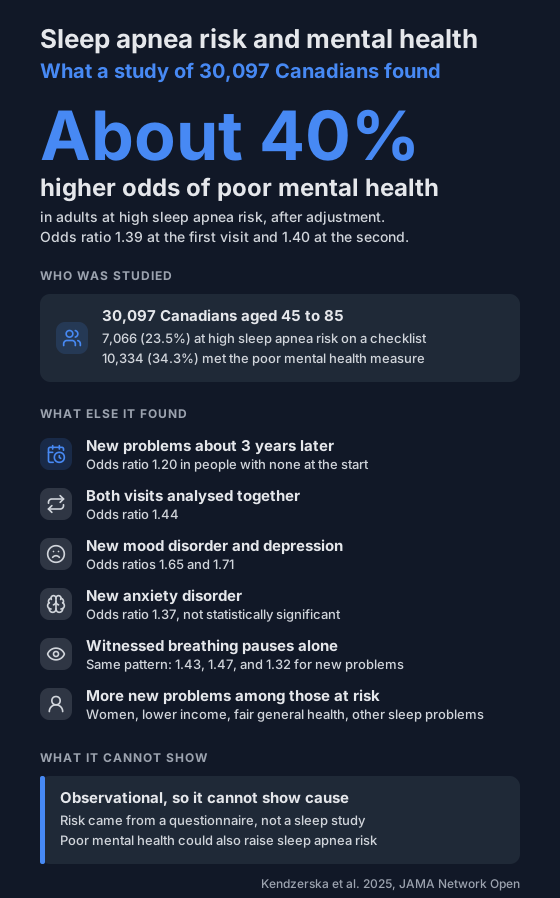
Sleep apnea and low mood often turn up together. A study in JAMA Network Open checked 30,097 Canadians, and most of them again about 3 years later. People at high sleep apnea risk had about 40% higher odds of poor mental health at both visits.
Who was studied?
- 30,097 adults aged 45 to 85 from the Canadian Longitudinal Study on Aging.
- 27,765 took part again a median of 2.9 years later.
High risk meant at least two of four signs on the STOP questionnaire: snoring, daytime sleepiness, someone seeing you stop breathing, and high blood pressure. 7,066 people (23.5%) were at high risk at the first visit.
How was mental health measured?
"Poor mental health" meant any one of these:
- A high score on a depression symptom scale.
- A high score on a psychological distress scale.
- A doctor saying you have an anxiety disorder, mood disorder or depression.
- Taking antidepressants.
10,334 people (34.3%) met it at the first visit.
What did it find?
These are the study's odds ratios for high against low risk, adjusted for age, sex, income, pain and more.
- First visit: 1.39.
- Second visit: 1.40.
- New problems: among people with no mental health problem at the start, 1.20.
- Both visits together: 1.44.
- New cases by condition: 1.65 for mood disorder and 1.71 for depression. Anxiety disorder was 1.37, not statistically significant.
Witnessed breathing pauses alone gave the same pattern: 1.43, 1.47, and 1.32 for new problems.
Who was more likely to develop a problem?
Of 3,213 people at high risk with no mental health problem at the start, 360 (11.2%) had one by the second visit.
The odds were higher for women, and for people with a household income under $50,000, low life satisfaction, fair general health, insomnia, restless legs or acting out dreams.
What can't this study show?
- Cause. It's observational. Poor mental health could also raise sleep apnea risk, through weight gain or medication.
- Confirmed sleep apnea. Nobody had a sleep study. Answers were self-reported, and the questionnaire also flags many people without it.
- Whether therapy changes anything. The study had no data on therapy.
- Everyone. 94.3% of participants were White, and they were healthier and more educated than Canadians overall.
What can you do with this?
If your mood has been low and you also snore or wake up tired, mention both to your doctor. The risk check gives you something to bring along. The same cohort was used for sleep apnea risk and memory.
Not a medical device. Does not diagnose, treat or prevent any condition. Discuss results and changes with a clinician.
References
- Kendzerska T, Mallick R, Li W, Robillard R, Taler V, Webber C, Saymeh M, Dang-Vu TT, Tanuseputro P, Fiedorowicz JG. Obstructive Sleep Apnea Risk and Mental Health Conditions Among Older Canadian Adults in the Canadian Longitudinal Study on Aging. JAMA Network Open. 2025;8(12):e2549137. doi:10.1001/jamanetworkopen.2025.49137