Sleep Apnea Risk and Memory: A 2026 Study
A 2026 study of 946 older Canadians found that people with a memory problem scored higher on a sleep apnea risk questionnaire. Insomnia showed no link.
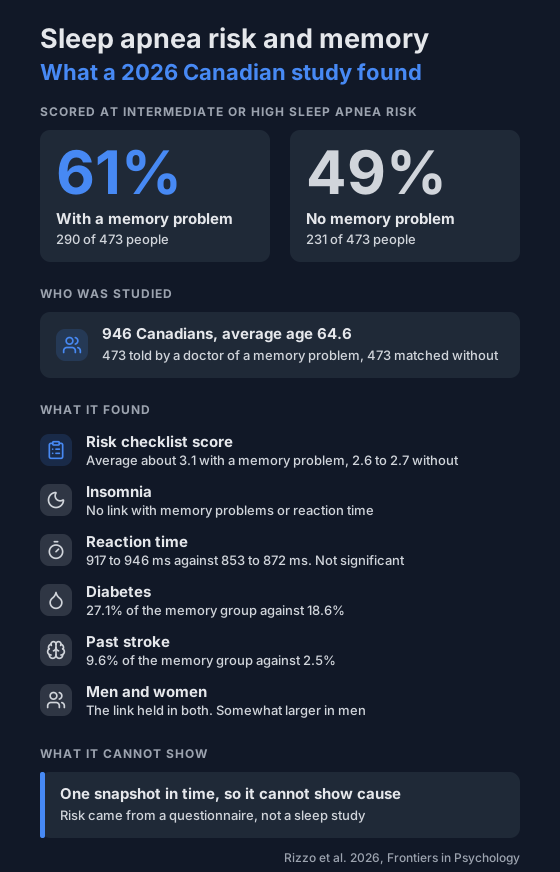
Sleep apnea and insomnia are both common in older adults. A 2026 Canadian study asked which one lines up more closely with memory problems.
Its answer was sleep apnea risk, not insomnia.
Who was studied?
The data came from the Canadian Longitudinal Study on Aging, which follows about 50,000 people.
- 473 people who said a doctor had told them they have a memory problem.
- 473 people without one, matched by age and sex.
- Average age 64.6.
Nobody had a sleep study. Sleep apnea risk came from the STOP-Bang questionnaire, scored on 7 of its 8 items because neck size wasn't measured. Insomnia came from questions about trouble falling asleep and waking in the night.
What did it find?
- Sleep apnea risk. 290 of the 473 people with a memory problem scored at intermediate or high risk, against 231 of the 473 without. That's 61% against 49%.
- Risk score. The average was about 3.1 with a memory problem and 2.6 to 2.7 without.
- Insomnia. No link with memory problems, alone or combined with sleep apnea risk.
- Reaction time. On a speed test, the memory group averaged 917 to 946 milliseconds against 853 to 872. That gap fell just short of statistical significance.
- Other health problems. 27.1% of the memory group had diabetes, against 18.6%. 9.6% had a past stroke, against 2.5%.
A model built from age, sex, blood pressure, diabetes, hours slept and the risk score picked out 66.6% of memory cases. The risk score and diabetes carried most of the weight. The authors suggest that people with memory complaints be checked for sleep apnea and diabetes.
Was it the same for men and women?
STOP-Bang gives one point for being male, so the authors checked each sex separately. The link held in both, and was somewhat larger in men.
What can't this study show?
- It's a single snapshot, so it can't show that sleep apnea causes memory problems.
- A questionnaire shows risk, not confirmed sleep apnea.
- "Memory problem" was one yes or no question.
- Depression and medicines that affect thinking couldn't be fully accounted for.
- No correction was made for running many statistical tests.
- Nothing was known about who was already on therapy for sleep apnea.
What can you do with this?
If you're worried about your memory and you also snore or wake up tired, mention both to your doctor. The risk check gives you something to bring along.
Got overnight recordings? Here's how to share them. For how sleep apnea shows up with age, see sleep apnea in older adults.
Not a medical device. Does not diagnose, treat or prevent any condition. Discuss results and changes with a clinician.
References
- Rizzo D, Baltzan M, Abu-Farha M, Alterki A, Abubaker J, Al-Mulla F, Elsaraj SM. Obstructive sleep apnea risk is associated with a diminished cognitive profile: findings from the Canadian longitudinal study on aging. Frontiers in Psychology. 2026;17:1864558. doi:10.3389/fpsyg.2026.1864558