Sleep Apnea, Thinking Tests and CPAP Hours
A small 2026 study gave 29 snorers with no complaints a thinking test. About half scored below the usual cut-off, and higher scores went with more hours on CPAP.
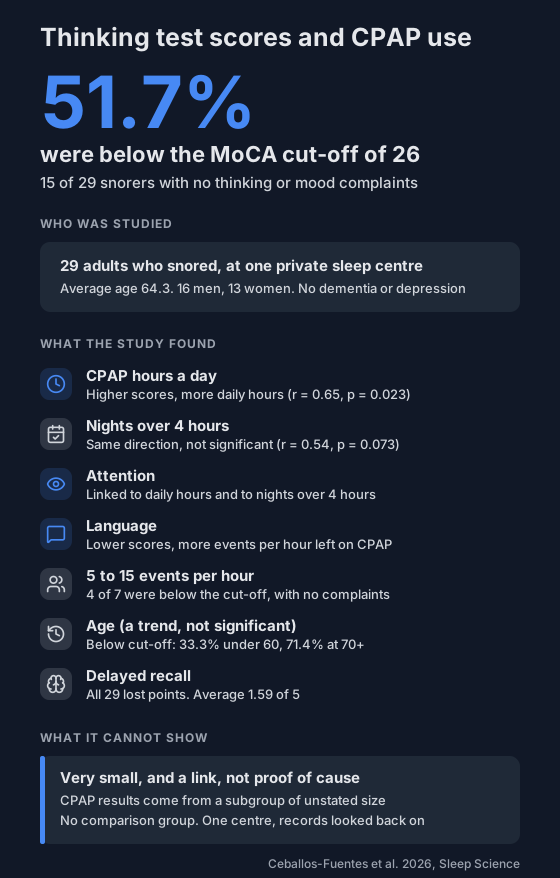
Research has often linked sleep apnea to problems with memory and concentration. But the paper notes that sleep clinics don't routinely test thinking skills, so they rely on what patients report.
A small study published in 2026 gave a short thinking test to 29 snorers who said they had no such problems. About half scored below the usual cut-off. Among those who went on CPAP, higher scores went with more hours of use.
Who was in the study?
- 29 adults referred to one private sleep centre for an overnight sleep study between July and December 2024.
- All snored. None reported memory problems, daytime sleepiness or mood problems.
- None had dementia, depression or major health problems, and none took drugs that act on the brain.
- Average age 64.3 (range 51 to 84). 16 men and 13 women.
- The authors looked back at their records, so it's a retrospective study.
- In its limitations section, the paper calls the design cross-sectional.
What was the test?
The Montreal Cognitive Assessment (MoCA). It takes about 10 minutes and scores out of 30. It covers memory, attention, language, visual and planning skills, abstract thinking and orientation. The study used the standard cut-off: below 26 counts as cognitive impairment.
A sleep doctor trained in the test gave it on the day of the sleep study or within a week.
What did they find?
- The average score was 25.2 (range 18 to 29).
- 15 of the 29 (51.7%) scored below 26.
- All 29 lost points on delayed recall, remembering 5 words learned earlier in the test. The average was 1.59 out of 5.
- Attention was next: 44.8% lost points. Then language, at 31.0%.
- Men and women scored about the same (25.25 and 25.08), with no statistically significant difference.
Did age matter?
The share below the cut-off rose with age:
- Under 60: 33.3%
- 60 to 69: 50.0%
- 70 and over: 71.4%
But the overall link between age and score was not statistically significant (r = -0.298, p = 0.116).
What about people with fewer breathing events?
Under US sleep medicine guidelines, 5 to 15 breathing events per hour only counts as sleep apnea if there are symptoms, and thinking problems are one of them. More than 15 counts with or without symptoms. These counts come from an in-lab sleep study, and a home oximeter is not a sleep study.
7 people in the study were in the 5 to 15 range. 4 of them (57.1%) scored below the cut-off, despite reporting no symptoms. The paper doesn't give the figures for the other ranges.
Did scores go with CPAP use?
According to the abstract, CPAP use was measured at 3 months.
- Hours a day: higher total scores went with more hours of CPAP use (r = 0.65, p = 0.023).
- Share of nights over 4 hours: same direction, but not statistically significant (r = 0.54, p = 0.073).
- Attention: linked to both hours a day (r = 0.61, p = 0.026) and share of nights over 4 hours (r = 0.57, p = 0.044).
- Language: lower scores went with more breathing events per hour still recorded on CPAP (r = -0.69, p = 0.019).
- The other parts of the test had no statistically significant link.
The authors suggest attention may affect how well people keep up with CPAP. They also suggest weaker language scores might mean more trouble following instructions or sorting out problems with the machine. Those are their explanations, not something the study tested.
For why events can still show up on CPAP, see events still showing on CPAP.
What doesn't it tell you?
This is a very small study, and the authors say the sample size and design limit what it can show.
- Size. 29 people in total.
- The CPAP group is smaller still. The paper doesn't say how many of the 29 went on CPAP.
- Cause. It shows what went together, not what caused what.
- No comparison group. Nobody without snoring took the test, so we can't tell whether 51.7% is higher than usual for people this age.
- Age and education. The authors note both affect MoCA scores. Most patients here had at least a high school education.
- One centre. Patients came from one private clinic, and nobody recorded how many people were checked for the study.
There was no outside funding, and the authors declare no conflicts of interest.
What can you do with this?
These are our suggestions, not the study's findings.
- If you're being checked for sleep apnea and have noticed any change in memory or focus, mention it, even if it seems minor.
- For a larger study on sleep apnea risk and memory, see sleep apnea risk and memory.
- On CPAP and finding it hard to keep up? The review on sticking with CPAP covers what has been studied.
- If you log your nights, here's how to track your oxygen alongside CPAP and share it with your doctor.
Not a medical device. Does not diagnose, treat or prevent any condition. Discuss results and changes with a clinician.
References
- Ceballos-Fuentes FA, Meghpara S, Niraula R, DelRosso LM. Cognitive Performance and Adherence to Treatment in Patients with Obstructive Sleep Apnea. Sleep Science. 2026;19(2):1-7. doi:10.1055/s-0046-1827497