Who Sticks With CPAP? A 2026 Review
A 2026 review says only 50-60% of people keep using CPAP long term. It sets out what goes with more use, what goes with less, and why the first 2 to 4 weeks count.
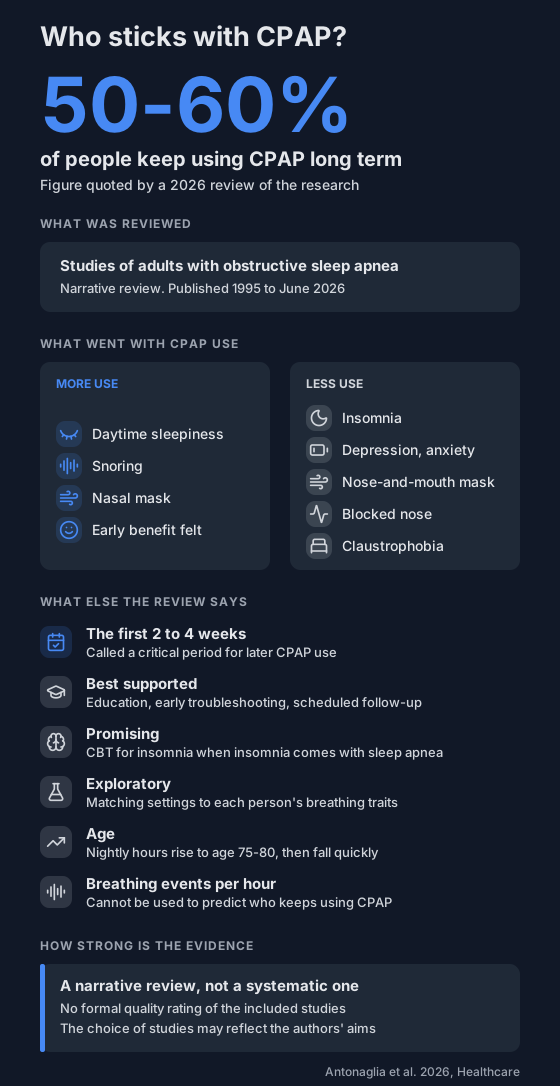
CPAP is the first-choice therapy for obstructive sleep apnea, but many people stop using it. A review published in August 2026 says only 50-60% keep it up long term, despite better machines and masks.
What kind of study was it?
- A narrative review by lung specialists in Trieste and Rome.
- It covers studies of adults published from 1995 to June 2026, and reports no new patient data.
What went with more use?
- Daytime sleepiness, and feeling a benefit early on.
- Snoring, which the review says stops straight away on CPAP. A bed partner notices too.
- A nasal mask.
And with less?
- Insomnia alongside sleep apnea.
- Depression and anxiety.
- A mask over both nose and mouth, a blocked nose before starting, claustrophobia and low socioeconomic status.
- Not feeling sleepy in the day.
Some things didn't sort so neatly:
- Events per hour. The review says the count of breathing events can't be used to predict who sticks with CPAP.
- Sex. Studies disagree on whether men or women use it more.
- Age. Nightly hours rise up to age 75-80, then fall quickly.
Why do the first weeks count?
The review calls the first 2 to 4 weeks a critical period for later use. Dry mouth and nasal symptoms are the most commonly reported side effects in the first month.
It also questions the usual target of 4 hours a night on 70% of nights. That figure comes from US insurance rules, and the authors say benefit often grows with more hours.
What does it say helps?
The authors sort the strategies into three levels:
- Best supported: patient education, early troubleshooting and scheduled follow-up.
- Promising: cognitive behavioural therapy for insomnia, for people who have both insomnia and sleep apnea.
- Exploratory: matching machine settings to each person's breathing traits.
One cited study found that giving patients accurate information about their condition went with 1 more hour of CPAP use a day.
What doesn't it tell you?
- It isn't a systematic review. The authors say their choice of studies may reflect their own aims.
- No quality rating. The included studies weren't formally graded.
What can you do with this?
If CPAP is hard going, tell your sleep clinic early. The review puts the most weight on sorting out problems in the first weeks.
An oximeter can log your oxygen on CPAP nights. It can't tell you whether your CPAP is working, so take the data to your clinician.
Not a medical device. Does not diagnose, treat or prevent any condition. Discuss results and changes with a clinician.
References
- Antonaglia C, Fabozzi A, Steffanina A, Soave S, Confalonieri P, Nicolai A, Olmati F, Sanna A, Pena N, Ruaro B, Salton F, Bonini M, Confalonieri M, Palange P. Optimizing CPAP Adherence in Obstructive Sleep Apnea: A Narrative Review of Practical Strategies for Everyday Clinical Care. Healthcare (Basel). 2026;14(15):2328. doi:10.3390/healthcare14152328