How Do Partners of CPAP Users Sleep?
A 2026 study of 97 people found that bed partners of CPAP users reported worse sleep and lower health scores than a comparison group, but similar relationship satisfaction.
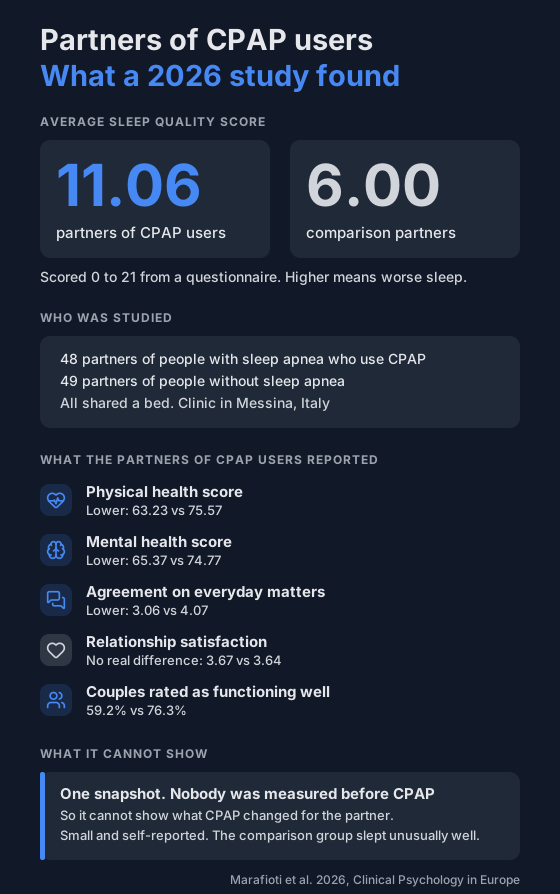
A cross-sectional study published in August 2026 compared bed partners of CPAP users with partners of people who don't have sleep apnea. The partners of CPAP users reported worse sleep and lower health scores, but about the same relationship satisfaction.
Who was in the study?
- 48 partners of people with obstructive sleep apnea who use CPAP, recruited at a sleep clinic in Messina, Italy, between October 2019 and March 2020.
- 49 partners of people without sleep apnea, recruited from the community.
- Everyone was in a stable relationship and shared a bed.
Each person filled in questionnaires on sleep, the relationship and health. Nothing was recorded overnight.
How did the partners sleep?
The sleep questionnaire gives a score from 0 to 21. Higher means worse sleep, and above 5 counts as poor sleep.
- Partners of CPAP users averaged 11.06.
- Comparison partners averaged 6.00.
- 55% of the partners of CPAP users scored above 5.
What about health and the relationship?
Partners of CPAP users scored lower on:
- Physical health: 63.23 against 75.57.
- Mental health: 65.37 against 74.77.
- Agreement on everyday matters like money and free time: 3.06 against 4.07.
- Shared activities: 1.04 against 2.97 in the table, though one line of the results says no difference.
Two things were about the same in both groups:
- Relationship satisfaction: 3.67 against 3.64.
- Showing affection: 2.27 against 2.15.
59.2% of the CPAP couples were rated as functioning well, against 76.3% of the comparison couples.
In the CPAP group, worse sleep went with lower physical and mental health scores, but not with relationship scores.
What doesn't it tell you?
- What CPAP did. It's a single snapshot. Nobody was measured before CPAP, so it can't show what CPAP changed for the partner.
- Cause. It can't show whether poor sleep strains a relationship or the other way round.
- Everyone. The group was small and mostly women.
- A fair comparison. The authors say the comparison group slept unusually well, which may exaggerate the gap.
- Settled numbers. Everything was self-reported, the couple ratings were exploratory, and the authors didn't correct for running many tests.
- Consistent figures. The paper says no comparison partner scored above 5, which doesn't fit that group's 6.00 average.
What can you do with this?
If you share a bed with someone who uses CPAP and you sleep badly, your own sleep is worth raising with a doctor too.
If the person next to you snores or stops breathing and hasn't seen a doctor, read snoring vs sleep apnea or try the sleep apnea risk check.
On CPAP yourself? Here's how tracking oxygen with CPAP works.
Not a medical device. Does not diagnose, treat or prevent any condition. Discuss results and changes with a clinician.
References
- Marafioti G, Vinci ES, Culicetto L, Lo Buono V, Cipriano GL, Silvestri R, Rizzo A. Sleep quality, relationship functioning, and health-related quality of life in partners of CPAP-treated OSA patients. Clinical Psychology in Europe. 2026;8(3):e20295. doi:10.32872/cpe.20295