Getting Used to CPAP as a Couple: A Study
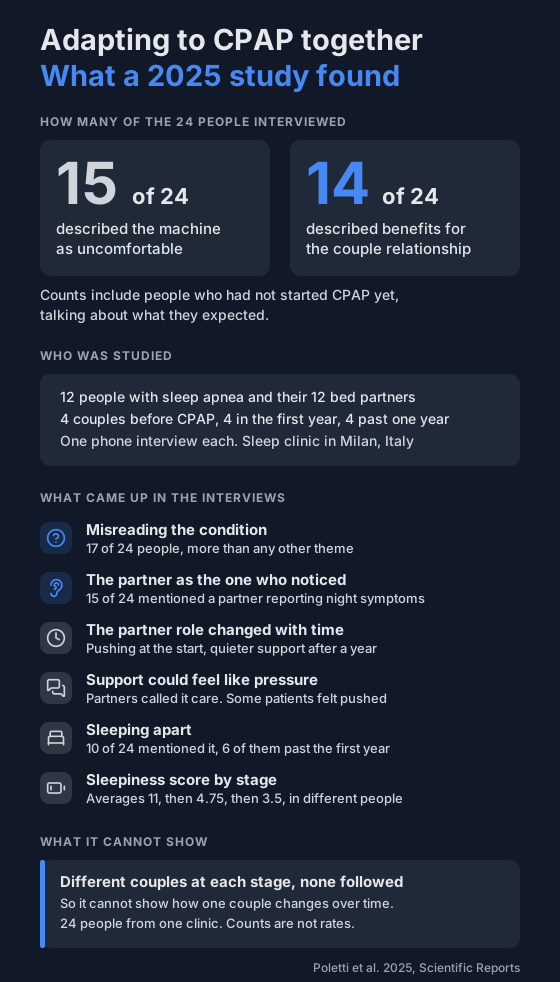
A 2025 interview study of 12 people with sleep apnea and their 12 bed partners found that 15 of 24 called the CPAP machine uncomfortable and 14 described benefits for the relationship.
Most CPAP advice is written for the person wearing the mask. A study published in December 2025 also interviewed the person on the other side of the bed.
It found that getting used to CPAP was something couples did together, and that the partner's part in it changed over time.
Who was in the study?
- 12 people with obstructive sleep apnea and their 12 bed partners, recruited at a sleep clinic in Milan, Italy, between June 2023 and May 2024.
- Four couples had not started CPAP yet, four were in their first year and four were past one year.
- Each person had one private phone interview with a psychologist.
- The researchers sorted what people said into themes and counted how many of the 24 raised each one.
- The 12 patients also filled in a sleepiness score.
- The authors report no funding for the research and no competing interests.
What did they say about the machine?
15 of the 24 described it as uncomfortable. That includes all 8 of the people who were using it.
- Before starting. People worried about how it looks, intimacy, noise and side effects. One patient said wearing it would feel like being terminally ill.
- First year. People spoke of partly accepting it. One user said they take the mask off on nights it bothers them. One partner said the noise made it hard to sleep at first.
- Past one year. It had become part of the nightly routine. One long-term user compared it to a security blanket.
The patients reported their own nightly use. It averaged 4.5 hours in the first-year group and 5.63 hours in the group past one year.
For what goes with more and less use in larger studies, see who sticks with CPAP.
What did the partners do?
- Noticed. 15 of the 24 mentioned a partner reporting night-time symptoms, like hearing the breathing stop.
- Pushed. One patient said he would have done nothing if his wife had not insisted. One partner said she started with gentle persuasion and moved on to arguments.
- Reassured. Some first-year users said they accepted CPAP at first only to keep their partner calm, and later came to see benefits themselves.
- Helped. One user said their partner adjusted the mask and encouraged them to keep it on.
- Stepped back. In the group past one year, many partners described leaving more of it to the patient while staying available.
Was that support always welcome?
No. Partners mostly described their involvement as care. Some patients felt it as pressure, and one said his wife had guilt-tripped him.
The authors say support works best when the patient still feels the decision is theirs.
Did both see the condition the same way?
Often not. Misreading the condition was the most common theme, raised by 17 of the 24.
- Before CPAP, patients were often vague about it or felt it had nothing to do with them. Partners were usually more aware of the night-time symptoms.
- One partner said that when he forgets the mask nothing happens, so maybe he's healed. The authors call this a common misconception: fewer symptoms on CPAP taken to mean the condition has gone.
- One partner in the group past one year said they had never noticed anything and slept through it.
What changed for the couple?
- 14 of the 24 described benefits for the relationship. Some had not started CPAP and were talking about what they expected.
- 10 of the 24 mentioned sleeping apart as a way of coping, 6 of them in the group past one year. One partner said they no longer share a bed but argue less.
- The average sleepiness score was 11 in the group yet to start, 4.75 in the first-year group and 3.5 in the group past one year. Above 10 counts as excessive daytime sleepiness.
Those three scores come from different people, so they aren't a before and after. The first-year group also started with about twice as many breathing events per hour as the group yet to start.
For numbers on how partners of CPAP users sleep, see this study of 97 partners.
What doesn't it tell you?
- How one couple changes. Different couples were interviewed at each stage. Nobody was followed over time.
- How common any of this is. It's 24 people from one clinic in Italy. The counts show what came up in interviews, not rates.
- What CPAP caused. There was no comparison group.
- Measured use. Nightly hours were self-reported.
- Everything said. The interviews were by phone, so the authors say body language was missed.
- Tidy tables. A few rows in the paper's tables don't add up, so the figures here are only ones where the group counts match the total.
What can you do with this?
- If you have a CPAP appointment, your partner can come along and ask their own questions. The authors suggest clinics involve partners early.
- If the mask or the noise is bothering either of you, tell your sleep clinic.
- If you're the partner, say how you're sleeping too.
Tracking your nights as well? Here's how tracking oxygen with CPAP works.
Not a medical device. Does not diagnose, treat or prevent any condition. Discuss results and changes with a clinician.
References
- Poletti V, Battaglia EG, Anelli LE, Banfi P, Volpato E. A multi-perspective interpretative phenomenological analysis of patient and bed partner experiences with CPAP therapy adaptation in obstructive sleep apnoea. Scientific Reports. 2025;16(1):1073. doi:10.1038/s41598-025-30682-2
- Poletti V, Battaglia EG, Anelli LE, Banfi P, Volpato E. Correction: A multi-perspective interpretative phenomenological analysis of patient and bed partner experiences with CPAP therapy adaptation in obstructive sleep apnoea. Scientific Reports. 2026;16(1):4937. doi:10.1038/s41598-026-36770-1