Aroma Oil and CPAP Use: A Small Pilot Study
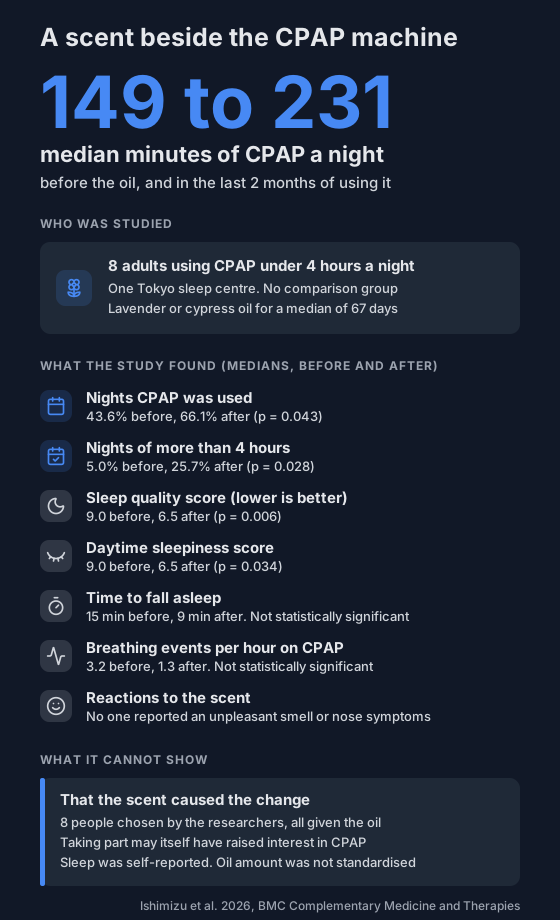
A pilot study gave 8 people who used CPAP under 4 hours a night a lavender or cypress scent at bedtime. Median use went from 149 to 231 minutes, with no comparison group.
Lots of people find CPAP hard to keep on all night. The usual fixes are a better mask fit, a humidifier and support from the clinic.
A small pilot study from Japan, published in January 2026, tried something else: a scent beside the machine. CPAP use went up, but the study had 8 people and no comparison group.
Who was in the study?
- 8 adults with obstructive sleep apnea at one hospital sleep centre in Tokyo: 4 men and 4 women.
- Their median age was 53.5.
- All had been on CPAP for at least three months and averaged under 4 hours a night.
- None had nose or mask problems or another sleep disorder, and none reported a poor sense of smell.
- Of 388 CPAP patients at the centre, 8 met the criteria and were enrolled, between March 2019 and February 2020.
What did they do?
- They put one to three drops of lavender or cypress oil on a tissue or cotton ball.
- They placed it next to the CPAP machine, near the air filter, before going to sleep.
- They did this on the nights they used CPAP and noted it in a diary.
- The median time using the oil was 67 days.
- There was no extra coaching, phone calls or remote monitoring.
The paper doesn't say how many people used each oil.
Did CPAP use change?
The machine's own data was compared between the period before the oil and the last two months of using it. These are medians:
- Minutes a night: 149 before, 231 after.
- Nights CPAP was used: 43.6% before, 66.1% after.
- Nights of more than 4 hours: 5.0% before, 25.7% after.
All three changes were statistically significant.
Even after the change, the median was under 4 hours a night, and about one night in four passed the 4-hour mark.
What about sleep quality?
Two questionnaires were filled in before and about two months after starting. Lower scores are better on both.
- Sleep quality score: a median of 9.0 before and 6.5 after.
- Daytime sleepiness score: a median of 9.0 before and 6.5 after.
Both changes were statistically significant.
Two things did not change by a statistically significant amount:
- Time to fall asleep: 15 minutes before, 9 minutes after. This was self-reported.
- Breathing events per hour while on CPAP: 3.2 before, 1.3 after. The authors say that's expected, because CPAP was already keeping events low.
No one reported an unpleasant smell or nose symptoms such as a blocked nose.
What can't it tell you?
Quite a lot, and the authors call it a pilot study.
- Cause. There was no comparison group. Everyone got the oil, so the study can't separate the scent from everything else that changed.
- Attention. The authors say using the oil may have made people more motivated or more aware of their CPAP, and that alone could raise use.
- Size. Eight people, chosen by the researchers and not at random.
- Sleep itself. Sleep quality came from questionnaires. No brain-wave sleep recording was done.
- The dose. People chose how much oil to use, and their sense of smell wasn't formally tested.
- The long run. The second set of questionnaires came about two months in, and the CPAP data covered the last two months of oil use. The study doesn't show what happens after that.
The authors conclude that the idea needs further research. The study was funded by grants from the Japan Society for the Promotion of Science, and the authors declare no competing interests.
What can you do with this?
It's an early idea, not a result to rely on.
- If you struggle to keep CPAP on, tell your sleep clinic. For what larger studies say, see sticking with CPAP.
- Mask leak is one thing that has been linked to lower use. Read CPAP mask leak and usage.
- This study isn't a reason to put oil near your machine. Ask your clinic or the machine's maker before putting anything new near it.
- If you log your nights, you can see how your own CPAP hours and overnight oxygen trend over time.
Not a medical device. Does not diagnose, treat or prevent any condition. Discuss results and changes with a clinician.
References
- Ishimizu E, Inoshita A, Suzuki Y, Nakamura M, Kasai T, Matsumoto F. Effect of aromatic stimulation on CPAP adherence and sleep quality in patients with obstructive sleep apnea: a pilot study. BMC Complementary Medicine and Therapies. 2026;26(1):66. doi:10.1186/s12906-025-05243-9