Does CPAP Mask Leak Predict CPAP Use?
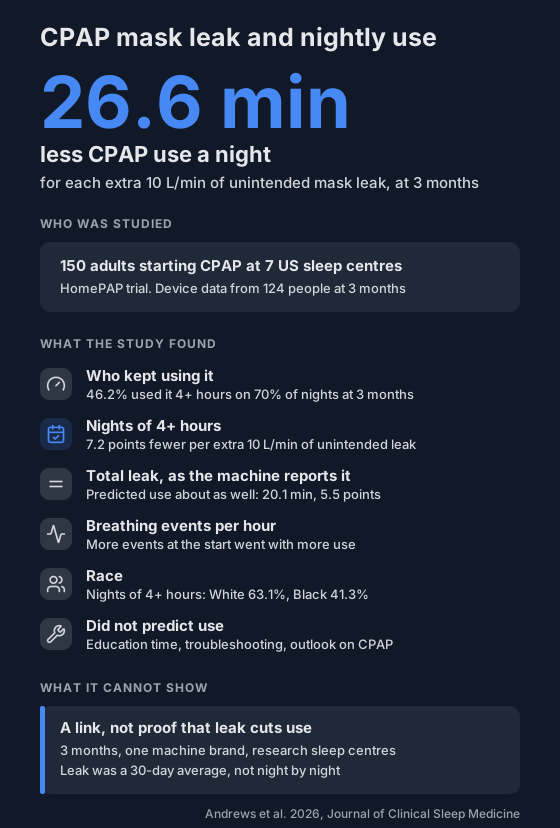
A 2026 analysis of 150 adults starting CPAP found that each extra 10 L/min of unintended mask leak went with 26.6 fewer minutes of use a night at 3 months.
A leaky mask is one of the usual reasons people give for struggling with CPAP. But CPAP machines report several different leak numbers, and it isn't clear which one matters.
A 2026 study tested a new leak number against the standard one. Both went with lower CPAP use, and the study found no significant difference in how well they predicted it.
What is "Real Leak"?
Every CPAP mask leaks on purpose. It has a vent that lets air out so you don't breathe your own carbon dioxide back in.
- Average Leak is what the machine reports. It includes the vent.
- Real Leak is the authors' new number: Average Leak minus the vent flow the mask maker lists for that mask and pressure.
So Real Leak is the leak that isn't supposed to happen, averaged over a month.
In this study the vent accounted for most of the total. The median vent flow was 26.6 L/min, the median Average Leak at 3 months was 41.4 L/min and the median Real Leak was 15.5 L/min.
Who was studied?
- 150 adults from the HomePAP trial, run at 7 US academic sleep centres.
- Average age 48, 65% men, 69% White, 18% Black. Median BMI 36.
- All had at least 15 breathing events per hour on their sleep test. The median was 36.8.
- Everyone got the same brand of auto-adjusting machine.
- Machine data were available for 139 people at 1 month and 124 at 3 months.
"Using CPAP" here means the common "4 and 70" rule: at least 4 hours a night on at least 70% of nights.
Did leak predict how much CPAP got used?
Yes, in this study. At 3 months, for each extra 10 L/min of leak:
| Nightly use | Nights of 4+ hours | |
|---|---|---|
| Real Leak | 26.6 minutes less | 7.2 points fewer |
| Average Leak | 20.1 minutes less | 5.5 points fewer |
The link held after adjusting for age, sex, BMI, race, education, sleepiness and breathing events per hour.
The two leak numbers tracked each other closely, and the authors found no significant difference in how well they predicted use. They still argue Real Leak is the clearer number, because it leaves the vent out and so compares fairly across mask types.
How much did people use it?
- At 1 month, 36.9% met the 4 and 70 rule.
- At 3 months, 46.2% did.
- Average use at 3 months was 4.3 hours a night.
The authors put the rise down to people getting used to CPAP, since nothing they measured explained it.
What else went with CPAP use?
- Breathing events per hour. People with more events on their sleep test used CPAP more: each extra event per hour went with 0.46% more nights of 4+ hours.
- Race. White participants reached 4+ hours on about 63% of nights, Black participants on about 41% (p = 0.02).
- Mask type. Nasal, nasal pillow and full-face masks showed no statistically significant difference.
These did not predict use:
- Minutes of CPAP education (about 45 on average).
- The number of troubleshooting contacts with staff.
- How hopeful people felt about CPAP before starting.
- Marital status and education level.
For the wider picture, see what a review found about sticking with CPAP.
What doesn't it tell you?
- Cause. This is a secondary analysis of a trial built to answer a different question. It shows leak and use went together, not that leak made people use CPAP less.
- The long run. Follow-up stopped at 3 months.
- Other machines. Everyone used one brand. Other makers define and calculate leak differently.
- Everyday care. The centres were research-heavy academic clinics.
- Night-to-night swings. Leak was a 30-day average, which hides bad nights.
- A cut-off. The study gives no leak figure that counts as too high. The authors say those cut-points still need working out.
The paper's own numbers also don't fully line up. Its results tables give different p-values and sample sizes from the text. The direction of the findings is the same in both.
What can you do with this?
- Your machine's app or report shows a leak figure. The machines in this study included the vent in it, so a number well above zero was expected. Check which kind yours shows.
- If the leak figure is climbing, or the mask is uncomfortable, tell your CPAP provider or sleep clinic. Mask fit is their job to sort out.
- The study gives no cut-off, so it can't tell you whether your own leak figure is too high.
Want to see what your oxygen does on CPAP nights? Here's how to track your oxygen alongside CPAP. An oximeter doesn't measure mask leak.
Not a medical device. Does not diagnose, treat or prevent any condition. Discuss results and changes with a clinician.
References
- Andrews ND, El Ahdab J, Pascoe M, Wang L, Bena J, Auckley D, Benca R, Billings ME, Kapur V, Zee PC, Redline S, Foldvary-Schaefer N. What's leak got to do with it? Association of mask leak and positive airway pressure adherence from the homepap study. Journal of Clinical Sleep Medicine. 2026;22(1):55. doi:10.1007/s44470-026-00046-2