Who Stops CPAP in the First Year? A Study
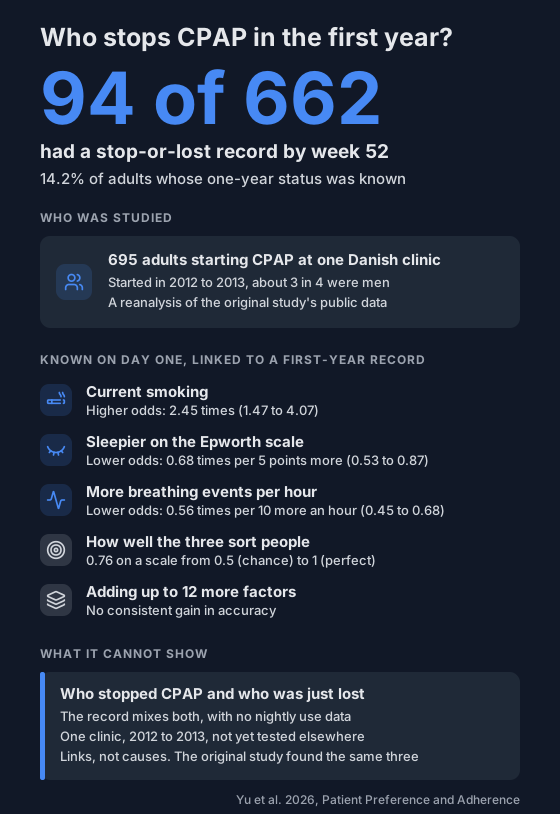
In 662 Danish adults starting CPAP, 14% had a stop-or-lost record within a year. Smoking, less daytime sleepiness and fewer breathing events per hour went with it.
Some people who start CPAP drop it within the first year. Before there's any data from the machine, all a clinic has is what it knew at the first visit.
A study published in August 2026 asked how much those day-one facts can tell you. In 662 Danish adults whose one-year status was known, three of them went with a higher chance of a first-year stop-or-lost record: smoking, less daytime sleepiness and fewer breathing events per hour. Adding more information didn't help.
Who was in the study?
- 695 adults newly found to have obstructive sleep apnea and prescribed CPAP at one sleep clinic in Silkeborg, Denmark.
- They started between January 2012 and February 2013.
- CPAP was free, there was a choice of masks, and a nurse saw everyone about a month in.
- About 3 in 4 were men.
- The day-one data came from questionnaires, a specialist visit and a home breathing test.
This is a reanalysis. A team in China took the public data from a 2017 Danish study of the same people and built a fixed one-year prediction from it.
What counted as stopping?
This is the part to read carefully.
- The data had one flag for "non-compliance" and how many weeks each person was followed.
- The flag didn't say whether someone stopped CPAP or simply dropped out of follow-up.
- There was no record of nightly use.
So the study's outcome is a stop-or-lost record within 52 weeks, not hours of use. The original paper counted 113 people who stopped and 29 lost to follow-up over a median of 3 years, but that can't be split person by person for the first year.
What did it find?
Of the 662 people whose one-year status was known, 94 (14.2%) had a record by week 52.
Compared with the others, they were:
- More often smokers: 40% against 23%.
- Less sleepy in the day: an average Epworth Sleepiness Scale score of 8.8 against 10.8.
- Lower on breathing events per hour: an average of 23 against 37.
In the model with all three together:
- Current smoking: odds 2.45 times higher (95% CI 1.47 to 4.07).
- Epworth score: odds 0.68 times as high for every 5 points more, so sleepier people were less likely to have a record (0.53 to 0.87).
- Breathing events per hour: odds 0.56 times as high for every 10 more, so people with more events were less likely to have a record (0.45 to 0.68).
This model used the 632 people with complete data, 85 of them with a record.
The Epworth scale is a standard sleepiness questionnaire scored from 0 to 24, where higher means sleepier.
Oxygen dips per hour told a similar story. They averaged 16 in people with a record against 29 in the rest. If you're not sure what that number is, see what ODI means.
How well did it work?
Reasonably, not precisely.
- The model scored 0.76 for telling people with a record from people without, on a scale where 0.5 is chance and 1 is perfect.
- Its predicted risks matched the real rates well on average.
- Most predicted risks were low: the median was about 11%, and very few went above 40%.
- The authors say high predictions are the least certain.
Did more data help?
No. The authors tried adding:
- Heart disease, body mass index, witnessed breathing pauses and oxygen dips per hour.
- All 15 day-one factors, including sex, diabetes, high blood pressure, sleeping pills and snoring.
- Three statistical methods that shrink weaker factors.
None of these did consistently better than the three-factor model.
Why might these three matter?
The authors don't know, and their data can't tell. They suggest:
- People who are sleepier, or have more breathing events, may notice more benefit from CPAP.
- People with fewer symptoms may weigh the hassle more, or move to another option with their doctor.
- Smoking is a marker, not evidence of low motivation.
- It could reflect airway symptoms, nicotine dependence or social factors.
These are ideas to test, not findings.
What can't it show?
- Stopping versus being lost. The outcome mixes both, and some stops may have been a reasonable switch to something else.
- Anything new about who stops. The 2017 study already found these three factors. This paper adds a fixed one-year equation and a fuller check of how well it works.
- A fair test. The model was chosen after the authors had seen the original results, so it may look better than it would on new data.
- The missing 33. People whose follow-up ended before a year without a record were heavier and had more breathing events. If the 31 of them with full data are all counted as having a record, the sleepiness and breathing event links get weaker, and the sleepiness one is no longer statistically significant.
- Today's care. One clinic, from 2012 to 2013, before cloud-connected machines and remote monitoring. It hasn't been tested anywhere else.
- Cause. This is a post hoc reanalysis of observational data, so these are links, not causes.
- Size. The authors' own calculations suggest a larger sample would be needed for a stable model.
The authors declared no conflicts of interest.
What can you do with this?
If CPAP doesn't seem worth the effort for you, that's worth raising with your sleep team. For what else goes with CPAP use, see the review of who sticks with CPAP and how early discomfort relates to use.
An overnight oximeter records what your oxygen does on and off CPAP. You can track it alongside CPAP and share it with your doctor.
Not a medical device. Does not diagnose, treat or prevent any condition. Discuss results and changes with a clinician.
References
- Yu H, Wei Y, Li S, Liu D. A Baseline Prediction Model for First-Year CPAP Treatment Disengagement in Adults with Obstructive Sleep Apnea: A Secondary Analysis of a Danish Cohort. Patient Preference and Adherence. 2026;20:626666. doi:10.2147/PPA.S626666
- Jacobsen AR, Eriksen F, Hansen RW, Erlandsen M, Thorup L, Damgård MB, Kirkegaard MG, Hansen KW. Determinants for adherence to continuous positive airway pressure therapy in obstructive sleep apnea. PLOS ONE. 2017;12(12):e0189614. doi:10.1371/journal.pone.0189614