Mouthpiece vs CPAP for Blood Pressure
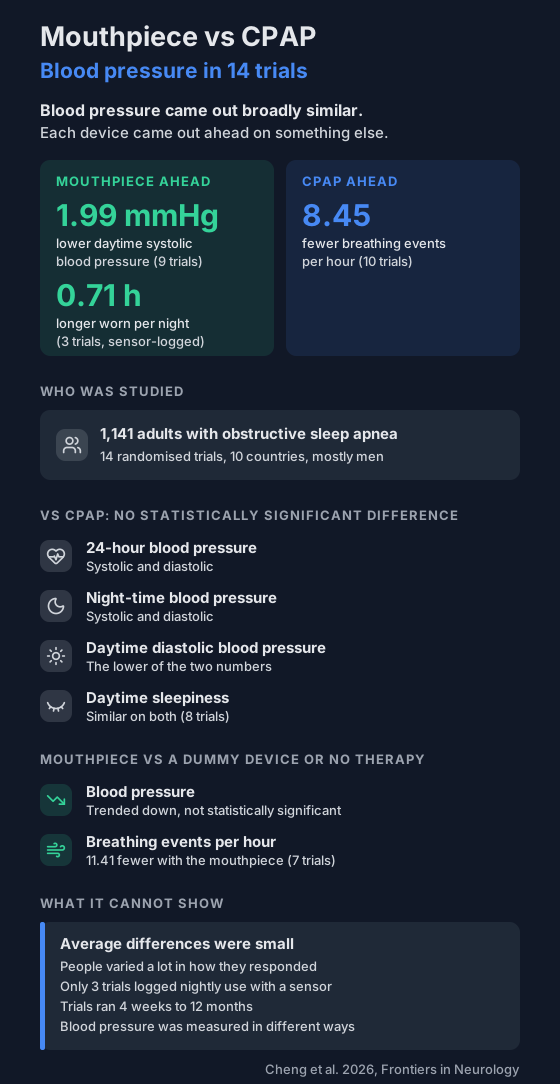
A 2026 meta-analysis of 14 randomised trials found blood pressure came out broadly similar on a jaw-advancing mouthpiece and on CPAP. CPAP lowered breathing events per hour more, and the mouthpiece was worn longer each night.
Sleep apnea and high blood pressure often go together. CPAP lowers breathing events per hour more than a jaw-advancing mouthpiece does, so you might expect it to win on blood pressure too.
A 2026 meta-analysis pooled 14 randomised trials to check. Blood pressure came out broadly similar on the two.
Who was in the trials?
- 1,141 adults with obstructive sleep apnea, in 14 randomised trials published up to February 2026.
- The trials ran in 10 countries, including Australia, Sweden, Brazil, China and Singapore.
- Average ages ranged from 46 to 61, and most participants were men.
- In 7 trials each person tried each option in turn. The other 7 split people into groups.
- 10 trials measured blood pressure with a monitor worn for 24 hours. 4 used clinic readings.
The mouthpiece in these trials is a mandibular advancement device: it holds your lower jaw forward while you sleep.
How did the mouthpiece compare with CPAP?
- 24-hour and night-time blood pressure. No statistically significant difference, for either number.
- Daytime blood pressure. The top (systolic) number was 1.99 mmHg lower on the mouthpiece, pooled from 9 trials. The 95% confidence interval ran from 0.17 to 3.82 mmHg lower, so the true gap may be very small. The bottom (diastolic) number showed no statistically significant difference.
- Breathing events per hour. CPAP lowered them more, by 8.45 events per hour, pooled from 10 trials.
- Daytime sleepiness. No statistically significant difference, from 8 trials.
Which one did people wear longer?
The mouthpiece, by 0.71 hours a night.
That figure comes from the 3 trials that logged use with a sensor, not from people's own reports. The results section calls it statistically significant, while the conclusion calls it a trend. The authors suggest the extra hours may partly explain why blood pressure came out similar despite the gap in breathing events. They also warn against reading too much into it, because only 3 trials had that data.
What about a mouthpiece against no mouthpiece?
Some trials compared the mouthpiece with a dummy device or no therapy.
- Blood pressure trended down on the mouthpiece, but no result was statistically significant.
- Breathing events per hour were 11.41 lower, from 7 trials.
- The sleepiness score was 1.19 points lower, from 7 trials.
What can't it show?
- How big the effect is for you. The average differences were small, and the authors say people varied a lot in how they responded.
- The long term. Trials ran from 4 weeks to 12 months.
- Like-for-like methods. The trials measured blood pressure in different ways and handled blood pressure medication differently.
- Every trial. The search covered English-language papers only, and some trials were small.
This is a meta-analysis: it pools the average results of other trials rather than running a new one. The authors declare no commercial or financial conflicts of interest.
For a broader look at the two devices, see what 14 reviews found comparing CPAP and a mouthpiece.
What can you do with this?
Which device suits you is a decision for you and your doctor.
If you use either one, an overnight oximeter can log your oxygen dips and pulse each night. The compare nights tool puts up to four recordings side by side. See tracking your oxygen alongside CPAP and how oxygen dips relate to blood pressure. Here's how to share your recordings with your doctor.
Not a medical device. Does not diagnose, treat or prevent any condition. Discuss results and changes with a clinician.
References
- Cheng T, Wang Q, Wei W. Effects of mandibular advancement devices vs. CPAP on blood pressure in obstructive sleep apnea: a systematic review and meta-analysis of randomized controlled trials. Frontiers in Neurology. 2026;17:1846726. doi:10.3389/fneur.2026.1846726