CPAP vs Mouthpiece: What 14 Reviews Found
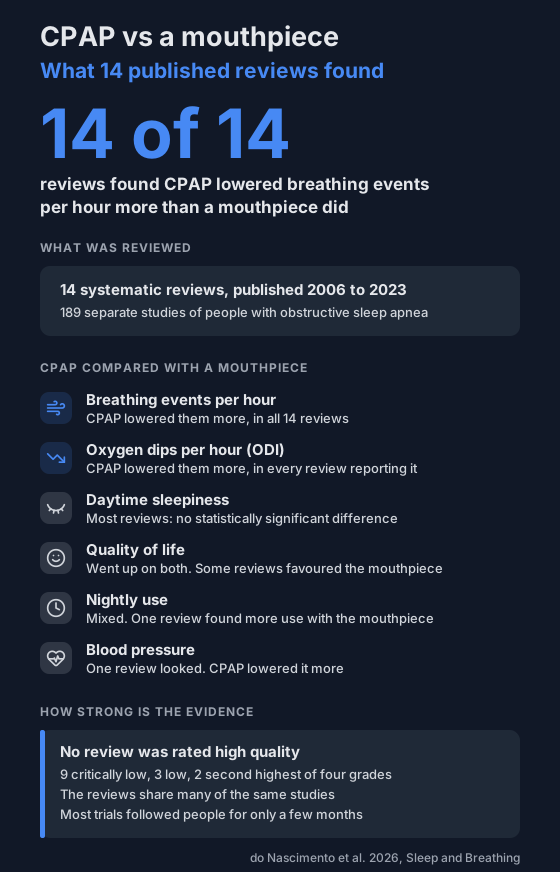
A 2026 overview of 14 systematic reviews found CPAP lowered breathing events and oxygen dips per hour more than a jaw-advancing mouthpiece, while daytime sleepiness came out about the same.
CPAP is the standard therapy for obstructive sleep apnea. The usual second option is a mandibular advancement device, a mouthpiece that holds your lower jaw forward while you sleep.
Plenty of reviews have compared the two, and they don't all agree. A 2026 paper went through 14 of them.
What did the authors look at?
- 14 systematic reviews published between 2006 and 2023.
- Between them, they drew on 189 separate studies.
- The authors compared breathing events per hour, oxygen dips per hour (ODI), daytime sleepiness, quality of life and how much people used each device.
- They also graded each review with the AMSTAR-2 quality checklist.
What did the reviews find?
- Breathing events per hour. All 14 reviews found CPAP lowered them more than the mouthpiece did.
- Oxygen dips per hour. Every review that reported ODI found CPAP lowered it more.
- Daytime sleepiness. Most reviews found no statistically significant difference between the two.
- Quality of life. It went up on both, and some reviews had better results for the mouthpiece.
- Blood pressure. Only one review looked at it. CPAP lowered it more.
Which one do people keep using?
The reviews are mixed here. The overview says they found no statistically significant difference in use, but that people generally preferred the mouthpiece long term. One of the 14 reviews did find more use with the mouthpiece.
The authors suggest more use may explain the similar quality of life and sleep quality results. They also warn that comfort may lead people to overrate how much better they feel.
The side effects reported most often differed:
- CPAP: a blocked nose, dry airways, eye irritation and facial muscle pain.
- Mouthpiece: tooth pain, jaw joint discomfort, extra saliva and a sore mouth in the morning.
How strong is the evidence?
Weaker than 14 reviews sounds.
- No review was rated high quality.
- 2 were in the second highest of four grades, 3 were low and 9 were critically low.
- The reviews share many of the same studies.
- Most trials followed people for only a few months.
- None of the reviews reported who funded the studies they pooled.
- The overview relied on the reviews and didn't re-analyse the original trials.
What can you do with this?
Which device suits you is a decision for you and your doctor.
If you're already on one, an overnight oximeter can log your oxygen dips each night. See tracking your oxygen alongside CPAP, and here's how to share the recordings.
Not a medical device. Does not diagnose, treat or prevent any condition. Discuss results and changes with a clinician.
References
- do Nascimento MCP, de Carvalho ALV, de Oliveira Lima Batista JF, da Silva SS, do Egito Vasconcelos BC, Moraes SLD, Pellizzer EP, Heimer MV. Comparative effects of CPAP and mandibular advancement devices in obstructive sleep apnea: an overview of systematic reviews. Sleep and Breathing. 2026;30(5):240. doi:10.1007/s11325-026-03784-y