Sleep Apnea and Hippocampus Blood Vessels
A 2026 autopsy study of 30 people who had sleep apnea found more narrowed or collapsed tiny blood vessels in one memory area of the brain in those with a higher oxygen desaturation index.
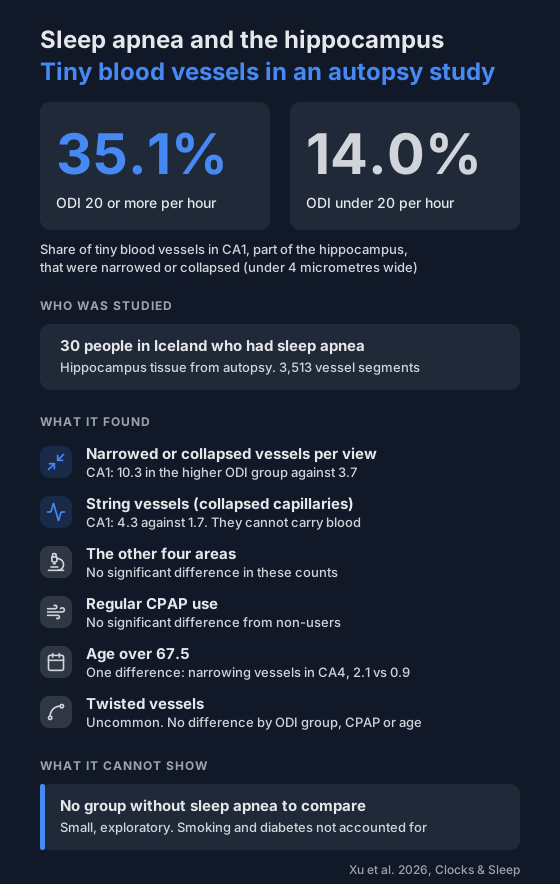
The hippocampus is the part of your brain that forms and recalls memories. A 2026 study looked at its smallest blood vessels in people who had sleep apnea.
It used tissue donated at autopsy, so it's a look back, not a trial.
Who was studied?
- 30 people in Iceland with clinic-confirmed sleep apnea.
- They came from a series of 31 who died between 1987 and 2014, at an average age of 67.
- The researchers split them at an ODI of 20 dips per hour, 15 in each group.
- The lower group averaged 18.5 and the higher group 35.9.
New to ODI? See what the oxygen desaturation index is.
What did they count?
They measured 3,513 vessel segments across five areas of the hippocampus. Healthy capillaries are 4 to 10 micrometres wide. They counted three narrower kinds:
- String vessels. Under 1.5 micrometres. These are strands left by collapsed capillaries and carry no blood.
- Narrowing vessels. 1.5 to 2.5 micrometres, about the limit for a red blood cell.
- Strictures. A short pinch of 2.5 to 4 micrometres.
What did they find?
The counts differed in one area, CA1. In each view, the higher ODI group had:
- 4.3 string vessels, against 1.7.
- 3.5 narrowing vessels, against 0.9.
- 2.6 strictures, against 1.1.
- 10.3 in total, against 3.7.
That's 35.1% of CA1 vessels against 14.0%.
Counts in the other four areas didn't differ significantly. In one of them, the fimbria, about half the vessels were abnormal in both groups.
Vessel width was also more uneven in CA1 and in one other area, the subiculum. How twisted the vessels were didn't differ.
Did CPAP or age make a difference?
Not significantly.
- CPAP. In the higher ODI group, regular users averaged 3.4 string vessels in CA1 against 6.0 in non-users. With 15 people, that gap wasn't significant. The authors say CPAP records were incomplete and urge caution.
- Age. People over 67.5 had more narrowing vessels in one area, CA4: 2.1 against 0.9. Nothing else differed significantly.
What can't this study show?
The authors call it exploratory.
- There was no group without sleep apnea, so the changes can't be put down to sleep apnea.
- Records on smoking and diabetes, which both affect small vessels, were incomplete.
- Many comparisons were run with no correction, so some results may be false positives.
- 30 people, all Icelandic, one brain region.
What can you do with this?
ODI is a number your oximeter already reports.
- Record several nights to see your usual ODI.
- If it's often high, share the recordings with your doctor.
Not a medical device. Does not diagnose, treat or prevent any condition. Discuss results and changes with a clinician.
References
- Xu C, Owen JE, Gislason T, Benediktsdóttir B, Ye J, Robinson SR. Microvascular Disease in the Hippocampus in Obstructive Sleep Apnoea. Clocks & Sleep. 2026;8(3):51. doi:10.3390/clockssleep8030051