CPAP and Heart Health: A 2026 Review
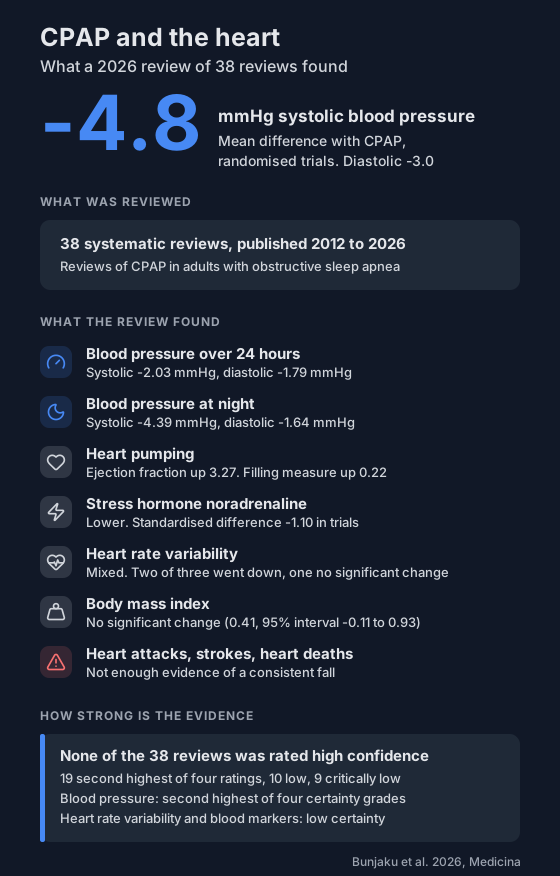
A 2026 review of 38 systematic reviews found CPAP use was linked to lower blood pressure, by about 4.8 mmHg systolic in trials, but not to a consistent fall in heart attacks or strokes.
Sleep apnea is linked to high blood pressure and heart disease, so it's easy to assume CPAP protects the heart. A review published in July 2026 found that several heart measurements changed with CPAP, but a consistent fall in heart attacks, strokes or heart deaths hasn't been shown.
What did the authors review?
- 38 systematic reviews and meta-analyses of CPAP in adults with obstructive sleep apnea, published between 2012 and 2026.
- Each one included between 4 and 52 studies and 167 to 10,104 people, where reported.
- It's an "umbrella review": a review of reviews. The authors picked one representative result for each measurement instead of pooling again.
What changed with CPAP?
Blood pressure was the most consistent result.
- In randomised trials, systolic pressure was 4.8 mmHg lower and diastolic 3.0 mmHg lower.
- Over 24 hours of monitoring, the gaps were smaller: 2.03 and 1.79 mmHg.
- Night-time systolic pressure was 4.39 mmHg lower.
The authors call these reductions modest.
Other measurements:
- Heart pumping. Left ventricular ejection fraction was 3.27 higher, and a measure of how the heart fills went up by 0.22.
- Stress hormone. Noradrenaline was lower in trials, which the authors read as less "fight or flight" activity.
- Heart failure. In people with heart failure, a blood marker of heart strain and a symptom grade both went down.
See also oxygen dips and blood pressure.
What didn't change?
- Body mass index. No significant change.
- Heart rate variability. Mixed. Two of three measures went down and one showed no significant change.
- Heart attacks, strokes and heart deaths. The review wasn't built to measure these. The authors say large trials have been inconsistent, and the evidence isn't enough to show a consistent fall.
A separate cohort study looked at CPAP and long-term survival.
How strong is the evidence?
- None of the 38 reviews was rated high confidence. 19 got the second highest of four ratings, 10 low and 9 critically low.
- Blood pressure evidence got the second highest of four certainty grades. Heart rate variability and blood markers got low.
- The headline blood pressure figures come from a review rated low.
- Results varied a lot between studies, and the same studies may be counted in more than one review.
What can you do with this?
This review can't tell you what CPAP does for your own heart.
You can track your overnight oxygen alongside CPAP and share the recordings with your doctor.
Not a medical device. Does not diagnose, treat or prevent any condition. Discuss results and changes with a clinician.
References
- Bunjaku J, Rashiti P, Lama A, Bunjaku G, Koliqi R. Effects of Continuous Positive Airway Pressure on Surrogate, Intermediate, and Functional Cardiovascular Outcomes in Obstructive Sleep Apnea: An Umbrella Review of Systematic Reviews and Meta-Analyses. Medicina (Kaunas). 2026;62(8):1456. doi:10.3390/medicina62081456