CPAP and Long-Term Survival: Up to 20 Years
A Polish study followed 4,368 adults for 8 to 20 years after a sleep study. CPAP use was linked to fewer deaths, mainly in people with 30 or more breathing events an hour and a good response.
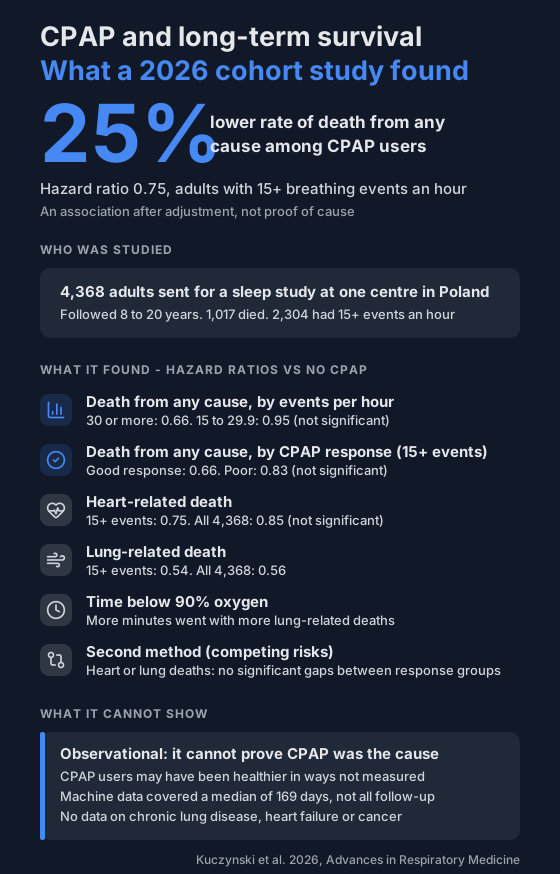
Does CPAP help people live longer? Observational studies have mostly said yes, and large randomised trials have mostly said no.
A 2026 study from Poland also looked at how well CPAP was working.
Who was in the study?
- 4,368 adults sent for an overnight sleep study at one centre in Lodz.
- Median age 58, and 70% were men.
- 2,304 of them had 15 or more breathing events an hour.
- Followed for 8 to 20 years through national death records, and 1,017 died.
- CPAP use meant at least 4 hours a night on at least 75% of nights.
What did it find?
Among people with 15 or more events an hour, CPAP users had a lower rate of death after adjusting for age, sex, BMI, smoking and other conditions:
- Any cause: hazard ratio 0.75, so 25% lower.
- Heart-related: 0.75.
- Lung-related: 0.54.
It depended on how many events people started with:
- 30 or more an hour: hazard ratio 0.66.
- 15 to 29.9 an hour: 0.95, not statistically significant.
Did it matter how well CPAP worked?
The authors used the events per hour that the CPAP machine recorded at home. A good response meant events cut by at least half and under 10 an hour left.
In the 15 or more group, compared with no CPAP:
- Good response: hazard ratio 0.66 for death from any cause.
- Poor response: 0.83, not statistically significant.
Poor responders more often had high blood pressure, diabetes or a past heart attack.
What about time below 90%?
More minutes below 90% oxygen during the sleep study went with more lung-related deaths, after adjustment. The authors call it the main predictor of lung-related death. It's the same idea as T90, counted in minutes.
What doesn't it tell you?
- Cause. It's observational. CPAP users may have been healthier in ways nobody measured.
- Long-term use. Machine data covered a median of 169 days, not the full follow-up.
- Other illness. Chronic lung disease, heart failure, kidney disease and cancer weren't recorded.
- A second method. A competing-risks analysis found no significant gaps between response groups for heart or lung deaths.
- Everyone. One centre, one country.
What can you do with this?
If you use CPAP, your machine reports events per hour. You can ask your clinician about that number.
You can log overnight oxygen alongside it. See tracking oxygen with CPAP and sharing data with your doctor.
An oximeter can't tell you whether CPAP is working or whether to change it.
Not a medical device. Does not diagnose, treat or prevent any condition. Discuss results and changes with a clinician.
References
- Kuczyński W, Pierzchała K, Bielska W, Boczar Z, Kudrycka A, Białasiewicz P. Who Really Benefits from CPAP? Disease Severity, Response Quality, and Long-Term Survival in Obstructive Sleep Apnea. Advances in Respiratory Medicine. 2026;94(4):55. doi:10.3390/arm94040055