Oxygen Burden and Blood Pressure on CPAP
A 2026 study of 141 adults starting CPAP tested whether oxygen burden predicts who gets a blood pressure fall. It did no better than breathing events per hour: both scored 0.58.
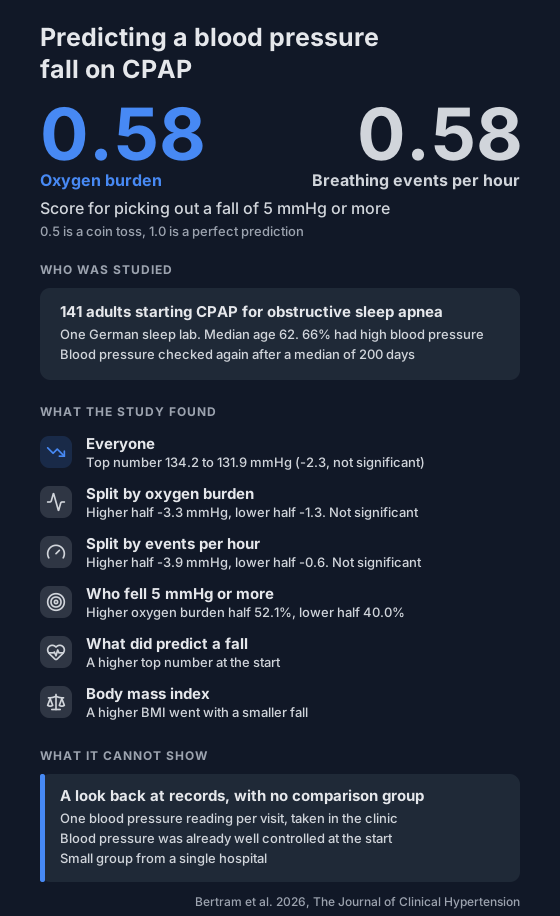
Sleep apnea is usually graded by breathing events per hour. Oxygen burden is a newer number that some researchers think says more about heart and blood vessel risk. So a team in Germany asked: does it also tell you who gets a blood pressure fall on CPAP?
In their 2026 study of 141 adults, it didn't. Oxygen burden and events per hour both scored 0.58, where 0.5 is a coin toss.
What is oxygen burden?
It adds up how deep and how long the oxygen dips tied to breathing events are, per hour of sleep. The unit is %min/h. The paper calls it hypoxic burden.
For more on it, read long breathing pauses and oxygen burden.
Who was studied?
- 141 adults at one university hospital sleep lab in Germany, seen between December 2023 and September 2025.
- All had obstructive sleep apnea with at least 15 breathing events per hour on a full sleep study, and all were starting CPAP.
- Median age 62, and about a third were women.
- 66% had high blood pressure. Across the whole group, the median was one blood pressure medicine.
- Median events per hour: 33.3. Median oxygen burden: 57.7 %min/h.
- They used CPAP for a median of 5.5 hours a night.
People who used CPAP for under 2 hours a night, or whose blood pressure medicine changed, were left out.
Blood pressure was taken once in the clinic before the first sleep study, and once at the follow-up visit a median of 200 days later.
What happened to blood pressure?
Not much, on average.
- Top (systolic) number: 134.2 to 131.9 mmHg, a change of -2.3. This was not statistically significant (p = 0.12).
- Bottom (diastolic) number: 81.1 to 80.7 mmHg, a change of -0.4 (p = 0.68).
The authors say this is in line with earlier trials, where CPAP went with a fall of about 3 mmHg in the top number.
Did oxygen burden predict who got a fall?
No. The team split the group in half by each measure.
| Group | Top number at the start | Change on CPAP |
|---|---|---|
| Higher oxygen burden | 136.5 mmHg | -3.3 mmHg |
| Lower oxygen burden | 131.9 mmHg | -1.3 mmHg |
| More events per hour | 136.8 mmHg | -3.9 mmHg |
| Fewer events per hour | 131.5 mmHg | -0.6 mmHg |
The higher halves started higher and fell a little more, but none of these changes was statistically significant. The authors call it a trend only.
They also tried a cut-off of 87.1 %min/h, which earlier research used to mark a higher-risk group. Above it, the change was -3.4 mmHg. Below it, -1.5 mmHg. Again, neither was significant.
The other tests agreed:
- Picking out a fall of 5 mmHg or more. Both measures scored 0.58. For a fall of 10 mmHg or more, events per hour scored 0.58 and oxygen burden 0.60.
- Share with a fall of 5 mmHg or more. 52.1% in the higher oxygen burden half against 40.0% in the lower half. For events per hour, 53.5% against 38.6%. The ranges of uncertainty overlapped.
- Correlation. Neither number tracked the size of the blood pressure change (r = 0.09 for oxygen burden, r = 0.11 for events per hour).
- After adjusting for age, sex, BMI, CPAP hours and other factors. Neither number was linked to the change.
- How far each number came down on CPAP. Not linked to the blood pressure change either.
So what did predict a fall?
- Starting blood pressure. The higher the top number at the start, the bigger the fall. Each extra 1 mmHg at the start went with 10% higher odds of a fall of 5 mmHg or more.
- BMI. A higher BMI went with a smaller fall when the team looked at the size of the change. In the separate test of who fell 5 mmHg or more, BMI did not reach statistical significance (p = 0.06).
The authors' reading: oxygen burden looks like a marker of higher starting blood pressure, not a predictor of how blood pressure changes on CPAP.
What doesn't it tell you?
- Cause. It's a look back at hospital records with no comparison group.
- Blood pressure through the day or night. There was one clinic reading per visit. The authors say this may have blurred the result.
- People with uncontrolled blood pressure. The average start was 134.2 mmHg, and the authors say high blood pressure was already well managed with medicine. They note that bigger falls are mainly seen when blood pressure is uncontrolled.
- Everyone. It was a small group from one hospital. 430 records were checked and 141 made it in.
- Other outcomes. The study looked at blood pressure only, not heart attacks, strokes or how people felt.
The authors want larger studies across several hospitals.
What can you do with this?
- Don't read a blood pressure forecast into your oxygen numbers. In this study, neither oxygen burden nor event count gave one.
- Oxygen burden here came from a full sleep study. A home oximeter report doesn't give you that number.
- If you're on CPAP and tracking overnight oxygen, read tracking oxygen with CPAP.
- Questions about your blood pressure or your CPAP belong with your doctor.
Related reading: oxygen dips and blood pressure and CPAP and heart health.
Not a medical device. Does not diagnose, treat or prevent any condition. Discuss results and changes with a clinician.
References
- Bertram S, Racovitan D, Doevelaar A, Seibert FS, Babel N, Wang S, Westhoff TH, Seidel M. Apnea-Hypopnea Index Versus Hypoxic Burden as Predictors of Blood Pressure Response to Continuous Positive Airway Pressure Treatment in Patients With Obstructive Sleep Apnoe. The Journal of Clinical Hypertension. 2026;28(5):e70262. doi:10.1111/jch.70262