Long Breathing Pauses and Hypoxic Burden
A 2026 study of 1,008 adults with sleep apnea found that people with the longest breathing events had about twice the oxygen burden of those with the shortest, at a similar number of events per hour.
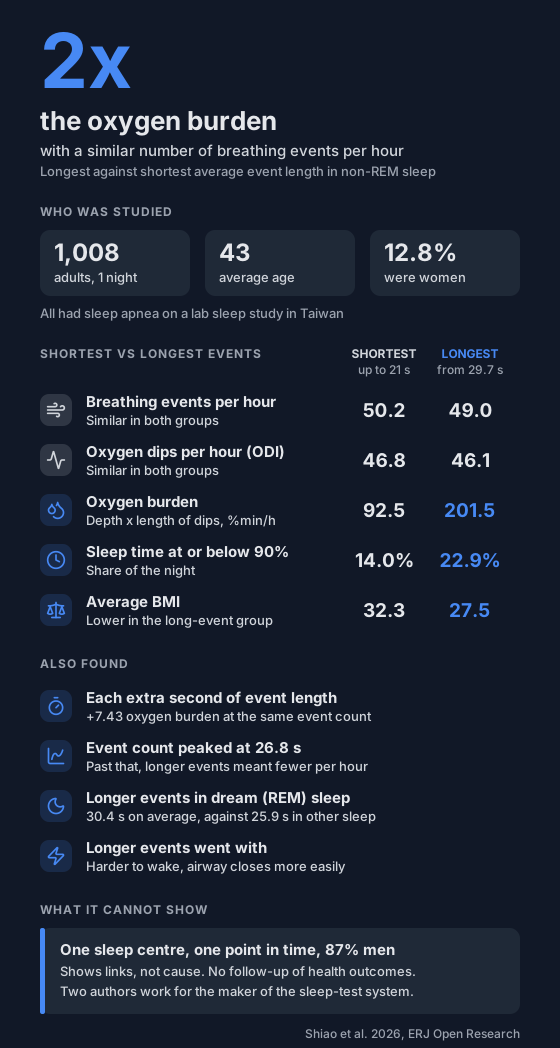
Sleep apnea is usually graded by how many times an hour your breathing stops or gets shallow. A 2026 study looked at how long each event lasts.
People with the longest events had about twice the oxygen burden, at a similar event count.
Who was in the study?
- 1,008 adults referred to one sleep centre in Taiwan.
- Each had a night in the sleep lab and at least 15 breathing events per hour.
- Their average age was 43, and 12.8% were women.
The researchers split them into four equal groups by average event length in non-dream (non-REM) sleep.
What is oxygen burden?
Researchers call it hypoxic burden. It adds up how deep each oxygen dip goes and how long it lasts, per hour of sleep. A count like ODI scores a short dip and a long dip the same.
What did they find?
Shortest group (events up to 21 seconds) against longest group (29.7 seconds or more):
- Breathing events per hour: 50.2 against 49.0.
- Oxygen dips per hour: 46.8 against 46.1.
- Oxygen burden: 92.5 against 201.5 %min/h.
- Share of sleep at or below 90% oxygen (T90): 14.0% against 22.9%.
The event count peaked at an average length of 26.8 seconds. Past that, longer events went with fewer per hour. The authors suggest long events take up more of the night.
After adjusting for age, sex, BMI, event count and other factors, each extra second of event length went with 7.43 %min/h more oxygen burden.
Who had the longer events?
- The longest-event group had a lower BMI (27.5 against 32.3).
- Events were longer in dream (REM) sleep: 30.4 seconds against 25.9 in the rest of the night.
- Longer events went with a more collapsible airway and a higher arousal threshold (harder to wake).
The authors note that event length can change with CPAP, and call for research on what that means for health.
What doesn't it tell you?
- Cause. It's a one-night snapshot, so it shows links, not causes.
- Outcomes. Nobody was followed up.
- Everyone. They were mostly male clinic patients in Taiwan. Medication use wasn't recorded.
- Independence. Two authors work for Nox Medical, which makes the sleep-test system used.
What can you do with this?
An overnight oximeter doesn't measure breathing events, and home oximetry is not a sleep study. Your report shows a count (ODI) and a time-based figure (T90), so read both. Here's how to read your report and how to share it with your doctor.
Not a medical device. Does not diagnose, treat or prevent any condition. Discuss results and changes with a clinician.
References
- Shiao TH, Chou KT, Hang LW, Finnsson E, Ágústsson JS, Sands SA, Cheng WJ. Event duration, endotypes and hypoxic burden in obstructive sleep apnoea. ERJ Open Research. 2026;12(5):01792-2025. doi:10.1183/23120541.01792-2025