Sleep Apnea and Fatty Liver: A 2026 Review
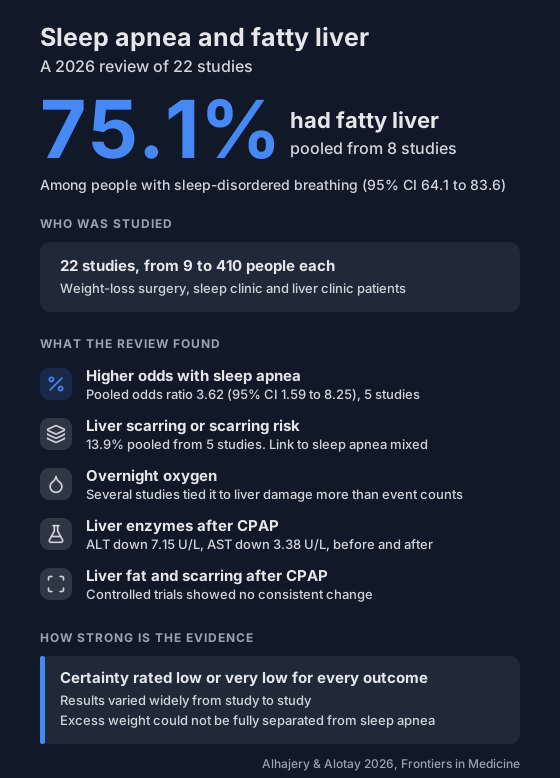
A 2026 review covered 22 studies. About three in four people with sleep-disordered breathing had fatty liver, but the authors rate the evidence low or very low.
Sleep apnea and fatty liver share risk factors: excess weight, type 2 diabetes and high blood pressure. So it's no surprise they often turn up in the same person.
A review published in September 2026 gathered 22 studies and pooled their results to put numbers on the overlap. It also asked whether liver results change on CPAP.
What is fatty liver?
It's a build-up of fat in the liver that isn't caused by alcohol. Doctors now call it MASLD, and it used to be called NAFLD. In some people it goes on to inflammation and scarring (fibrosis).
What did the review look at?
- 22 studies, found by searching six databases up to 15 May 2026.
- Each had between 9 and 410 people.
- Most recruited from weight-loss surgery units, sleep clinics and liver clinics. In six of the surgery studies the average BMI was between 37 and 55.
- Sleep-disordered breathing was confirmed with a sleep test in most studies. Two relied partly or wholly on the medical record.
- The liver was checked in different ways: biopsy, ultrasound, CT, a FibroScan, or blood tests alone.
How often did the two go together?
- Fatty liver: 75.1% of people with sleep-disordered breathing had it, pooled from 8 studies (95% CI 64.1% to 83.6%).
- Liver scarring, or a high scarring risk score: 13.9%, pooled from 5 studies (95% CI 6.0% to 29.0%).
- Odds: sleep-disordered breathing, or more breathing events per hour, went with 3.62 times the odds of fatty liver (95% CI 1.59 to 8.25, 5 studies).
The authors call that odds figure "hypothesis-generating". It mixes studies comparing people with and without sleep apnea with studies comparing lower and higher grades of it. It also mixes results that were adjusted for other factors with results that weren't.
One sleep lab study of 160 people shows the pattern. Fatty liver was seen in 20.0% of the comparison group, 59.5% of the middle group and 81.8% of the group with the most breathing events.
Is it the sleep apnea or the weight?
The review can't separate them, and the authors say so.
- In a study of 410 people without obesity, 65% of those with sleep apnea had fatty liver. So did 56% of those who only snored. Breathing events per hour still predicted fatty liver after adjustment, with an odds ratio of 1.02 (95% CI 1.00 to 1.03).
- In a study of 400 adults, the link faded after adjusting for other factors. BMI and metabolic syndrome were the independent predictors.
- The authors note that genetic (Mendelian randomisation) studies have not shown that sleep apnea causes fatty liver.
Their conclusion is that sleep apnea may add to liver damage, with excess weight and metabolic health still the main factors.
For more on weight and sleep apnea, see the obesity cohort study.
What about liver scarring?
The results were mixed.
- In 97 people who had both a liver biopsy and a sleep study, 82% of those with advanced scarring had 15 or more breathing events per hour, against 52% of the rest. The adjusted odds ratio was 3.48 (95% CI 1.03 to 11.83).
- Two other studies linked more breathing events per hour to scarring.
- A study of 133 people found age and BMI predicted a high scarring score, and the sleep apnea grade did not.
- Three biopsy studies in weight-loss surgery patients found no significant link between sleep apnea and liver inflammation (MASH).
Did oxygen matter more than event counts?
Several studies suggested it did. The review didn't pool these results, so there's no single number.
- One study found that spending 10% or more of the night below 90% SpO2 went with 2.32 times the odds of a liver inflammation risk profile (95% CI 1.12 to 4.81).
- In another, the size of the oxygen drops pointed to more liver inflammation in a small biopsy group, and the event count did not.
- In a CT study, men with fatty liver had spent 30.4% of sleep time below 90%, against 14.8% for men without it.
That time-below-90 figure is T90, and an overnight oximeter reports it. See also why event counts miss part of the picture.
What happened on CPAP?
Blood tests changed. Scans mostly didn't.
- Liver enzymes: ALT was 7.15 U/L lower after CPAP (95% CI -9.50 to -4.80, 7 studies). AST was 3.38 U/L lower (95% CI -4.45 to -2.30, 6 studies).
- Those are mostly before-and-after comparisons with no control group.
- Liver fat and stiffness: a randomised trial of 120 people with biopsy-confirmed fatty liver compared CPAP with a setting too low to work for 6 months. CPAP did no better than the low setting on liver fat or stiffness. Weight change tracked liver fat change.
- A sham-controlled analysis of 103 people over 6 to 12 weeks found CPAP did no better than sham on blood markers of liver fat, inflammation or scarring.
- Two longer studies that weren't randomised, running 2 to 3 years and about 31 months, saw liver fat fall on CT in some people who started with fatty liver.
The authors' read is that enzyme changes may show up before structural ones, and that the trials were short and small. They don't conclude that CPAP changes liver fat or scarring.
How strong is the evidence?
Weak.
- The authors rated certainty as low or very low for every outcome, on the four-grade GRADE scale.
- Results varied widely between studies. The I2 statistic was 84.1% to 96.8% for the pooled prevalence and odds figures, so the authors say the pooled figures are rough guides, not precise estimates.
- Fatty liver was defined differently from study to study. One of the eight prevalence studies inferred it from an ALT blood test alone, which the authors call a poor stand-in.
- Most studies were a single snapshot, so they can't show which came first.
- Many participants came from weight-loss surgery and specialist clinics, not the general population.
- No subgroup or sensitivity analyses were run, and publication bias wasn't tested.
What can you do with this?
- The authors say the findings support considering a liver check in people with sleep-disordered breathing, especially alongside obesity, diabetes, raised liver enzymes or low overnight oxygen. They also say people with fatty liver and signs of sleep apnea should have their sleep checked. Both are conversations for you and your doctor.
- If you record your nights, T90 and ODI are the oxygen figures these studies used. Here's how to share them.
- A home oximeter recording isn't a sleep study, and it tells you nothing about your liver.
Not a medical device. Does not diagnose, treat or prevent any condition. Discuss results and changes with a clinician.
References
- Alhajery MA, Alotay AA. Association between sleep-disordered breathing and liver outcomes in steatotic liver disease: a systematic review and meta-analysis. Frontiers in Medicine. 2026;13:1884855. doi:10.3389/fmed.2026.1884855